
Welcome, friends.
In this post, I’m going to introduce myself, my goals for the publication-in-progress I hope to someday share with you, and this new ‘brand,’ for lack of a better word, that I’ll be using as an outlet for that content.
About Me
My name is Christian H. Skinner. ‘H’ is for Hamilton (my great-great-grandfather, not the loathsome Federalist with the Broadway musical about him). My education is in English and graphic design, but I also love history, literature, poetry, Spanish, art, and music. I read, write creatively, and work out in my spare time. I also started doing Brazilian Jiu Jitsu about a year ago and like to describe myself as the whitest white belt, both in terms of my skill level and complexion.
I’ll let that serve as my segue into a brief discussion of my interest in self-defense—firearms, in particular—although recently that has expanded to include other aspects of personal protection and training for violence.
I’ve been playing with gun-shaped sticks and pinecone grenades for longer than I can remember. By the time I checked out a copy of Eyewitness Arms & Armor from my tiny Catholic school’s library, I was already hooked.
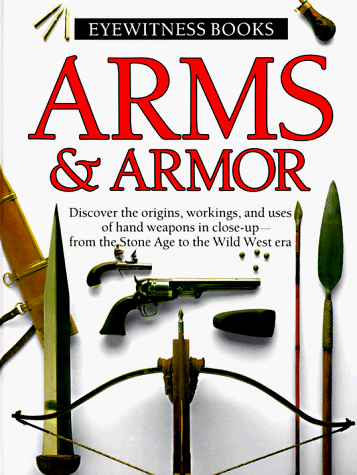
Video games, airsoft skirmishes in the woods, and war movies did little to turn me off from the subject. It wasn’t until late in high school that that interest evolved into anything resembling what it currently exists as: GunTubers like the late James Yeager, Reid Henrichs, and Jordan Winkler (fxhummel1) introduced me to the notion of gun ownership as civic duty and the allure of firearms training. As my political views shifted, understanding of history deepened, and life experience increased, I found new role models to emulate and learn from. But the seed had been planted and continued to grow.
Eventually, I purchased my first center-fire rifle and handgun: an Arsenal SLR-107FR and Glock 19 Gen 4. It is somewhat interesting to note that, even though guns had been a fixture of my father’s life long before I was born, and my late maternal grandfather kept a sizable collection of long guns and revolvers, no one in my family had ever owned any “assault weapons” or autoloading pistols. I am, in many ways, a first-generation part of what my acquaintance David Yamane calls Gun Culture 2.0. But more on that at a later date.
My first ever exposure to ‘training’ was an NRA Basics of Pistol Shooting course at my community college in 2017. The gentleman instructing, while friendly enough, arrived at the live fire portion of the class sporting a 1911 with Punisher grip panels. His meme-worthy armament may not have inspired confidence, but at least he did his best to make sure everyone left the class with the same number of holes they came with. As you might expect, though, that experience didn’t exactly challenge me in the ways I was seeking.
I took my first quote-real-unquote class in 2020: Concealed Carry Pistol with Ashton Ray of 360 Performance Shooting and Tim Chandler of Justified Defensive Concepts, both of whom are phenomenal instructors. I have learned and practiced a lot, and trained quite a bit more, since then.
The Project
That brings us to the advent of Fire Carrier Defense. This blog is my attempt to help people in the only ways I know how to. I am not and do not claim to be qualified to teach. But, if I can save people time, money, and frustration by summarizing my own experiences and some of what I’m learning as a student of the various disciplines of self-defense, I feel an obligation to do so. I also believe it can be done ethically without masquerading the work of far more accomplished men and women as my own.
As they say, you don’t know what you don’t know. My goal is to point people towards skills and areas of study so that they can at the very least start from a place of knowing what they don’t know. Much—dare I say most—of those skills and subjects I personally have only scratched the surface of, if that. But I hope that I’ve laid enough of a foundation for myself to be able to at least lead the proverbial horse to water.
That, in a nutshell, is my objective for what I’ve tentatively titled Introduction to The Armed Lifestyle. Although I originally imagined it as a primer, it’s now a book manuscript 50K words long and climbing. My vision for the finished product is a publication that will guide readers through the first steps toward becoming competent, confident self-defenders in the 21st century. I want to introduce people to information and resources that will help them build and refine a robust mindset, equip themselves, pursue quality instruction, grow their knowledge base, and sustain themselves as they hone their skills. It’s meant to outline a wholistic, multidisciplinary, realism-based approach to planning for both everyday and extraordinary risks while at the same time cultivating a healthy balance between defensive preparations and enriching experiences and pursuits that contribute to a happy, fulfilled life.
Overall, I want to explain to people my age or younger—and newcomers to self-defense in general—that being prepared doesn’t have to come at insurmountable monetary cost, or at the cost of free time, relationships with friends and family, performance at work, or hobbies. And that it can be really fun, to boot.
I don’t feel like any print publication I’ve read thus far has really laid out how to leverage the internet and social media for our purposes…Or, more importantly, how not to. I think the added nuances of shopping online for guns and gear also bear special consideration, especially since so many normies have no idea how to buy a gun from their local FFL, let alone how a transfer works. Even though most of the best and brightest minds in the industry routinely share golden nuggets of wisdom on their blogs, websites, and social media accounts for free, the internet has only been paid lip service in the books I’ve read so far (granted, I still have dozens more on my list, so there may be exceptions). That’s something I want to capitalize on.
More broad than deep, the book will provide an accessible introduction to several relevant topics and concepts as well as their respective subject matter experts and creators. I’ll also draw upon some of my experiences as a student and share a bit of what I’ve gleaned on my journey thus far in hopes of giving people some rough starting point and a tentative map of what their own might look like.
As I continue to write, I plan on publishing short chunks here as I finish them in order to generate discussion, solicit input from whoever wants to chime in, refine my own thinking, and get a better lay of the land audience-wise without having to wait for the book to be finished. I’ll also share some of the articles, videos, and links I’ve compiled as references thus far, plus new ones I stumble across.
Torch, Time, and Text
At the risk of sounding like I’m too far up my own ass, I’d like to talk about the symbolism of the logo—at least so that if anyone ever wonders what the little icons stand for, I can gesture to this post and say ‘here.’
The moniker Fire Carrier Defense and the torch are an homage to the late author Cormac McCarthy’s novel The Road, which I consider one of the greatest literary works of all time. It is an utter masterpiece that I believe everyone should read at least once in their life. He also wrote Blood Meridian and No Country For Old Men (two other fantastic, five-star novels), each of which also contain symbolic references to fire.

I’m planning a much deeper dive into what it means to carry the fire that will probably be posted under my other blog handle, but since it will be heavy on research and literary analysis, I felt it would be best to leave that discussion out of this post and keep that content in the outlet that makes the most sense. (On that note, kudos to bloggers like Tamara Keel who are able to keep everything under one roof, but the obsessive side of me likes to sort everything into its own neat little bucket).
If you follow Aaron Moyer and the team at Integrated Skills Group, the phrase “carry the fire” is no doubt already familiar to you. They released a book by the same name earlier this year, which I have read and recommend.
Suffice right now to say that, in the context of my personal philosophies on life and self-defense, to carry the fire is to acknowledge that there is hope as long as there is life, even in the bleakest of circumstances. To carry the fire is to retain our humanity and morality because losing those would mean losing who we are, both as individuals and as a species.

You may be in an active gunfight, paralyzed from the waist down, with the fingers of your dominant hand shot off and your pistol laying on the floor with its slide locked back next to your wounded wife and child. But you can—you must—pick it up, reload it, and keep trying. There is always a reason to fight on.
And if we lose, even if we carry that fire into darkness, that is nothing to be ashamed of. There are far worse things than death. Besides, it’s coming for all of us someday. When considered properly, this fact should be freeing—comforting, even.
As such, we always keep in mind that preparing to defend life should not come at the cost of living it. Life is short and can end unexpectedly; even when we do what we can to protect it and prolong it, it’s still finite. The hourglass symbolizes all of that. It is the brief candle of life burning out in Macbeth’s soliloquy, the shot timer that holds us accountable for every fraction of a second, and the ultimate fate of the universe, whether cosmological or eschatological. As Tom Hanks’ character in Cast Away said, “we live and die by time, and we must not commit the sin of turning our back on time.”
Lastly, we have the book: the symbol of knowledge over ignorance, the civilized over the primitive, and tradition over modernity. It is an accessory of both scholars and sorcerers. No one should be shocked to hear that I believe literature has a lot to teach us, if we are receptive to it—even, and sometimes especially, fiction.
History, likewise, is something it would be a mistake to ignore. There is nothing new under the sun. And while history may not repeat itself, as Mark Twain is alleged to have said, it often rhymes. People have been committing and training for violence, practicing martial arts, lifting weights, and contemplating the meaning of life for thousands of years before us; personally, I suspect most of them were smarter than me. Shouldn’t we learn what we can from them? Even in the comparatively fleeting history of professional firearms training, our predecessors have created a vast canon of work through which we can trace the evolution of equipment, tactics, and techniques to the present day. The book symbolizes all of this and represents the willingness to learn that all good students should embody.
Moving Forward
So, with all that being said, what can you expect from Fire Carrier Defense? In addition to posting excerpts of Introduction to the Armed Lifestyle in advance of its completion, you can also plan on seeing some relevant book reviews, a gear review here and there, possibly some after-action reviews of classes, occasional updates on my BJJ journey, and posts more akin to Greg Ellifritz’s famous Weekend Knowledge Dumps (but probably not as good).
As I work on getting things up and running, please check out the Support page to read about a few ways you can potentially help me learn more and suck less.
Thanks for reading!
 Fire Carrier Defense