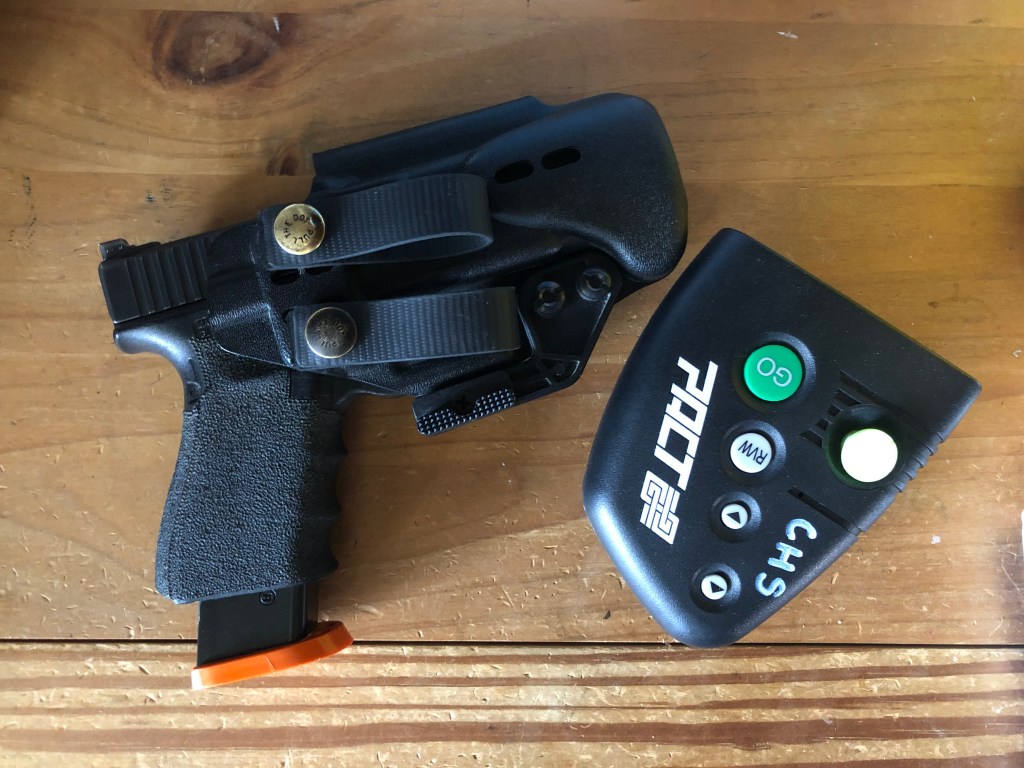
Welcome, friends.
Today, I’d like to talk about a popular aid for dry fire practice: the DryFireMag®. It’s highly recommended both by laypeople and influencers. But does it work? And how helpful is it, really? In this blog post, I’ll try to answer those questions based on my experience.
Because conflicts of interest (perceived or actual) are so endemic to gunblogging space—especially among GunTubers—I want to specify up front that I have no affiliation with DryFireMag, LLC. As I’ll go on to discuss, the two DFMs I’ve purchased were paid for out of my own pocket.
Keep in mind that this is a small sample size. As the saying goes, your mileage may vary.
What and How
The DryFireMag is a device that simulates a resetting trigger in striker-fired handguns, eliminating the need to rack the slide between trigger presses during dry fire practice. They retail for $98.99 but can be had for just under $90 on sale. Mickey Schuch also has a standing $10 off discount code (MICKEY).
The flagship G9 model is made to fit double-stack Glocks chambered in 9mm, .40 S&W, .357 SIG, and .45 GAP, plus the Glock 44 (.22LR), Palmetto State Armory Dagger, and a few Shadow Systems pistols. They also make a DFM for 10mm and .45 ACP Glocks, the single-stack 43X and 48, Sig Sauer P320, and full-sized M&P pistols in 9mm and .40 S&W…Oh, and the 9mm Springfield XD series, so that in the event you made the best possible choice of a suboptimal brand and model, you’re covered.
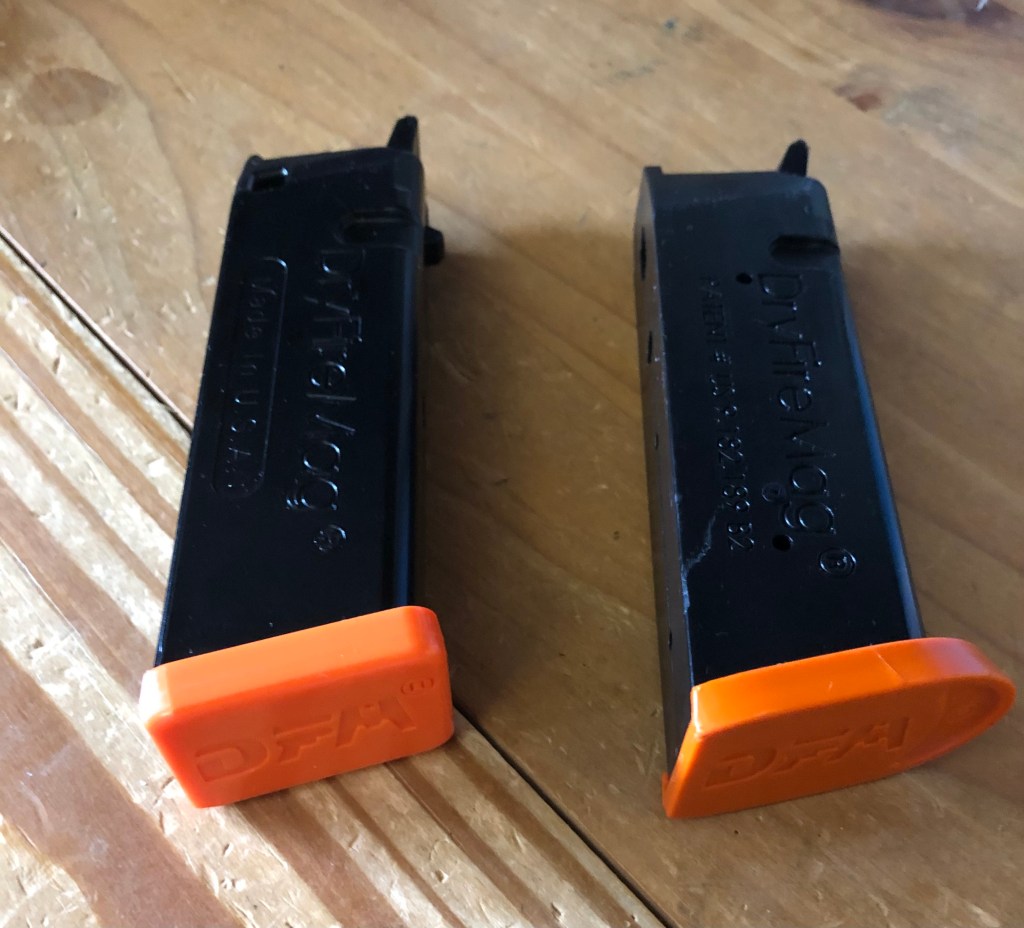
As the name suggests, the DryFireMag resembles a factory magazine. Installation, such as it is, consists of inserting the DFM into your pistol’s magazine well, where it locks into place via ambidextrous cutouts like those on newer-generation Glock mags.
Note that, since this model of DFM is made to be compatible with large-frame Glocks like the 17, 34, 19x, etc., the baseplate doesn’t fit flush with the bottom of the grip in a G19. The stendo effect would be even more prominent with a 26 or other subcompact Glock. Personally, it’s never hindered me when drawing with a long T-shirt as a cover garment, although it does effectively increase the length of the grip, which should make concealment more difficult.
The vertical extension on the pistol’s trigger bar (I’ve also seen this referred to as the ‘ear’) pushes the lever at the top of the DFM backwards, which flexes an internal leaf spring to create the audible and tactile click; the compression of the coil spring behind the lever and the flexion of that leaf spring then push the trigger bar forward again, creating the ‘reset.’
Once the DFM is inserted, the first long, heavy trigger press releases the striker. At that point, the perceived weight, break, and reset of the trigger are solely the function of the DryFireMag.
The simulated trigger weight can be tuned by installing coil springs of different thicknesses, which are sold in sets of 5 as a $5 add-on to a DFM purchase, or $10.95 ala carte. Using these, the end user can tweak the feel of their DFM to achieve anywhere between a two- to 10-pound simulated trigger pull. Additionally, adjustment of a set screw on the back of the DFM allows users to shorten or lengthen the amount of trigger pre-travel. This is done with an included #10 Allen wrench.
They’re not designed for practicing reloads, and DryFireMag recommends against using them for that purpose in their FAQ. In any case, they don’t weigh close to as much as a loaded magazine and need to be stripped from the magazine well since they don’t drop free.
Why
As alluded to above, the DFM was created to do away with the repeated need to rack the slide between trigger presses during dry fire practice. The claim is that this “[builds] muscle memory that could get you killed” (this quote, which appears on DryFireMag’s website, is from a product spotlight from 2019 SHOT Show on Police1). Frankly, I think the chances of dry fire practice getting you kilt in da streetz are slim. Incorporating a deliberate pause after breaking the shot during dry fire, validating frequently enough with live fire, and generally being mindful during practice should be pretty good hedges against that.
On a practical level, there is something more to be said for a dry fire tool that allows you to practice maintaining a two-handed grip for longer strings and courses of fire. Removing your support hand every few seconds probably isn’t conducive to building grip endurance. It might also make it easier to get lax about gripping the gun as hard as we do in live fire. At the end of the day, these are things that you can work around without a special gadget…But I’m getting ahead of my conclusion.
Some would argue that anything less than a perfect analogue of a true break and reset is pointless. I personally don’t agree; regardless, you should know that a DFM does not recreate the feel of a live break and reset one to one. If that’s a deal-breaker for you, proceed accordingly.
I don’t have enough firsthand experience with other dry fire aids to make any comprehensive head-to-head comparisons, but I can seize upon a few pros of the DFM based on my cursory knowledge of what else is out there:
- Even with the hundred-dollar price tag, it’s still easily the least expensive of the more popular options, coming in at well under half the cost of a SIRT pistol, Mantis X10 unit, or CoolFire Trainer barrel.
- There are no consumables associated with continued use of the DFM as is the case for something like the CoolFire Trainer (at least, in theory).
- In addition to the above point, the DFM doesn’t require a mobile device or tablet for use. The vast majority of people have smartphones, so this isn’t much of a barrier to entry, but it is worth mentioning.
- To reiterate, since there’s no associated software to link with or parts to swap out before use, it’s as fast to set up as one could hope for. By the same token, the process of returning your pistol to street-ready condition after dry fire practice is just as quick. As always, just make sure to be extra diligent about your procedures for unloading and reloading.
Summary
I ordered my first DFM on November 27th, 2020. It worked exactly as advertised for about two and a half months until I began to notice a slight stickiness to the reset. I was quick to attribute this to trigger freeze resulting from poor technique on my part. It happened once or twice over the course of two or three days. Then, the DFM began failing to reset at all.
Outside of the pistol, I could press the lever with my thumb and hear/feel both the break and reset, but—when inserted—the trigger only gave a bit of mushy resistance without any break or reset. After the first press to drop the striker, the trigger was under perceptible tension, but would travel all the way to the rear without a click. There wasn’t enough pressure to return the trigger forward, either. With the slide removed, it was clear the lever was trying to push the trigger bar forward but wasn’t quite strong enough anymore.
I tried swapping the stock coil spring for the included spare. No dice. Since my DFM was still covered under the one-year warranty, I submitted an RMA request, got a prepaid return label, and ultimately received my DFM back in the mail after repairs. The turnaround time was good, and the process went smoothly and seamlessly.
No one wishes more than I do that it ran without a hiccup from that point on. Unfortunately, a few months later in July 2021, the same problem developed. And, after another cycle through the return process, it happened to the (at that point) twice-repaired DFM a third time in October.
At that point, Gary—a gentleman at DryFireMag who does repairs and tech support—offered in an email to include some spare parts with my DFM when it was fixed and sent back, just to save me the trouble of shipping it back to them. He even gave me his personal cell number to reach him directly in the event that I needed to perform some DIY with those parts. True to his word, I received two or three extra leaf springs with my returned DFM.
Since Gary told me he would rather I call him before trying to play Wish-dot-com MacGyver on my own, I took him up on the offer; unfortunately, I didn’t record the date of our conversation. The call lasted between 10 and 15 minutes. Like an air traffic controller trying to pull off a talk-down aircraft landing, Gary led me through the steps of replacing and re-tensioning the internal leaf spring, which they call the reed. He explained that these thin metal wafers can develop hairline cracks due to poor metallurgy, since they are mass-produced. He was extremely patient and very personable.
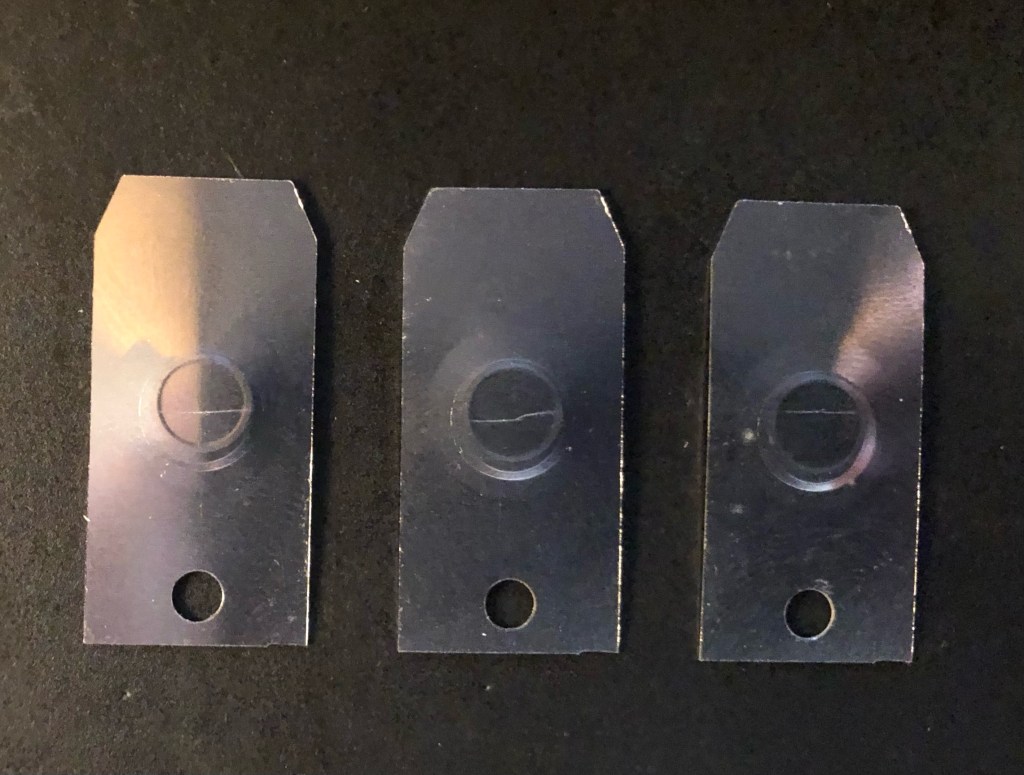
After getting my DFM back up and running with Gary’s assistance, I continued to use it throughout the remainder of 2021 and into 2022. To my disappointment, the pattern of leaf spring breakages persisted; after each disassembly, the removed reeds all had the same telltale hairline crack running through their circular dimples. When it became clear I would burn through all my replacement springs, I sent an email asking whether I could purchase some more and continue periodically servicing my DFM.
Sadly, I got no response to that inquiry, and saw no solution but to cave and buy a second one in August 2022.
I realize this narrative begs the question: why? It’s normally not like me to make an impulsive purchase, so the fact that I’m only just formulating an answer to that question is odd. I think there were a few reasons:
- They had done right by me with their excellent customer service and one-on-one technical support long after my original purchase.
- Some part of me naively hoped that the first DFM had been a bad apple, and that a new specimen might work flawlessly. I didn’t expect that to be the case, but hoped there was a chance.
- On some level, I subconsciously justified my decision by comparing the price to what the equivalent cost would be in live ammunition.
- I am very much a creature of habit and do not like it when my routine is disrupted. For better or worse, the DFM had become part of that routine.
- I picked up a copy of Ben Stoeger’s Dry-Fire Training later that year; had I read it sooner, I would have learned about the rubber band trick within literally the first few pages. Additionally, the two live-fire classes I took shortly after purchasing the second DFM would have steered me away from doing so. I’ll discuss this more at the conclusion.
In hindsight, it wasn’t the right decision.
In any case, I gave the DryFireMag a full second chance. But, dishearteningly, that same telltale stickiness and abrupt failure to reset reared its ugly head a few months later, killing the new DFM. Based on the presenting symptoms, I knew without a doubt that it must be another cracked reed. Persistent to (and clearly beyond) a fault, I requested a prepaid shipping label just before December 2022.
That repair lasted me a bit longer than the previous ones, until a different problem brought things to a halt: a chipped lever. The far corner of the plastic part had worn away under the thin edge of the trigger bar ‘ear’ so that it slipped past when the trigger was pressed by just a millimeter or two.

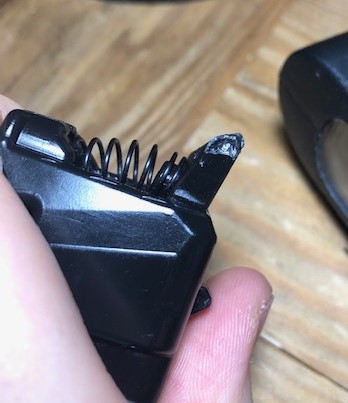
Now, when the leaf springs in my first DFM were replaced, it appeared that they also reinforced the leading edge of the lever with some clear epoxy. Having noticed this, I emailed to ask what kind of compound they used, figuring I could build it up with a few drops and smooth it off with an emery board or fine-grit sandpaper. To my surprise, the reply was, “best send it in” so a new lever could be installed.
“Well,” I thought, “If you’re paying to ship it back and forth, that’s up to you, I guess.” This time, I included a handwritten note in the package along with my first, broken DFM, which was of no use to me at that point. I can’t recall exactly what I wrote, but stressed that since my original unit was well out of warranty, I could not in good conscience ask them to service it when they replaced the lever on the newer DFM. I guess I felt it would have been a shame to throw it away and thought maybe they could devise some use for it.
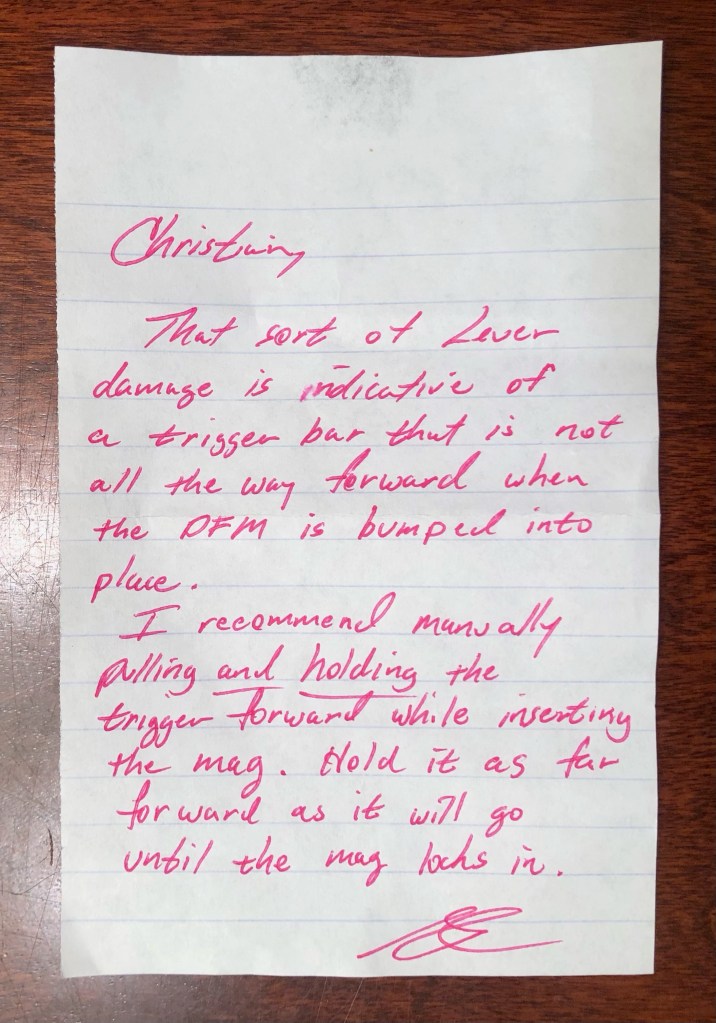
I was sincerely not expecting anything to be done with it—let alone for it to be repaired and returned to me in the same box as the second DFM, which had also been fixed. That rises beyond the level of customer service to something more like charity.
Gary also replied with a handwritten note of his own, pictured here.
After that, I resumed use of the newer DFM, since it still had some time left on the warranty. As expected—although it makes me sound more cynical than I am to say that—DFM #2 has since given up the ghost (a broken leaf spring, I can tell) and I’ve fallen back upon my repaired original unit. How long it still is for this world is anyone’s guess.
The cause of these repeated failures is still a mystery to me.
Internally, the Generation 4 Glock 19 in which I used both DFMs is in original factory configuration. According to the company, the DryFireMag will work just fine with aftermarket triggers; other than that, I’m not sure what other modifications could pose an issue. Regardless, that’s one variable that wasn’t in play in my case.
I can’t fathom that the issue could have been caused by overuse. My dry fire regimen, while surprisingly consistent, has never been extreme: I’ve managed to squeeze in 15 minutes a day for about the past 4 years without missing many days (how productive and structured those sessions have been—the early ones, especially—is certainly up for debate). I’m not sure how many cycles on a DryFireMag one can rack up in one 15-minute session, but it’s ludicrous to think that some random nerd in his bedroom is running a DFM ragged on that schedule when there are so many USPSA and IDPA shooters grinding to win matches. I find that too hard to believe.
In fact, in their FAQ, DryFireMag notes that they have “not yet determined” how long a DFM lasts, only adding that, “we have had units being used for 7+ years by some of our customers who do thousands of reps per week, and they are still going.” That makes my experience all the more baffling.
One could question whether several of those breakages were due to incorrect installation on my part. In those instances, I would say it’s possible but unlikely. The fact that the leaf springs broke in precisely the same way after I replaced them as they did when they were factory installed leads me to believe I’m not at fault.
I do tend to leave my DFM inserted after finishing dry fire practice, so that may be a factor for some reason or other.
So, with all that being said, what have I taken away from my experience? What should you take away from it?
The Verdict
Is DryFireMag a good company that will stand behind their product? The answer is a resounding, unequivocal yes. On two occasions now, they have bent over backwards to prove that customer satisfaction really is their number one priority, and that that’s not just canned marketing copy.
The amount of time and energy that the folks at DryFireMag have invested in me as an individual customer—me, with absolutely zero name recognition, social media clout, or prestigious institutional affiliations—is astounding. I know this for a fact: their business is brisk enough that they could have told me to kick rocks and it wouldn’t have affected their bottom line by one cent. But they didn’t. Gary, in particular, would be tenured employee of the month if it were up to me.
But is the DryFireMag a necessity? No—far from it. You can achieve the same effect (albeit without a tactile click) by placing a thin piece of rubber band between the breech face and barrel hood of your pistol to keep it slightly out of battery. Granted, the rubber band solution can’t recreate the exact same feeling as the true break and reset of a live-fire trigger press any more than the DFM can. But it can get you most of the way there for less than a hundredth of the cost.
With some pistols, you don’t even need the rubber band. The M&P-series triggers will ‘reset’ to the same degree from the factory. A DAO revolver with snap caps should behave exactly the way it does in live fire sans the noise and recoil. Not to mention, there’s nothing to stop you from pulling a dead trigger on a Glock. Even if it isn’t under tension, it can still be pressed in a way that will tell you whether you’re doing so without disturbing the sights or dot.
That brings to me my main point. The more I’ve learned about pistolcraft, the less necessary the DFM has come to seem. So much of dry fire practice doesn’t involve pressing the trigger at all. When it does, it’s up to you to be brutally honest with yourself about what you’re seeing: you are responsible for hearing what your sights or dot are telling you (visually). No tool can force you to be mindful of the habits you’re building during dry fire practice or remind you to grip the gun as hard as you do during live fire.
As much as I’ve endeavored to be extremely wary of ‘purchasing skill,’ I had invested in the DFM as a dry fire aid without understanding the nuances of trigger control. See, you don’t know what you don’t know. And then there are the things you think you know, but don’t. That was me, not understanding that when people say, “press the trigger straight back without moving the sights,” that means literally straight back, and literally motionless. I still struggle to isolate my trigger finger and fight against a lot of interdigital sympathetic movement, but at least now I recognize the goal.
At the end of the day, cost is really what will make or break the DryFireMag for potential buyers. To say the price difference between a DFM and the rubber band setup is substantial is an understatement. Since the rubber bands you get around heads of broccoli are basically free, it’s hard for me to recommend the DryFireMag to budget-minded self-defenders—especially given the problems I’ve had with my two specimens. For many people, $90 is a lot of money. Yes, that ninety bucks gets you trigger pulls that would cost you a lot more if they were setting off live cartridges, but the point remains.
DryFireMag, LLC is a good company that will go the extra mile to support you after you buy. The DFM feels more like a live trigger than a rubber band but is perhaps not worth the cost. I had bad luck with mine, but apparently a lot of people don’t. Take that as you will.
If you’ve made it this far, thanks for reading! Remember to know yourself and that habit is a powerful thing. Carry the fire.
 Fire Carrier Defense