
Welcome, friends.
Imagine an armed robbery or assault. Focus on the attacker. Picture them. What do they look like?
For many people, the character that came to mind is a young man between the ages of 18 and 35. Maybe your imagination added some extra details—identifying marks like tattoos, scars, or cauliflower ear; certain clothing like a hooded sweatshirt or even a ski mask; a weapon like a knife or crowbar. But, chances are, the most notable features of your hypothetical assailant were his sex and relative youth.
These demographics are the two that Dr. William Aprill identifies in his chapter of Straight Talk on Armed Defense as representative of “a statistically ‘average’ VCA,” or violent criminal actor. I might also add that, since it’s estimated 75.5% of the US population is “white alone,” odds are that they would also be Caucasian…Nationally speaking, at least. State and local demographics may not reflect that racial breakdown. In any case, this would seem to be borne out by FBI’s Uniform Crime Report (UCR).
This is one benefit of visualization: it lets us practice filtering people, behaviors, and situations through what we know about violence in order to gauge the possible risk to ourselves.
Some filtering process is necessary from a purely practical perspective. First and foremost, in certain places and situations there are simply too many people to pay attention to at once. There is a finite limit to how much sensory information we’re capable of taking in and processing. Trying to achieve an impossible ‘perfect’ level of awareness beyond that may very well cause social friction, as constantly scanning the environment will likely make you appear jumpy and on edge, which tends to make people uncomfortable and could even be considered suspicious. Second, it’s just bad for a person’s mental health. Living in a state of hypervigilance isn’t conducive to happiness or fulfillment.
“Too Much Situational Awareness?” by Greg Ellifritz, Active Response Training blog
Since most of us thankfully lack firsthand experience as victims of violence, our filters are primarily informed by data and the synthesized, second-hand experience of law enforcement and corrections officers, criminal psychologists, and criminologists.
However, while these provide a fairly robust set of general guidelines to help us identify potential threats, they shouldn’t be considered gospel. Averages reserve the right to outliers.
These outliers are the subject of our discussion here today.
Have you thought about how you might react if a child tried to rob you, stab you, or shoot you?
I wish that was just an inflammatory rhetorical question.
Credit goes to Phil Elmore at The Martialist for first writing on this topic in the excellent article above, and for the post subtitle, which I’ve graciously borrowed from that article with his permission.
More and more often, it seems that adolescents who are legally children are engaging in crime and violence. Phil puts a name to this underlying societal shift, which he’s identified as both a cause and consequence of this apparent trend.
The titular Latin phrase in loco parentis is a legalese term meaning “in place of a parent” or “instead of a parent,” according to Black’s Law Dictionary. It refers to the responsibility of an adult like a schoolteacher, sports coach, grandparent, or stepparent to act in the capacity of a biological parent under certain circumstances. “Much more broadly, though,” Phil writes, it speaks to, “the notion that an adult, even a stranger, has a certain amount of authority [over] and responsibility for other people’s children.”
For instance, he says, if you saw a child about to fall from the jungle gym at a public park, or a tussle between two kids on the playground, you would have some standing as an adult to intervene and catch them or break up the fight. Adulthood itself bestowed some default level of authority. At the same time, it was not out of line for an adult to reprimand someone else’s child for bad behavior, or for scolded children to heed the discipline they received based solely on the seniority of whoever doled it out.
That is no longer the prevailing attitude among kids, their parents, or adult third parties.
American youth now behave like mini adults and act more or less with autonomy. This has always been true to some degree in poorer neighborhoods, where children are often left to fend for themselves while adults are off making their own bad decisions and disappointing Jesus. But one could make the case it’s becoming more common. I haven’t been alive long enough to confirm or deny that a change is taking place, but I have seen plenty of evidence that there’s hooliganism afoot. And that’s putting it mildly.
Now, keep in mind that the subject at hand is technically ‘minors as unknown contacts,’ not exclusively minors as VCAs. But, of course, harm doesn’t have to rise to the level of violent assault or armed robbery to qualify as something we want to avoid; if a child or preteen who approaches you on the street gets close enough to pick your pocket, that’s still a negative outcome. Not to mention there’s always the possibility that a little kid is running interference for an adult crook who will stick you up or blindside you with a sucker punch to the head while you’re distracted.
Obviously, teenage boys are probably more likely and capable of posing a deadly threat; they are, after all, male—that is, more aggressive and statistically more violent—and are at an age where their height and weight means they can give plenty of adults a run for their money. Don’t think this is a sex-specific issue, though.
After seeing the below post from BladeCraft Method on Instagram, I tried to find a corresponding news story to learn the details.
I got plenty of relevant results from my first Google query…But, alarmingly, none of them pertained to the incident in question. The precedent for young girls stabbing one another is apparently much greater than I’d thought. I found a similar story from Forth Worth, Texas.
The 2021 officer-involved shooting of Ma’Khia Bryant is relevant for the same reasons.
The aggressors in these cases were 13-, 15-, and 16-year-old girls, respectively.
There are also more extreme examples, like the arrest of Sadaat Johnson in February 2022, during which his four-year-old son fired a gun at responding officers. Whether the boy was following his father’s explicit instructions in doing so or simply acting on the attitudes fostered by his environment and upbringing, either way, it sets an alarming precedent.
It’s neither my place nor my intent to speak to the societal implications of events like these. My only agenda is to bring them to your attention so you can wargame similar scenarios and think through how you might respond.
Reality can subvert our expectations when a criminal exceeds the typical age, as well.
Take for instance the two cases below:
Ohio man, 81, fatally shoots Uber driver, 61, after scammers target both of them, officials say
Ohio Woman, 74, Uses a Handgun to Allegedly Rob Her Own Credit Union
Both of these crimes were committed by elderly perpetrators—and, interestingly, both incidents may have been precipitated by financial scams.
William Brock fatally shot Uber driver Loletha Hall in his driveway, believing her to be in cahoots with a scammer from whom he had received fraudulent phone calls: first a request for him to post bond for a jailed relative, then a demand for ransom to free them. Either the scam caller or an accomplice ordered the Uber to come and collect the extorted money under the guise of a package pickup; it seems miss Hall had no knowledge of what she was getting into when she arrived. Mistaken identity cost Hall her life and Mr. Brock his freedom.
In the same month, Ann Mayers brandished a handgun at her local credit union and demanded money. Her relatives claim she, too, might have been the victim of an online scam, though this is apparently still unconfirmed.
What we might call an ‘unconventional’ violent criminal actor may deviate from the norm in more ways than just their age and sex. See this Facebook post from Anette Evans:
Did the bad guy you initially imagined look anything like the one in the mugshot above?
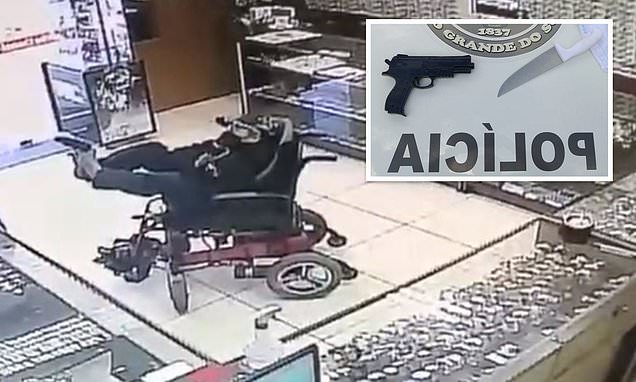
What if the person holding you at gunpoint was pregnant? Or a paralyzed deaf-mute holding a passably realistic toy pistol with his feet?
Here’s a similar story from Kevin Creighton’s home state of Florida: in 2018, Jonathan Crenshaw—an armless (note: not harmless, for my dyslexic readers) street painter who lived on Miami Beach—stabbed a tourist using a pair of scissors wielded with his feet. This was later proven to be a case of righteous self-defense on the part of Mr. Crenshaw, but I think it’s still noteworthy.
As we can see, things aren’t always as they seem. Homeless Florida men can be justified self-defenders just as any of us can, and sweet teenage girls can be shot by police while trying to sewing machine someone in the guts with a knife.
So no, on the whole, spending the same mental energy to vet a Girl Scout hawking cookies as you would to vet a grown man wearing sunglasses and a bandana mask indoors isn’t logical from a cost-benefit standpoint. Still, it’s better to keep somewhat of an open mind about which unknown contacts could potentially turn into VCAs.
This was, and still is, one of my biggest gripes with The Gift of Fear: I believe DeBecker’s constant emphasis on the statistical likelihood of male attackers, stalkers, and murderers ultimately does a disservice to his readers. His data is correct, but he belabors the point to the extent that I think it could lead people to create a rut in how they visualize defensive encounters. That is, I worry that his dogmatic adherence to the male attacker premise inadvertently promotes a habit of picturing every defensive encounter as beginning with a violent or aggressive man. When all of someone’s mental imagery is built upon that presupposition, what happens when reality differs drastically from their expectations?
“When the Bad Guy is a Girl” by Wendy Lafever, NRA Women
This is something that self-defenders should take into account when setting boundaries, making pre-decisions, and building mental maps.
Thanks for reading!
Tell me: do you see the same trend of minors becoming ‘adultified?’ If so, what do you think is driving it? Have you ever had an encounter with a yute that could have turned ugly? Let me know below in the comments.
 Fire Carrier Defense