Welcome, friends.
Since I began my BJJ journey and discovered that, one, grappling is hard and that, two, if I had to use my jiu jitsu to defend my life I’d need every advantage I could get, I’ve wanted to learn more about small fixed-blade knives for EDC.
Today’s blog post will be a dual-purpose product review and comparison. By necessity, it will include some limited discussion on the rationale for carrying and using knives for self-defense, but a more comprehensive list of pros, cons, and legal considerations will have to wait for a dedicated blog post. I’m writing today to capitalize on the trendiness of nonmetallic tools and to offer consumers an in-depth look at a G10 knife and how it measures up against its inspiration.
Get Off Me, Stay Off Me
As with firearms, it can be easy to get caught up in the glamor of new gear and the sense of agency and empowerment that comes with taking steps to prepare yourself—both of which, in my opinion, are totally valid and relatively harmless. However, as good, sane, sober, moral, prudent self-defenders, it’s incumbent on us to look objectively at the pros and cons of our tools without fetishizing them or romanticizing their use.
And, contrary to what we see in movies and TV, evidence would tend to suggest fighting with a knife is less like an elegant, choreographed duel and more like a pair of monkeys stitching each other full of holes with prison shanks. Take that with a grain of salt, since it’s coming from someone who has never been in a knife fight and never wants to be. You’re welcome to come to your own conclusions.
With all that being said, why would someone carry a knife to defend themselves instead of, or in addition to, other lethal options?
Here are a few reasons:
- Fixed blade knives can be easier to access in a clinch or entanglement than pistols.
- Knives are more affordable than pistols. Decent defensive fixed blades like the KA-BAR TDI Investigator can be had for less than $50, and even more expensive knife-and-trainer combos like the ones I’m reviewing here only cost around $200. You’d be hard-pressed to find a decent handgun for that.
- Whereas handguns require a lot of training and practice to employ effectively, knives are fairly intuitive—especially certain designs like push daggers.
- A strike with a knife that fails to connect doesn’t carry nearly the liability that a miss from a defensive pistol does. There’s comparatively little risk of harming a bystander and no risk of overpenetration.
- Because they’re pointy and usually have at least one sharp edge, I would argue knives are less inviting to a disarm attempt. Even though people can and do grab knives by the blade during a struggle when they’re desperate, adrenalized, or high, there’s simply less to hold onto.
- What knives lack in ability to induce a physiological stop, they make up for with powerful psychological deterrence. When a blade opens up a person’s forehead, cleaves through the roof of their mouth and into their sinus, or they suddenly realize there’s a slit in their cheek from lip to ear big enough to put their tongue through, that may give someone pause about continuing an assault.
The pros and cons of fixed-blade versus folding knives, matters of legality, and tactics for using blades defensively are all separate topics that will have to wait for discussion at a later date.
Why G10?
G10 is a composite industrial material created by heating and compressing layers of fiberglass that have been soaked in resin epoxy. It’s commonly used to create textured scales and handles for knives, as well as revolver stocks and grip panels for pistols like the 1911 and Beretta 92.
The popular consensus is that G10 tools have three main advantages: invisibility to metal detectors, a high weight-to-strength ratio, and corrosion resistance.
“Pocket Preps: Nonmetallic Weapons” by Patrick McCarthy, Offgrid Magazine Web
Theoretically, their undetectability means they can defeat any security measure short of a thorough pat-down or a full-body scanner. For those who visit or work in so-called nonpermissive environments (NPEs) like hospitals, concert venues, nightclubs, schools and universities, or houses of worship and feel they must carry a defensive tool, this is an attractive (haha, magnetism pun) quality.
I’ll discuss that further towards the end of the post. For now, let’s look at our contenders.
Short and to The Point
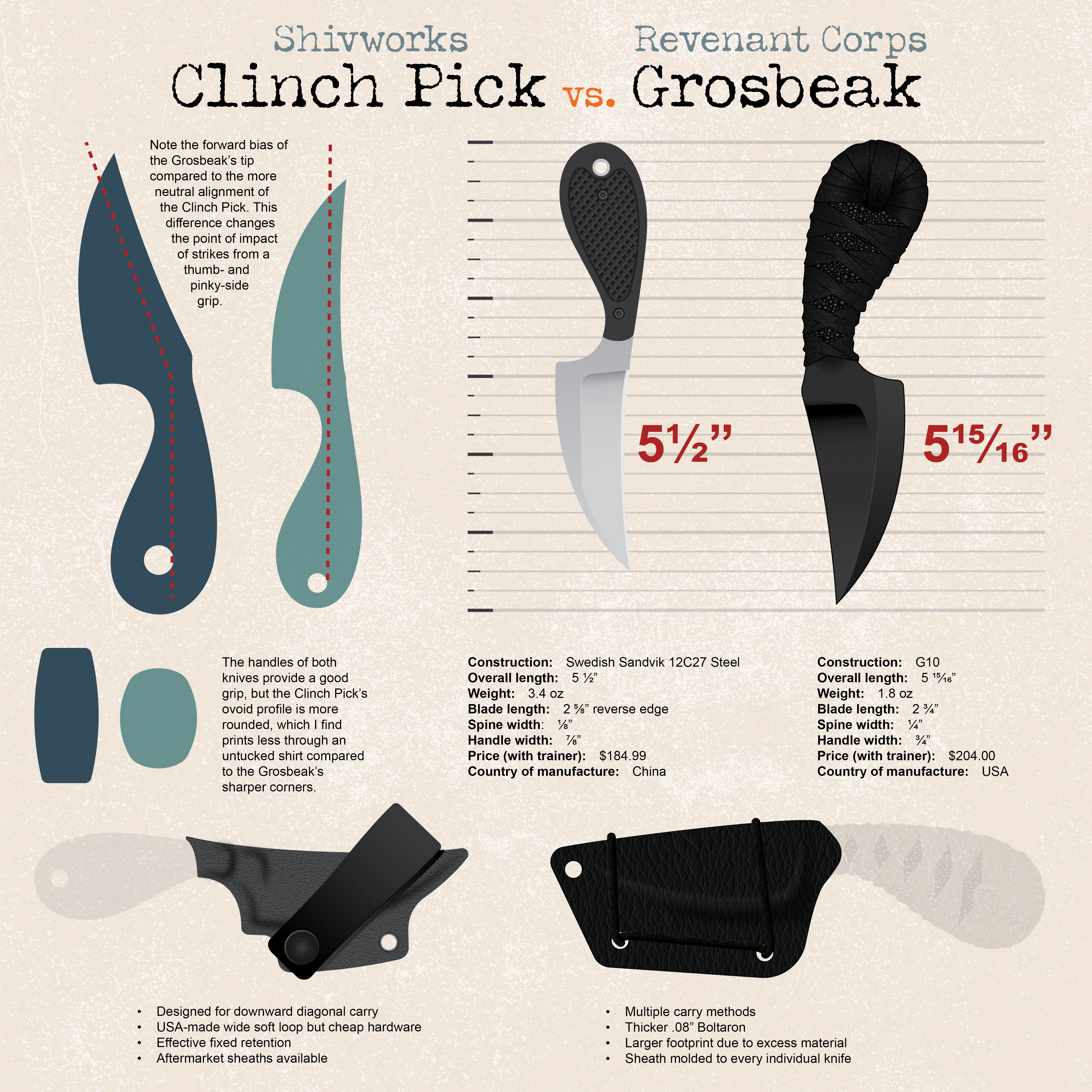
The Shivworks Clinch Pick 2.0 is a full-tang, fixed blade knife that measures 5½” overall with a 2 and 5/8th” reverse-edge blade. The spine of the blade is 1/8th” thick and the knife is 7/8th” wide at the handle with its checkered G10 scales. An older, first-generation model, a double-edged variant, and a titanium version are also available. The 2.0 can be had in a satin finish or with a black PVD coating.
The Clinch Pick is priced at $121.99 for the live blade and sheath alone and $184.99 in a combo package with its aluminum trainer.
The standard Clinch Pick 2.0 is constructed of Swedish Sandvik 12C27 steel. Arguably, this is a trivial detail for a defensive knife which, by definition, is not a working knife like one that would be used for bushcraft or game processing. Since it will either never open anything except the occasional package or end up bagged in an evidence locker, edge retention and ease of sharpening aren’t as critical as they would be for a different use case. Still, this is a knife review, so I feel like I’m obligated to mention it.
It is mass-produced overseas to cut manufacturing costs. Again, though, for what should really be thought of as a disposable tool, that doesn’t bother me. The important thing is that it doesn’t feel cheap.
The Revenant Corps Grosbeak comes in at just a hair under 6 inches long, measuring 5 and 15/16th” overall with a 2¾” double-edged blade that has what I think would be called a single-bevel profile. Because it has two grinds, the blade has a triangular cross section at the point.
While the Grosbeak’s full-tang G10 construction has an advertised thickness of 1/4th”, mine is slightly beefier at 3/10th” according to my infallible Harbor Freight calipers. Since every tool is handmade, variances like that are probably to be expected. Its handle widens to almost a full 3/4th” at the ‘peaks’ of the grip where its epoxy-coated tsukamaki wrap is twisted over.
The Grosbeak is priced at $135.00 for the knife and sheath alone and $220.00 in a combo package with a jade G10 trainer. I picked up the combo during a sale for $204.00.
Note that the Grosbeak can be ordered without the rayskin underlay, which reduces the thickness of the grip and lowers the cost of the knife.
Here are a few other key differences I want to highlight.
Sheath
While this might seem like much ado about nothing—after all, shouldn’t the focus of a knife review be the knife itself?—if we think of the sheath as analogous to a holster for a pistol, it should be easier to see why I place so much emphasis here.
The Clinch Pick’s factory sheath is unremarkable but satisfactory. Its fixed, passive retention provides the perfect amount of friction without being too snug. Like the knife itself, the sheath is made in Chyna.
I personally don’t see a need to upgrade, but end users looking for a USA-made aftermarket option can check out Henry Holsters’ Omni sheath (for fans of the DCC clip), this version from JM Custom Kydex, and Dark Star Gear’s belt wrap or vertical clip sheaths.
Unfortunately, while the extra wide soft loop that comes on the factory sheath is of very high quality, the hardware that attaches it is not. On the sheath for my trainer, I’ve already stripped the Phillips screw on the male end of the loop, and the slot in the post that goes through the eyelet is so shallow it’s difficult to keep a flathead in.
Although not nearly as noticeable when bending over as a pistol, I do occasionally get poked in the stomach by the tip of the sheath, which protrudes just barely past the top of my belt.
Overall, I find it much less restrictive to movement than the Grosbeak sheath.
The Grosbeak is available with two different sheaths, both constructed of 1/8th”-thick Boltaron, a moldable thermoplastic like Kydex. The Boltaron they are pressed in has a unique leather texture that pairs well with the knife’s fancy rayskin underlay. It’s also noticeably thicker than the Clinch Pick sheath’s material, which is probably not registered trademark Kydex.
The first sheath is a three-hole foldover design configurable for neck carry, static line carry on the waist, or vertical, horizontal, downward diagonal, or scout carry on a belt. The second has a somewhat slimmer footprint and is lashed to a Tier 1 Concealment EZ Adjust belt clip with 1/8th” shock cord for vertical belt carry. Neither version of the sheath has any metal hardware or eyelets.
I opted for the first. The so-called multi-method sheath comes with shock cord strung between its three holes, as shown. Truth be told, I didn’t have much luck with the shock cord. After a few practice draws in a horizontal carry position, friction from the abrasive top edge of my belt had almost sawed through the elastic core. This could have been user error on my part, but I wanted something more robust anyway, so I cut the rest off.

While I do plan to experiment more with static line carry, it’s never been logical for me based on the way I dress.
This method entails looping a short length of cord through an eyelet on a knife sheath and anchoring the other end to a tie-off point—typically either around your belt or some part of your pants, such as a belt loop, buttonhole, or a knot around the end of a pocket turned inside out. At that point you can either tuck the knife inside the waistband or carry it in the pocket.
“Simple Knife Carry Hack – The Static Cord” by Matt, Jerking The Trigger
Personally, if the pants I’m wearing that have belt loops, I’ll wear a belt; in which case, I’d rather attach a tool to that with more robust, traditional hardware like a clip or loop. If I’m wearing sweatpants or gym shorts, there’s too much other shit in my pockets to carry a tool in them, which rules out static line carry in the pocket. Gi pants and my Phalanx fight shorts don’t have belt loops or pockets, and frankly I’m almost always too damn lazy to change back into big boy pants before leaving the gym.
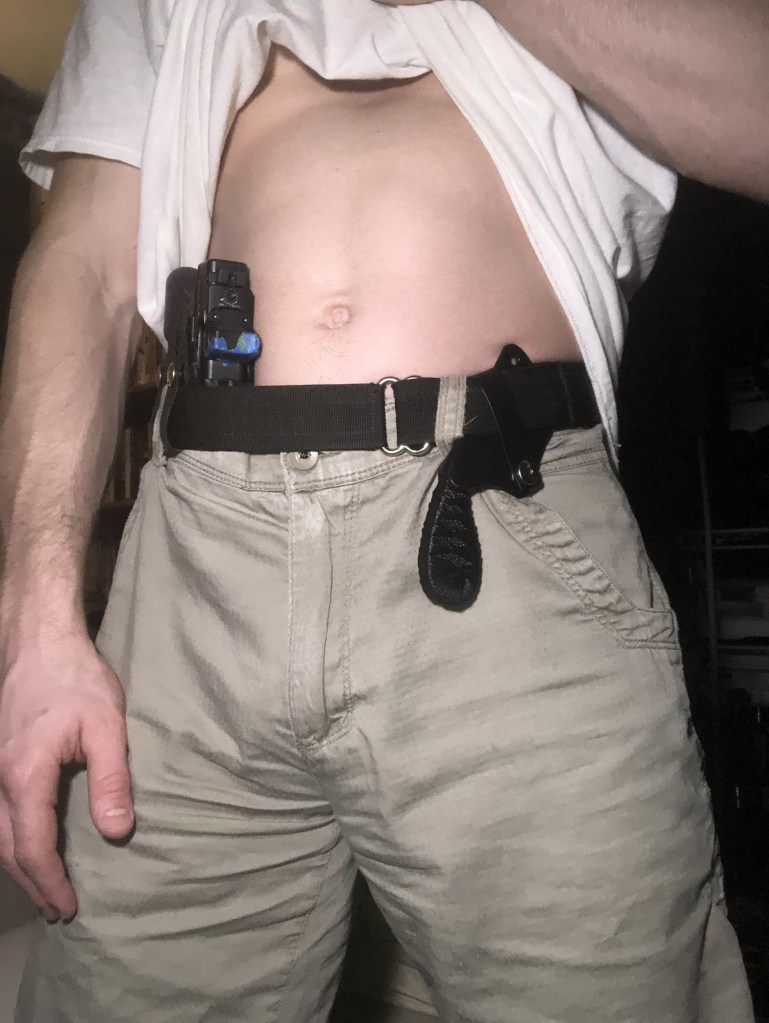
As a result, I originally tried to set up the Grosbeak for a downward-diagonal draw by adding an extra-long soft loop from NSR Tactical; meant for their KA-BAR TDI sheath, they’re sold in pairs of two, so I screwed one onto the live blade sheath and the other blade for the trainer.
Carrying it in this orientation quickly made two things clear: first, the handle of the Grosbeak extends much farther below the belt line due to its overall length. Second, the excess material of the sheath around the blade becomes much more pronounced.
Whereas the Clinch Pick sheath tucks neatly behind the doubled-over tail of my belt, the Grosbeak doesn’t really tuck. The sheath is like a hard, nonpliable pancake of thermoplastic that doesn’t want to conform to the curve of my hip.
I would love to see Cache come out with a third sheath option with the same layout as the factory sheath for the Clinch Pick, something like I’ve illustrated below.

Since carrying it like a Clinch Pick didn’t work quite as well as I’d hoped, I’ve been testing out an angled vertical carry position. The knife is canted at a roughly a 30° angle so that the pommel points toward my navel.


Remember to tuck your thumb, not brace it on the pommel or rest it on the spine (with reverse- or double-edged knives, there’s a blade there). Sick shirt from Rubashka.
This orientation lets me get an easy pinky-side grip with my support (left) hand and a passable thumb-side grip with my dominant (right) hand; however, the latter requires a crossdraw movement that feels like drawing a sword. The motion is pretty much impossible not to telegraph, and passing my hand across my centerline seems risky. I worry it would leave me vulnerable to an arm drag or that that arm could get pinned across my chest with enough upper body pressure from an opponent.
My buddy Tim was kind enough to drill with me so I could get a feel for whether carrying with the knife oriented this way was feasible. Except for a few hangups, I got the trainer out with both hands without much difficulty. We were only flowing and messing around, though. I’d like to see whether the position holds up under a higher level of pressure.
While I’m more concerned about my left-handed draw for several reasons, this process of experimentation has definitely made me appreciate the potential benefits of a knife with a more neutral, symmetrical handle shape, like the Shivworks Barracuda or Benchmade SOCP. A knife that feels exactly the same in thumb-side and pinky-side grips with either hand seems like it would simplify in-fight weapons access, and freeing up a little brain power for decision-making is never a bad thing.
Geometry
As tried to get across in the infographic, the slight forward bias described in the Grosbeak’s product description is one of the more noticeable differences between the two knives.
Initially, I wondered whether this would make it harder to strike towards yourself with a thumb-side grip by reaching around your opponent in a clinch. Entangled, with your arms wrapped around the other person and your chests connected, a lot of the time all you can reach is their back—the back of the neck, hips, glutes and perineum, hamstrings, or maybe an armpit—by hinging the arm at the elbow and using a hooking motion to strike.
I questioned if a user would have to break their wrist (radial deviation) to overcome the forward angle of the blade and orient the point back towards themselves more than they would with the Clinch Pick, which protrudes more or less straight out of the top of a closed fist. After drilling with the trainer, though, I didn’t notice having to contort my wrist in any weird way to get the business end pointing where I wanted it to.
Another difference is the shape of the knives’ handles. Both provide an excellent grip and have qualities that I like. The Grosbeak’s tsukamaki bites into the hand nicely, and the palm-filling, rounded egg shape of the Clinch Pick’s scales allow you to start building a grip with only three fingers, two fingers, or even just a pinky.
I’ve found the Clinch Pick’s ovoid grip shape less prone to printing through an untucked shirt. Since the Grosbeak’s handle has a rectangular profile, the somewhat sharp corner can show through the fabric unless I move it over towards my left hip to the 10–11 o’clock position. Unfortunately, that only puts it farther away from my dominant hand.
Don’t Cut Yourself on All That Edge
Now that I’ve taken EWO, I know that point-driven methodology reigns supreme in the niche world of defensive knife use. And the Grosbeak is certainly pointy…but it’s not sharp—at least, not in the way a metallic knife can be. That’s just the nature of the beast, though: unfortunately, G10 will never be shaving-sharp like steel. With that being said, I do think the Grosbeak could open up an attacker if applied with enough speed and force.
Ultimately, though, just as I’d rather my EDC flashlight set someone on fire than be too dim, if I have a tool with an edge advertised for cutting, I’d like it to be so sharp that it kind of scares me.
The Clinch Pick didn’t come with a great edge out of the box, but the difference is that I’ve been able to get it paper-cutting sharp with a fine-tooth hand file and a stone. A person with a steady hand and a belt grinder or Ken Onion Work Sharp might be able to make the Grosbeak a little keener, but I wouldn’t advise that. These are one-of-a-kind knives, and altering the blade profile too much would affect sheath retention.
Now that I have firsthand experience with the material, I would say G10 lends itself best to spike or stiletto designs geared towards penetration, like the Revenant Corps IMP or one of these daggers from VZ Grips.
Verdict
Is the Grosbeak really just a Clinch Pick made out of G10?
No, it’s not. That was shameless clickbait. And just because I prefer the Clinch Pick doesn’t mean that it’s better, per se. They’re two different tools with different use cases.
A lot of that comes down to the material. So, do the main selling points of G10 knives, awls, and other pokey devices align with what I think is their actual value proposition? Yes and no.
N[O]PE
To be clear, I didn’t buy a G10 knife to have something to carry into a NPE; if I had, you wouldn’t be reading about it. This is also one of the reasons I wasn’t worried about negating any clandestine capability by adding soft loops to the sheaths and introducing metal into an otherwise totally nonmetallic package.
I pass zero judgement on anyone who does choose to do so, so long as they accept the potential consequences. And being outed while carrying any kind of tool—edged, ballistic, or otherwise—can have life-altering if not life-ruining professional and legal repercussions. If you work an office job where corporate policy prohibits weapons, you may be lucky and only lose your livelihood. Being caught with one in a courthouse or government building could very well land you in a ‘pound me in the ass’ federal penitentiary.

“G10 Tools for Your Everyday Carry” by Mitch Eckler, Athlon Outdoors

If you’re found with a G10 knife or awl, as Craig said at EWO, “They’ll put you under the jail.” District attorneys, judges, and jurors may simply not be able to grasp the rationale for carrying something designed specifically to defeat security measures. Deception makes you look guilty. Period. A tool disguised as an ordinary object like a Sharpie or carpenter pencil (which are very popular right now) would have even worse optics. In the above-linked article, Mitch articulates this well:
“Unlike a conventional knife or a firearm, which are widely recognized as standard self-defense tools, a hidden or non-metallic weapon could be portrayed as something designed explicitly for illicit use rather than lawful protection.”
Even for those of us who believe self-defense with whatever tool we deem optimal is a human right, you have to weigh the risk of needing it and not having it against the risk of having it at all.
LIGHT WEIGHT, BABY
According to my food scale, the Grosbeak weighs 1.8 ounces to the Clinch Pick’s 3.4. Their carried (sheathed) weights are not much different at 3.1 and 4.2 ounces, respectively.


While that difference is significant in mathematical terms, in practice, it’s kind of a moot point. The Clinch Pick feels functionally weightless and I sometimes forget it’s on me. I think the greater practical benefit is in having a smaller tool that’s easier to conceal rather than a larger one that weighs marginally less.
Don’t Sweat It
When I asked Craig what his opinions on the use case for G10 were, after strongly cautioning against bringing nonmetallic tools into ‘hard’ non-permissive environments, he said they’re great for two things: exercise and beach/pool carry.
While he got some laughs with a joke about shanking a shark, I think that in all seriousness he’s right on the money. A visit to the big blue wet thing might be one of the few situations in which carrying your pistol in a fanny pack is actually your best option. Still, unless you’re on overwatch and stick to just sunbathing, you can’t take a tool into the drink with you. But G10 could fit the bill.
Probably the most universal role that G10 could fill is a defensive tool during and after workouts. Whether you jog, bike, lift in a commercial gym, or even work out at home in a basement or garage gym, the ability to have something on your body that’s light enough to be unobtrusive and that won’t be eaten away by acidic sweat is handy.
This is a big concern for me since I perspire more than anyone I’ve ever met. Mickey Schuch has called me, quote, a “sweaty bitch.” He’s right. I actually feel bad for my training partners, but I appreciate the ones who tolerate it.

Once the USPS stops being trash and gets it to me, one of these Clanton Combatives shanks will become my post-roll carry—something I can tuck it in my waistband before I limp to the car.
Why not carry the Grosbeak? Good question. I picked up one of Matt’s 6” awls because the price was right, supporting a small business is nice, and because I’d just gotten out of a relationship and regained the freedom to buy whatever unnecessary shit I felt like. And, honestly, the Grosbeak feels too much like art. To be clear, that’s a compliment to Cache—it’s almost too pretty to repeatedly subject to after-class IWB sweat.
Conclusion
If you’re interested in buying G10 tools, I encourage you to give these vendors your business:
What do you think? Are nonmetallic tools a novelty or a serious option for niche self-defense needs? Let me know in the comments.
Look forward to an after-action review of EWO as soon as I can line up an audience with Brian to answer my obsessive, autism-fueled questions.
Disclaimer: I will never encourage readers to violate any law or condone those who do (at least, in writing). The author assumes no responsibility for any act committed or decision made by a reader based on the opinions presented in this post or elsewhere on this blog.
 Fire Carrier Defense