Welcome, friends.
As self-defenders, we have a variety of options—primarily in the form of tools and techniques—available to us to stop violence directed against us or head it off. One person may have greater or fewer options than another based on their knowledge, skills, physical attributes, and what tools they choose to carry, if any; still, most of us have at least a few to work with, and they can all be placed on a hypothetical sliding scale of forcefulness. For our purposes, we can define forcefulness as the degree to which an action is potentially escalatory, injurious, or deadly.
While it might seem clear-cut where one option ranks compared to another—the proverbial harsh word is obviously less forceful than the proverbial gun, for example—things aren’t always so obvious. As we make more options available to ourselves to solve a wider range of problems, the ambiguity only increases.
Then, there’s not only the question of ‘how much’ forcefulness each constitutes, but when to use which option based on what is legally permissible and will give us the best outcome.
Significant efforts to answer these questions have historically been made by law enforcement rather than civilians. Given the multiplicity of tools at their disposal and their obligation to use lawful force on a much more frequent basis, that’s no surprise. Over the decades, police departments and state and federal agencies have made countless attempts to arrange the gamut of options into a kind of hierarchy, offer guidance on what level of hostility should trigger which response, and organize it all into a simplified visual format to streamline pre-decision making.
This has culminated in what is today known as the use of force continuum: a graphic created to help train officers in their understanding of the progressively more extreme options available to them to control a resisting suspect and effect an arrest.
Of course, the Mission of a police officer is radically different than our own; our training is piecemeal and intermittent rather than organized and sequential, lacking a cohesive program and corresponding written department/agency policy for such a graphic to integrate with. Still, I think the idea is useful for self-defenders.
Let’s talk about why.
Background
Force is an intangible: a word which, although it has no universally applicable legal definition, includes threats, compulsion, and physical violence, as well as confinement and physical restraint. In our context, it is generally lawful. Various descriptors like ‘reasonable,’ ‘excessive,’ and ‘deadly’ or ‘lethal’ are sometimes applied to force based on why, when, how, and against whom it’s used. Because so many factors affect how it might be perceived in the eyes of the law, it is nearly impossible to quantify objectively. This is not to say that it’s totally subjective—only facts can determine whether a use of force is reasonable.
At the end of the day, I would argue that distinct force options do differ in amount (at least, when isolated from other variables) and that some should preferably be employed sooner or later than others for practical reasons.
This parenthetical qualifier makes all the difference in the world, because, as we’ll see, no forceful action can really be considered in a vacuum.
History
My original intention for this blog post was to research various examples of police UOF continuums, critique both their content and presentation, and ultimately adapt the concept for civilian use by creating a more relevant and better-designed visual model.
Once I started digging, though, I found out that not only have many departments and agencies abandoned the use of continuums altogether, but that heated discourse surrounding the influence they have on officer training and criminal/civil prosecution has been going on for well over 30 years.
Now that I’ve climbed back out of the rabbit hole, let me share what I’ve learned:
- According to Peters and Brave, writing for Police and Security News way back in 2006, the first continuums began to be developed in the late ‘60s as teaching aids. James Marker of the Wyoming Law Enforcement Academy (WLEA) places their advent in the mid ‘70s, attributing the first to professor emeritus Gregory J. Connor of the Illinois Police Training Institute. Published in a 1978 bulletin, the Los Angeles Police Department (LAPD)’s barometer-style continuum is an early example mentioned in several sources. The trademarked Confrontational Continuum of Kevin Parsons Ph.D., Federal Law Enforcement Training Center (FLETC)’s staircase-style use of force model, and John C. Desmedt’s use of force model, all shown below, are a few more that come up in the two articles referenced in the above bullet point.
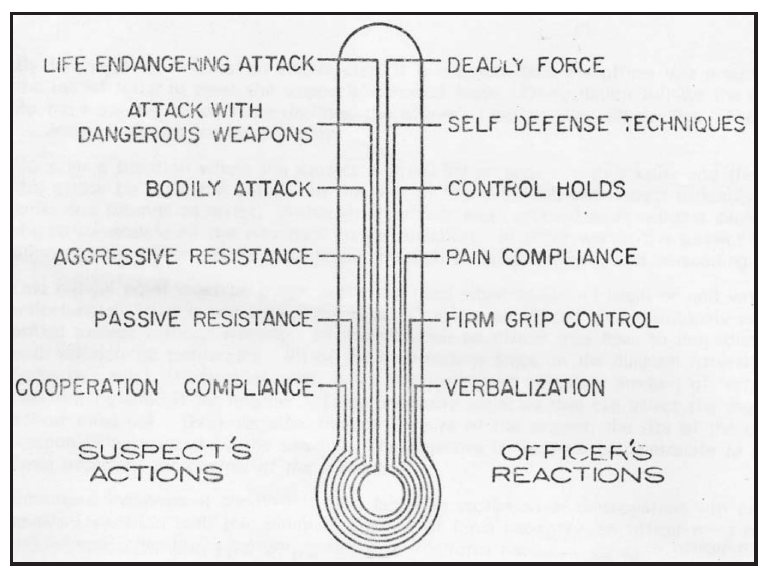
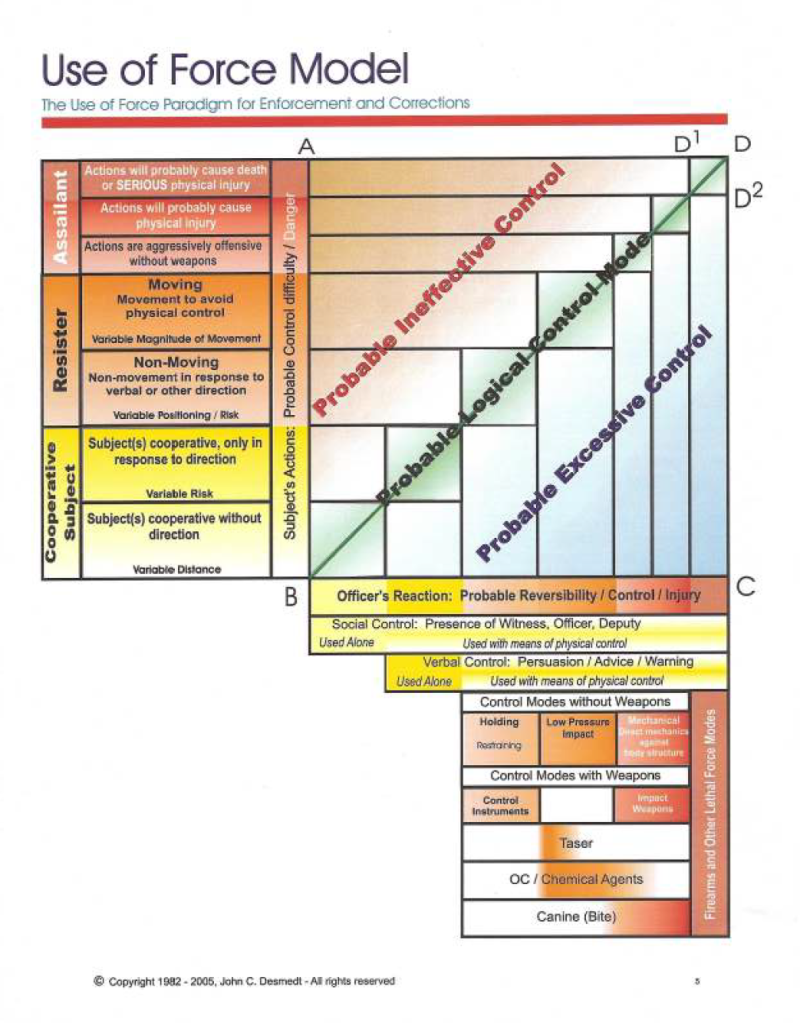
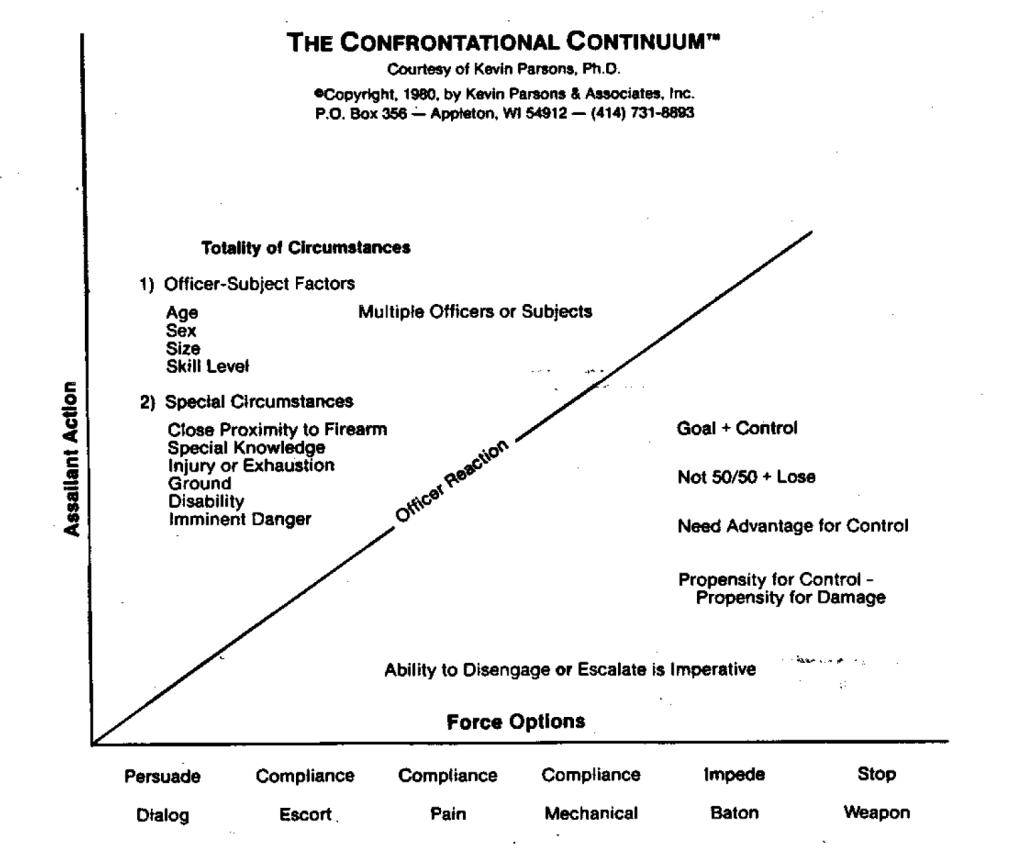
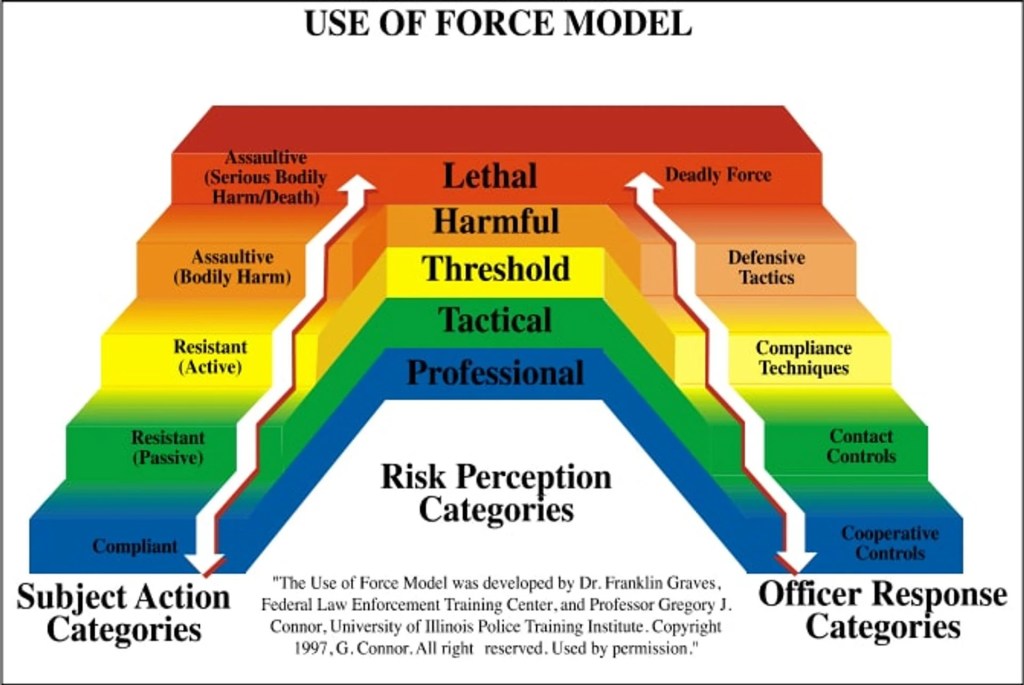
- Various other LEO trainers over the years saw fit to customize and redesign their predecessors’ continuums; as such, dozens upon dozens of increasingly complex proprietary versions in the form of steps, wheels, scales, pyramids, and matrices are floating around today. None of them are universally subscribed to, which is part of the problem. Despite wildly different formats, most make some effort to pair various levels of suspect resistance with appropriate force options available to arresting officers—if suspect does A, officer can do B. Keep that in mind.
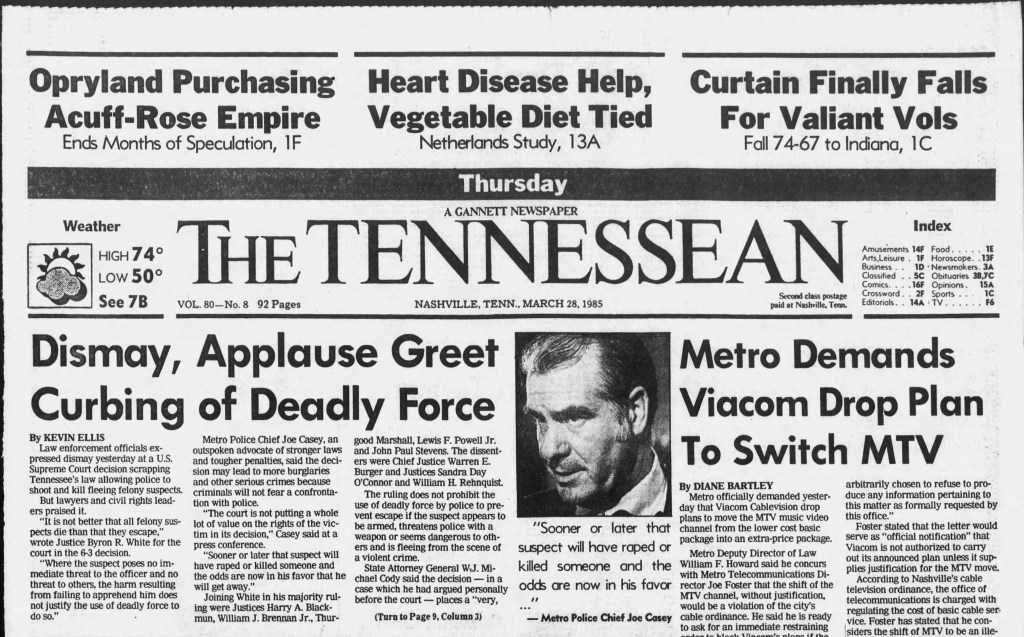
- In 1989, the landmark Supreme Court case Tennessee v. Garner ruled that a police officer can’t use deadly force to stop an unarmed, nonviolent fleeing felon because it violates the 4th Amendment. This might not seem super relevant to us, but bear with me.
- Four years later in 1989, Graham v. Connor established the objective reasonableness standard by which claims of excessive force and 4th Amendment violation would be examined. The Court held that, “the ‘reasonableness’ of a particular use of force must be judged from the perspective of a reasonable officer on the scene, rather than with the 20/20 vision of hindsight.” Moreover, “the calculus of reasonableness must embody allowance for the fact that police officers are often forced to make split-second judgements—in circumstances that are tense, uncertain, and rapidly evolving—about the amount of force that is necessary in a particular situation.” The phrase ‘totality of the circumstances’ that viewers of Active Self Protection are no doubt used to hearing from John Correia and Mike Willever was used in Garner and referenced in Connor.
- As a result of these two Supreme Court cases, a large number of departments and agencies have transitioned to teaching what is called 4th-Amendment-based use of force. Proponents of this approach say it obviates the need for any visual aid.
Not only was the legal standard set by Graham v. Connor arguably so simple so as not to need a supporting graphic, but the use of continuums creates plenty of problems in and of itself.
For starters, a two-dimensional, static diagram can never really reflect the dynamic, ambiguous, stressful circumstances in which decisions about which force option to use, and when, actually need to be made. Neat if-then statements rarely apply under those conditions.
Probably the biggest criticism levied against continuums is that they inadvertently lead jurors and even judges to conclude that an officer is legally required to progress through each step or rung sequentially, starting from the bottom. This is obviously not the case—they can bypass all lesser options and skip straight to lethal force based on the totality of the circumstances, if necessary. There is no legal obligation to start with the least forceful option; force need not be minimal to be objectively reasonable.
So, you see, there is a conflict between the informal ‘standard’—or rather, many standards—set by disparate, idiosyncratic, and sometimes conflicting continuums, and the actual legal standard officers are held to.
The pairing of a given action on the part of a suspect with a specific officer response is also problematic. Marker said it best:
“Traditional continuum-style training focuses on suspect behavior as a variable and the officer’s response as the constant. In contrast, amendment-based use-of-force training focuses on each officer as [a variable] and the suspect’s behavior cues as the constant. For example, at the WLEA, each individual officer must make a solo arrest in a dynamic force-on-force scenario…The scenario is performed thirty-six times, for thirty-six officers. Because the officer walking through the door is the ‘variable’ with differing heights, weights, strength[,] and abilities, there is potential for thirty-six different outcomes, with different force options, and they all could be reasonable” (Emphasis mine)
Furthermore, says attorney Randy Means in Peters and Brave’s article, “[continuums] inappropriately suggest that the officer’s response should be determined solely from categorization of the subject’s current behavior” (Again, emphasis mine). But what if, as is sometimes the case, police are pursuing a subject fleeing a violent crime they just committed, and this is known to them? Shouldn’t that play a part in determining the officers’ response? Of course, the answer is yes.
As self-defenders, our responses to an unknown contact or a known hostile party will probably be based largely on their actions in the moment…But not “solely.” Take for example a case that I mentioned in a blog post from 2024: a shootout between two neighbors in Indiana over a longstanding feud. It came to a head when one pulled a gun on the other.
While Weigle’s current behavior was probably the biggest contributor to Keller’s response, it was not the only contributor. The confrontation between the two men was preceded by years of harassment, threats, assault, police reports, and even a restraining order at one point. All of this no doubt influenced Keller’s response in the moment, as well it should have.
So What?
How is this relevant to us as self-defenders? If the use of continuums presents so many problems for LE, why try to adapt the concept for civilians?
I believe a continuum-like visual aid could still provide baseline practical guidance in when to use one tool or technique versus another without becoming unwieldly or confusing, as long as its inherent limitations are understood. The Pennsylvania Criminal Code tells us when the use of force is justifiable—nothing more. Beyond that, we don’t have much to go off of and could benefit from a basic template for pre-decision making.
As for Graham v. Connor, caution should be used in applying those standards to anything we do: any legal proceedings a self-defender finds themselves in will likely be to determine whether they’ve committed a criminal offense or are liable for a civil tort, not whether they’ve violated someone’s 4th Amendment rights. Because the nature of the inquiry is different, we would be judged by the statutory standard, not the Constitutional standard.
I think there are still things to be learned from the case, though:
- Just because we aren’t going to be searching or seizing in the capacity of a government agent—and, as such, can’t use ‘excessive force’ in the same sense a police officer can—doesn’t mean we can’t get ourselves in hot water by using more force than necessary. The elements of necessity and proportionality still apply.
- The PA legalese closely mirrors Graham’s language of objective reasonableness. While the word ‘objective’ does not appear as a modifier of “force [the actor believes to be] immediately necessary,” the preceding definitions specify that belief means reasonable belief. This shifts the meaning away from subjectivity.
- Attorney Robert Thomas points out in Peters and Brave that, “Fourth Amendment reasonableness does not require that an officer use the least intrusive means.” To my knowledge, this holds true for citizens. Anything is fair game for prosecutorial scrutiny, like why you drew a pistol if you were also carrying OC spray, for example. But so long as the force used was immediately necessary, proportional, and objectively reasonable, it doesn’t need to be the least available. That’s not to say that we shouldn’t try to use the least-forceful option when the circumstances don’t preclude it, though.
Some would argue that the only distinction between force options that could be considered quantitative is between less-than-lethal force and deadly force—and that, on either side of that line, all options are in effect equally forceful. Legally, I believe that’s true. For example, stabbing a person with a knife is no less “readily capable of causing death or serious bodily injury” than shooting them. Neither OC spray nor lesser forms of physical force are more “readily capable.”
And yet, I think presenting these options in a specific order can make sense and serve a purpose.
Civilian Model
If the continuum concept still has some merit—and I believe that it does—we are essentially left with three questions: what force options should appear on a version for civvies? In what order should those options appear? How should they be presented?
To answer those questions and ultimately create a civilian prototype, I’ll be working off of a sampling of several continuums and a few associated policy documents (keeping in mind that visual models, for those departments and agencies that use them, are not always technically considered to be part of the written policy). Among these are the only citizen-oriented adaptation that I’ve yet seen, proposed by co-founder of CCW Safe Mike Darter in a 2017 series of blog posts; this outline of an archetypal police use of force continuum from the National Institute of Justice (NIJ); procedural orders 12-06 and 12-08 from the Pittsburgh Bureau of Police manual; and a model use of force policy from 2021, published by the Allegheny County Chiefs of Police Association (ACCPA) and Allegheny County DA’s office.
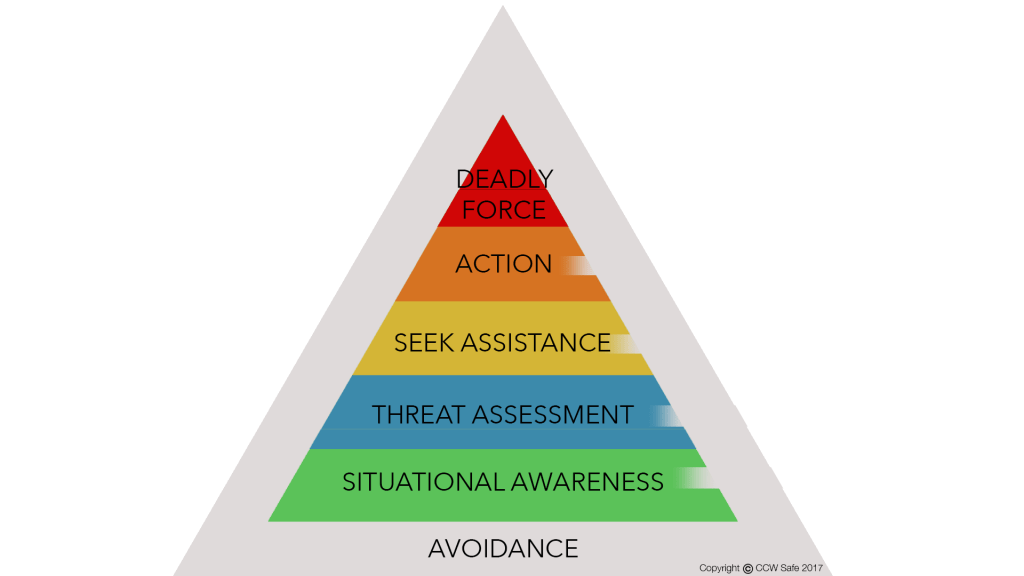
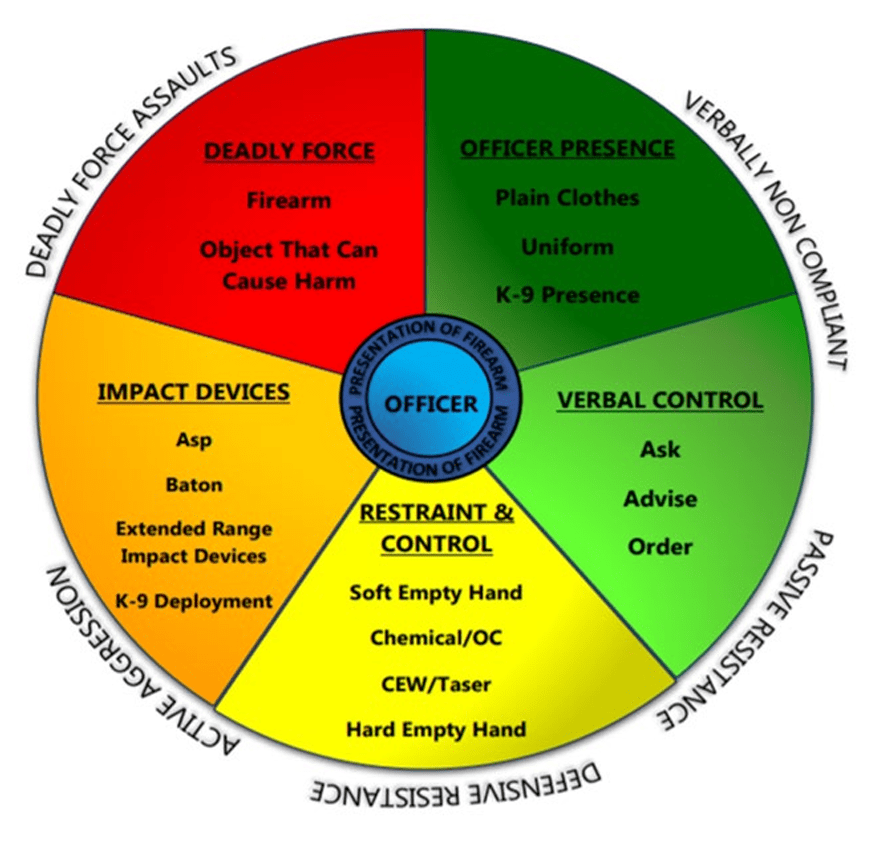
Here’s what I ultimately came up with:
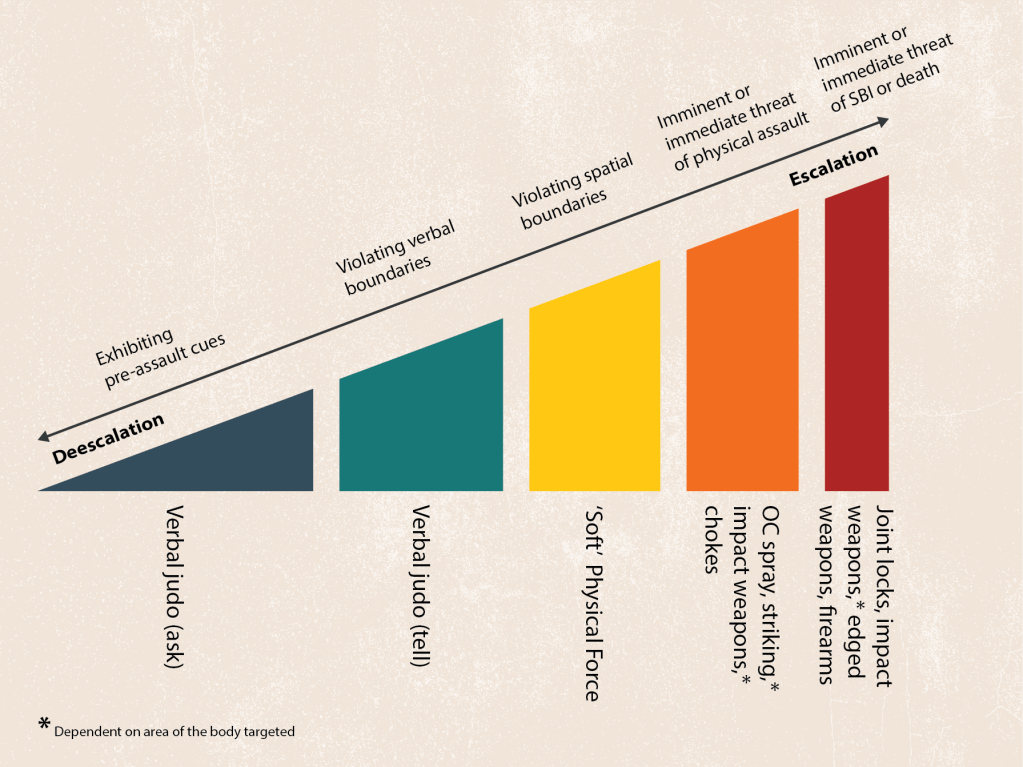
My priorities for the design were to create a continuum that would serve as (in order of importance):
- A ‘scale’ ranking tools and techniques from least to greatest amount of force and presenting them in the order I would choose to employ them in, based on what I’ve learned and the instruction I’ve received.
- A ‘menu’ of options that better reflect those available to self-defenders, since most of us don’t have a police canine or TASER in our back pockets.
Content
Here’s the stuff I put on the thing (and didn’t put on the thing) and why.
Note that the options listed within each step on the continuum—both in the writeup below and on the graphic itself—are presented in a specific order.
Verbal Judo
While we don’t have the luxury of backup and, as such, won’t regularly need to coordinate with allies, many of the principles and objectives of language use are the same for us as they are for law enforcement: to gain voluntary compliance and avoid pissing off the other party.
The NIJ continuum outline is the only LEO-oriented source whose gradations for this step reference differences in the volume and length of commands. Although our commands don’t carry the weight of the law, I believe this distinction is worthy based on the instruction I’ve received.
I can’t say at what point speech rises to the level of force for private citizens, but I’d hazard a guess that most language that could get a person charged with the crimes of terroristic threats or harassment would likely qualify. Even if ‘threats’ are made as warnings in a lawful defensive context—for example, ‘back up or I’ll be forced to pepper spray you, punch you, shoot you, etc.’—we should still consider that a use of force.
Craig Douglas has said that, if you’re not ambushed or blindsided, criminal assaults almost always start with language. Although verbalization can be employed at any point during an encounter to deescalate or create an opening to launch a counter-ambush, the Managing Unknown Contacts (MUC) stage of an ambiguous interaction is when tongue-fu will prove most important. In keeping with the ask-then-tell progression taught in ECQC and EWO, I divided what is in reality an unlimited range of verbal options into a binary of requests and commands. A self-defender would also be making use of arcing movements and the fence position while asking and telling, but I opted not to list those alongside verbal judo since they’re defensive in nature and don’t count as force options, in my mind.
‘Soft’ Physical Force
Like ice cream and skills, empty-hand techniques are often broken down into soft and hard varieties on police continuums. I chose to do the same.
Among ‘soft’ empty-hand techniques I count things like acquiring grips (wrist and bicep tie, collar tie, clothing grips); pummeling and the use of overhooks, underhooks, and head position to break posture and improve position; low-risk—at least, to the recipient—takedowns like foot sweeps, leg trips, and the split seatbelt.
Way back in March 2025, Brian from Shivworks put out a thoughtful newsletter on the subject of takedowns for self-defense. He categorized takedowns into low-, medium-, and high-risk categories, taking into consideration:
- The risk of injury posed to the person being taken down
- In relation to the above, the ability of the person initiating to control the descent
- The risk posed to the person initiating based on the required level of physical connection with the person being taken down and the control of their hands, or lack thereof (since we are discussing this in the context of a weapons-based environment with the potential for multiple attackers)
- The level of skill and athleticism required to execute a given takedown
- The likelihood of success
For my purposes, the foremost bullet point is the one that will determine where a particular takedown gets placed on the continuum. For example, an explosive double-leg or suplex will still be considered high-risk—just not because it leaves the opponent’s hands uncontrolled.
In my post on OC spray, I made passing mention of the infamous case of Daniel Penny, who was charged with manslaughter and, later, criminally negligent homicide after putting a man in a chokehold on a New York subway.
The generally accepted difference between a chokehold and a choke, as we know them in jiu jitsu, is that chokeholds “apply pressure to the throat or windpipe and restrict an individual’s ability to breathe,” whereas chokes occlude the veins and arteries in the neck to restrict blood flow to the brain until unconsciousness (quoted from the DOJ).
Following the deaths of Eric Garner and George Floyd, it appears that many departments and agencies have procedurally restricted the use of either technique unless the requirements for deadly force have been met. Based on this layperson’s review of some of the scientific literature, I’m not so sure this policy shift is as evidence-based as it is political.
What is commonly termed a vascular neck restraint (VNR) seems to be a rear naked choke variation historically used to either make resisting suspects either comply or put them to sleep so they can be cuffed.
- One of the first sources I stumbled upon was an article from JAMA Neurology by Berkman et al. that frames itself as something of a position statement on behalf of all neurologists. The authors claim in very explicit terms that there is no safe way to restrain a person with carotid manipulation. None. Furthermore, they assert that “The possibility of devastating repercussions is too high to merit the use of neck restraints in any circumstance.” Ignoring the spectacular reductionism at play in the phrase “any circumstance,” that doesn’t seem to be the consensus among the science hippies…
- Through Force Science Institute, I next found research conducted by Bozeman et al. and published in the Journal of Forensic and Legal Medicine. Although the authors’ “findings do not exclude the possibility of a rare serious complication or guarantee safety if the technique is not applied correctly,” the paper—which reviewed almost a thousand VNR applications—seems to suggest the incidence of such serious complications is rare.
- I also looked at a very small (n=11) study by Stacey et al. from the Scandinavian Journal of Medicine & Science in Sports. They hypothesized that BJJ players would have comparatively lower cognitive performance than sex-, age-, and BMI-matched controls due to repeated exposure to chokes—that is, interrupted blood flow to the brain. Not only was their hypothesis disproven, but they actually concluded there might be “preconditioning” associated with intermittently, repeatedly depriving the brain of oxygen. The technical jargon puts further explanation beyond me, but a full-text PDF is available online if you feel like learning more.
- PT Mike Piekarski (@doctorkickass) summarized the results of yet another study by Stellpflug et al., published in the The Physician and Sportsmedicine. Stellpflug gathered data from a self-report survey’s 4307 respondents, concluding that the vast majority of BJJ players choked unconscious had no lingering symptoms after 24 hours.
- Finally, I saw this literature review by Gartenberg et al., published in the same journal as Stellpflug above. Although I wasn’t able to get my hands on a copy of the full article, the abstract shares that the authors concluded, “The current literature appears to demonstrate an acceptable safety profile when the VNR is performed properly.”
There is evidence that serious complications like carotid dissections and strokes can and do happen when chokes are applied both in sport BJJ and by law enforcement, often presenting after a delay. These seem to be the exception rather than the rule. Regardless, does this mean they should be considered lethal force?
In my opinion, probably not. Chris Leblanc, a Shivworks alum with black belts in BJJ and judo and 25+ years of law enforcement experience, referred to the VNR as, “the most useful, effective, non- or minimally injurious control tool that [can be used effectively by] people who are not otherwise well[-]trained.” While blood chokes theoretically risk damaging the trachea if applied incorrectly, I wasn’t able to find any information on how often that happens or how easy it is to fuck up that badly, for lack of a better way to put it.
Overall, I would err on the side of caution, considering the overwhelmingly negative optics associated with any technique that normies would call a chokehold; however, I’ve found no evidence to suggest chokes pose a significant risk of serious bodily injury or death every time they are used. Honestly, the bigger considerations are whether you want to risk the level of attachment required and cede control of the hands in a weapons-based, multiple attacker environment.
‘Hard’ Physical Force
Big disclaimer up front: because saps and blackjacks have enjoyed somewhat of a renaissance among combatives practitioners within the last few years thanks to trainers like Guy Schnitzler and professional students like Mark Luell, I’ve included them on my civilian continuum. However, based on how I currently read Pennsylvania’s statute on prohibited offensive weapons, “any blackjack [or] sandbag” is considered an “implement for the infliction of serious bodily injury which serves no common lawful purpose.”
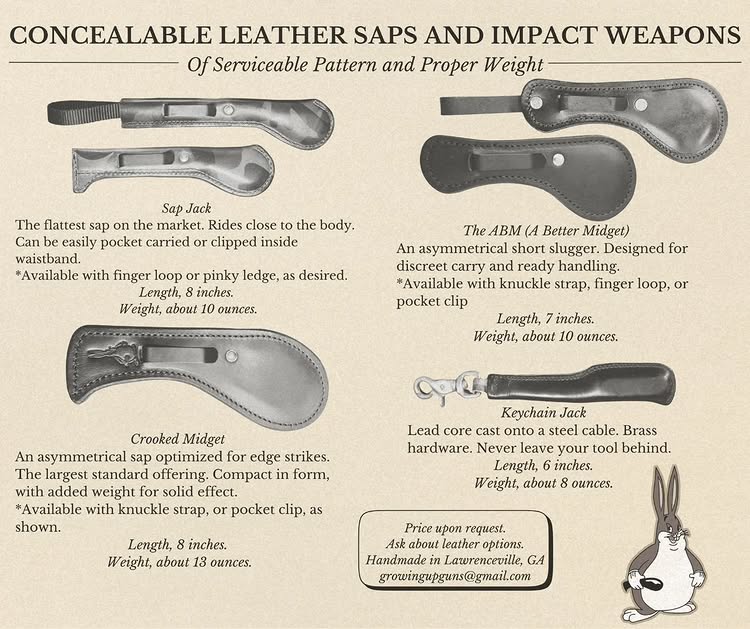
No, this is not a professional interpretation of the law. Yes, saps, slungshots, monkey’s fists, and coshes are technically different than blackjacks. Do I think this would matter to a DA if you cracked someone upside the head with one, even in justified self-defense? No. In fact, I fear it might be considered a deadly weapon per se, meaning one that is understood to be inherently deadly regardless of the manner in which it’s used. Know your local laws and do what you will. I’m not your real dad.
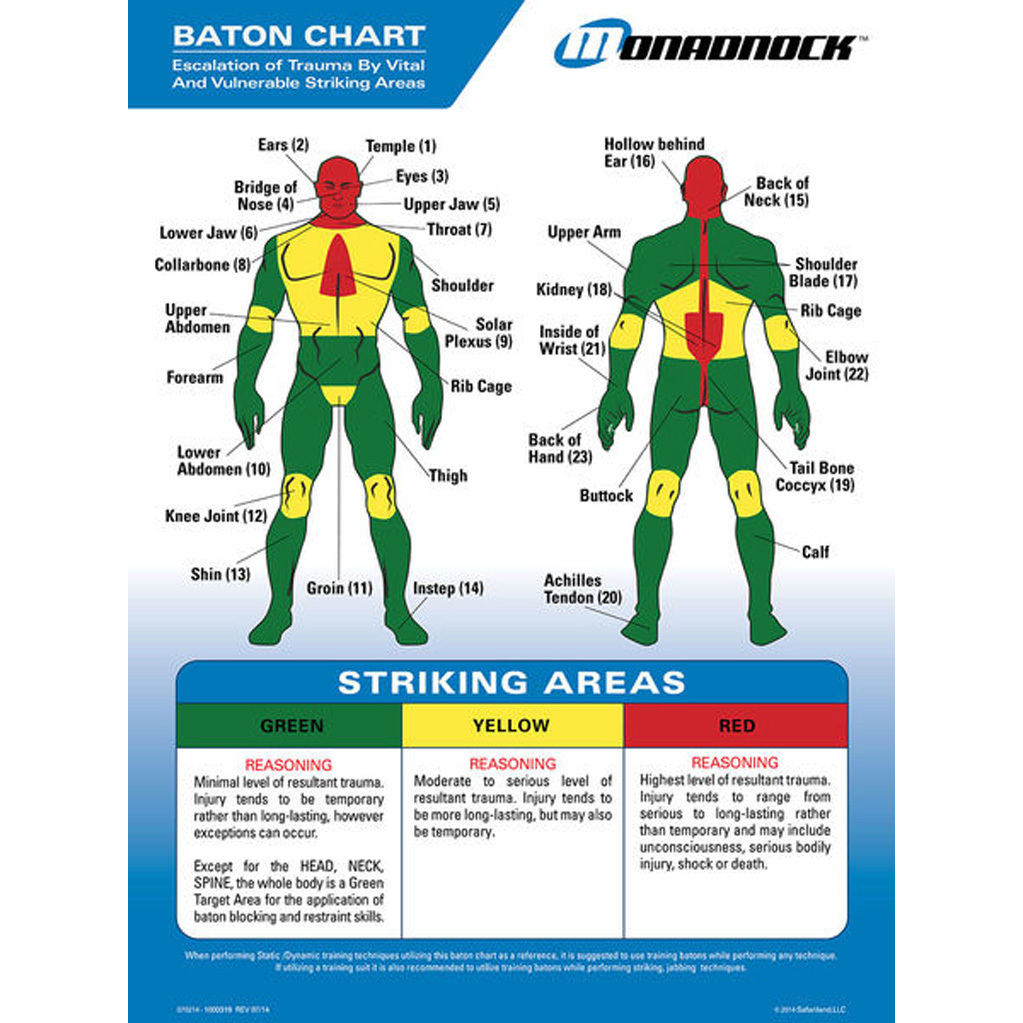
In the category of ‘hard’ empty hand techniques, I include OC Spray; techniques like the eye jab; most striking with open hands, fists, feet, knees, and elbows*; high-risk takedowns; and impact weapons.* As in the visual, the asterisk indicates that that ranking depends on what area of the body is targeted.
As for impact weapons, credible sources detailing where and how to strike are as scarce as hands-on instruction (for civilians, at least). Most of the guidance out there is tailored to collapsible batons—do any cops still get issued nightsticks or billy clubs?—but we can extrapolate to saps, blackjacks, coin saps, etc.
Generally, the hierarchy of targets seems to start with major muscle groups, progress to joints, and end with the head, neck, and spine. Strikes directed at any of the latter grouping are considered deadly force in both the ACCPA’s model policy and the LVMPD’s policy, for reference.
Deadly Force
I place joint locks, impact weapons,* edged weapons, and firearms in this bracket. The same ‘target dependence’ caveat applies.
It baffles me that some police sources consider joint locks to be ‘soft’ physical force.
I understand that joint locks can be used to gain control over a resisting subject, in theory. But I would point out that every time we drill armbars in BJJ fundamentals, coach makes a point of telling the new students to tap when they feel pressure and before they feel pain. That leaves a very narrow window for pain compliance; plus, reacting the wrong way can make a submission go on even quicker. Add individual variations in flexibility (or lack thereof) to the mix, and it seems like a risky proposition.
As I wrote back in my first ever post about BJJ, a dislocated elbow, a spiral fracture of the humerus, or a torn ACL would almost certainly be considered serious bodily injury (SBI), which—in Pennsylvania, at least—is tantamount to deadly force. Thus, I’ve placed joint locks alongside knives and guns.
Visuals
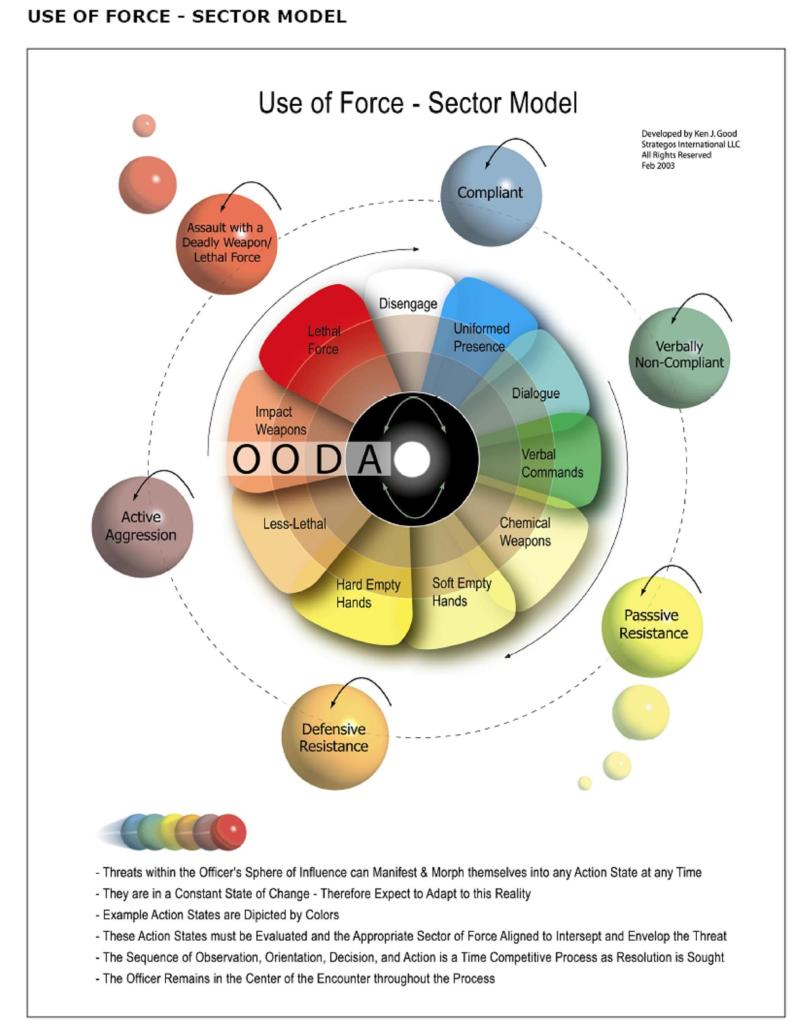
Communicating with images is quite literally a science unto itself, but it doesn’t take an academic to conclude that some of the continuums shown earlier in the post just plain suck. Still, I thought it might be interesting to see what a scholarly source would have to say about the best format for a police UOF visual model.
In this review, Di Nota et al. looked at three examples: the province of Ontario, Canada’s circular model, a cyclical model used in British Columbia’s mandatory Crisis Intervention and De-escalation training, and the Las Vegas Metropolitan Police Department’s (LVMPD) staircase-style model. They conclude by offering some general recommendations for the design of UOF visuals.
Here’s why I did what I did, design-wise:
- After considering the possible layouts, a horizontal, linear continuum was the only kind that made sense based on my goals. The circular, cyclical, and matric models shown above are either simplistic or wildly overcomplicated. A Y-axis was needed to convey differences in the ‘amount’ of force. Although the left-to-right progression of a linear continuum does to some degree imply deadly force is an inevitable endpoint, I trust my readers to know this is not the case. I included a bidirectional escalation-deescalation arrow like those that appear in some other models to try and get this across.
- I deliberately ignored Di Nota et al.’s guidance to use black and white graphics in favor of following the style guide I created for the blog. This was not done to exclude any colorblind readers. Furthermore, printing and distribution costs aren’t a factor for me.
- While the use of red for the ‘lethal force’ segment could be said to de-emphasize lesser force options displayed in other colors, Di Nota et al. acknowledge that this is standard practice with police continuums. I trust my readers to know that less-forceful tools and techniques are preferable (total avoidance even more so) even though they’re shown in less “perceptually salient” colors.
- Note that the height of the segments is meant to represent the level of force each set of options might reasonably constitute, not the likelihood of needing to use them. While the ‘deadly force’ segment of the spectrum is the tallest, it is also the narrowest to reflect the comparative infrequency of lethal threats to those that can be solved with less forceful tools and techniques.
This gets to one of the authors’ most harped-upon points: that “each type of force…should be represented proportionately to its occurrence.” For instance, one criticism of the LVMPD’s model is that, because the ‘deadly force’ step is the highest on the staircase, it might be subconsciously interpreted in the same manner as a bar graph in which police officers use deadly force most often out of all their available options.
As the reader may know, the number of private citizen defensive shootings to statistically occur in any given year has not only been the subject of intense debate since Gary Kleck’s work in the ‘90s, but is basically impossible to prove. Estimates hover around several million annually. I am confident in saying that data regarding the number of instances in which people defend themselves with physical force is even less attainable. However, I believe we can safely assume that civilians are involved in more verbal and physical confrontations than deadly ones. Thus, I would argue my continuum represents the difference types of force proportionately for our non-scientific purposes. - 90-degree rotated text isn’t the most user-friendly, but keeping the force option labels vertical seemed to make the most sense based on the format I had going. I tried canting them at 45 degrees but didn’t like that as much.
- In their critique of the LVMPD’s continuum, Di Nota et al. correctly point out that, “Suspect behaviours and appropriate force options are visually represented in discrete categories but are much more ambiguous in real-world contexts.” No doubt, a gradient would have been the most appropriate way for me to convey the lack of clear distinction both between an unknown contact/violent criminal actor’s inciting actions and a self-defender’s force options. As you’ll recall, though, arranging those options in a hierarchy was kind of the point. While real-life decision making isn’t so simple, I think it’s logical start from a baseline of having at least a first resort, second resort, and so on and so forth.
Limitations
- As Emilee Green and Orleana Peneff write for the Illinois Criminal Justice Information Authority (ICJIA), violence occurs in “ever-evolving situations that cannot be neatly transposed to a static continuum.” Those situations are too dynamic to be diagrammed by what is essentially an if-then flowchart. Even though what I’ve done differs slightly in its aim, it is good to remember this.
- Ranking force options quantitatively is kind of moot, because the courts will ultimately decide ‘how much’ force you used and whether or not it was immediately necessary, proportional, and objectively reasonable.
- While none of the sources I referenced explicitly stated that UOF models like continuums are meant to be used to guide decision making in real time, some made passing allusions or implications about more complex models being “difficult to apply or recall in a combative situation in the field” (a quotation from attorney Mike Stone in Peters and Brave). I don’t think it would be speaking out of turn for me to say that you may want to develop your tacit understanding of when it’s appropriate to use which force option beyond the point where you need to mentally reference a diagram. This is best done in force-on-force training beforehand. Consulting a continuum is probably not wise in the heat of the moment.
- I listed only tools commonly carried by serious self-defenders on their person in the context of EDC. Not only does this not include defensive long guns like rifles and shotguns staged for home defense, but it also excludes one of the most powerful lethal options we have available to us: cars. Are there circumstances where putting someone over the hood or under the wheels could not only be justifiable but make perfect sense in the moment? You betcha. Cops do it with some frequency. Unfortunately, though, there’s just no way to account for every improvised tool or weapon of opportunity.
- Similarly, my knowledge of striking arts is virtually nonexistent, and even my exposure to the breadth of guards, submissions, and takedowns in jiu jitsu is no doubt massively limited. While it would probably not be practical for a civilian force continuum to account for every one of these techniques anyway, I’m sure far more options exist than those appearing on mine.
Conclusion
Thanks for reading! I spent probably a few dozen hours researching for this post, so hopefully you got something out of it.
What do you think: are there other options you would have included on a continuum for private citizens? Would you rank any of the options discussed differently? Let me know what you think in the comments.
Special thanks to my wonderful girlfriend for being my sounding board over the past few months as I grappled with how to organize this post.
I’ll update this post with a full bibliography. I hate citations.
 Fire Carrier Defense