
Welcome, friends.
This blog post is the first installment in a two-part series about my inaugural ECQC experience. Part 1 will cover the curriculum and my takeaways from the course; in part 2, I’ll take a hard critical look at how I performed in the evolutions, provide a breakdown of several other choice scenarios my peers were involved in, and do some personal reflection on what my training and practice should look like moving forward.
Synopsis
Shivworks is widely considered the gold standard in training for integrated grappling, bladecraft, and pistolcraft, a discipline broadly known as combatives. ECQC, their flagship course offering, is described as follows:
“Extreme Close Quarter Concepts is a two-and-a-half-day (20-hour) block of instruction that offers a multi-disciplinary approach to building functional, combative handgun skills at zero to five feet. The course is designed to instill core concepts to avoid, stabilize, and resolve a problem at arm’s length or closer. We instruct a simplistic and congruent system. Once students’ skill sets are ingrained, they will be stress-inoculated with force-on-force drills using marking cartridges and protective equipment.”
The class ran from Friday, October 4th to Sunday, October 6th and was hosted by Judd Ekis of Know H.O.W. Dynamics at Logan’s Ferry Sportsman’s Club in New Kensington, Pennsylvania.
At $749 plus a $60 range fee ($20 per day) ECQC currently holds the rank for the most expensive training course I’ve attended.
Teaching the class was none other than the legendary Craig “SouthNarc” Douglas and full-time co-instructor Brian Frias. We also had Asia of Katalyst Krav Maga assistant instructing, with passive support and guidance from James Ash, Jeff Bloovman, and my mentor-by-proxy Shawn Lupka, who are all Shivworks veterans.
My peer group was a motley mixture of my coaches, training partners, a few cops, and a handful of people with little formal training of any kind—firearms or otherwise. Among them were my mentor Derreck Almasi and my friend and fellow well-rounded white belt Chris Faraglia. The professions of those attending included a doctor (MD, not PhD or DDS), an electrician, a truck driver, a financial analyst, and a menagerie of IT/tech guys. As is to be expected, the vast majority of the class was male. Only two women attended.

Day 1
The first four-hour block of instruction laid the groundwork for everything that would follow. While the broad topic on the itinerary for Friday night was Managing Unknown Contacts (MUC), we were certainly not dropped into the deep end with helmets and sim guns right away. Craig and Brian have the progression of the course down to a science: the sequence of concepts, drills, and demonstrations was carefully orchestrated to maximize accessibility, and this was on full display from Day 1.
Craig began by providing an overview of the criminal assault paradigm, “or ‘how bad guys do business.’” This was a shrewd look at the ‘what,’ ‘when,’ and ‘how’ of violent crime.
As Shawn notes in the above blog post, this portion of the course is taught using the Socratic method, which you would think I would have picked up on given that I spent an entire fucking semester of grad school studying rhetoric. This cooperative teaching technique involves posing open-ended questions to create collaborative dialogue—a much better way to get students engaged with a lesson than passive lecture.
Craig identified the two core themes of the criminal assault paradigm as unequal initiative and unproportional armament. Generally, the defender/victim is at an initiative deficit because they either don’t see the problem coming in time (or at all), or do see the problem coming and misinterpret what they are seeing. Additionally, by approaching a defender/victim when their attention is elsewhere—and by using distracting questions—criminals leverage task saturation and task fixation against us to strike at vulnerable moments.
These realities contribute to the condition of unproportional armament. Proportion here refers not to size or number (although the use of long guns in crimes is not unheard of, nor are group attacks) but to accessibility: a defender/victim may very well find themselves at the end of the bad guy’s muzzle while their own pistol is still concealed.
Three other commonalities are that these assaults happen at very close ranges, often involve more than one criminal actor, and always presume the presence of weapons even if none are visible.
After this prelude, the remainder of the night was divided between technical and further conceptual instruction. In a broad sense, Friday was dedicated to imparting and reinforcing three principles that form the bedrock for much of the Shivworks curriculum:
- Distance and reaction time are directly related. As one increases or decreases, so does the other. Expressed as a mathematical equation, it would be a simple statement of equality in which range = time.
- Language applies friction. This can contribute to task fixation and task oversaturation. Humans are bad at multitasking, among other things; this is why it’s important to have pre-rehearsed responses cued up in a playlist or tape loop, as Tom Givens calls it, with which to address and respond to unknown contacts.
- The two overarching directives in a physical confrontation are to stay conscious and stay upright. The latter is crucial to the former. On the ground, you forfeit your mobility and the possibility of escape while letting your opponent use gravity to assist their striking and top pressure. Not to mention, being taken to the ground in the first place can involve being dropped on your head and neck or your skull rebounding off of pavement.
Distance, Time, and Options
Drilling the verbal agility and positioning aspects of MUC hammered these ideas home. Craig led us into the topic of managing distance between ourselves and an unknown contact by asking whether minor changes in distance matter. Obviously, he said, major changes are significant—10 feet to 5 feet, or 3 yards to 3 feet, for example. But what about minor changes? Should we respond to those?
He pointed out that, in fact, we already do. Behind the wheel, we adjust following distance based on things like heavy traffic or poor road conditions. We see brake lights one car length in front of us, and we slow down. This is the unconscious level of distance management we were encouraged to begin practicing on foot.
A series of four drills designed to simulate a sucker punch emphasized the stakes of failing to do so while also giving us a better firsthand appreciation of that distance-reaction-time relationship. These drills also gave us a chance to practice maintaining an active fence: a term coined by Geoff Thompson to refer to a nonaggressive defensive hand position with the palms outturned and the arms raised relatively high and compressed. Often, this can be disguised in an innocuous way with gesticulation and animated speech.
We also examined the default position, which I would describe as a protective posture assumed by level changing, widening the stance, tucking the chin, rolling the shoulders up and forward, and wrapping one’s arms around the head to form a sort of cage. All of this is done to serve those two overarching directives of staying upright and staying conscious. It is said to be non-diagnostic in that it is meant to be assumed automatically, in circumstances where there is no time to determine what direction blows are coming from, whether a tool is in play, or whether there are multiple attackers. It is an immediate reaction rather than an assessment-based response.
Shawn has described the default position as a “primary motor skill” because all of the motions described above can occur at once, functionally making it a single movement.
Now that we understood the advantages of distance, it was time to practice maintaining it. We were shown to move in an arc when approached rather than back straight up, circling to our 3 or 9 o’clock to keep eyes on the primary unknown contact while checking for any flanking accomplices. By doing this, you avoid being ‘herded’ towards an ambush or being jumped while looking over your shoulder. It’s also a very abnormal movement pattern that, in and of itself, might be strange enough to deselect you.
Verbal Judo
At the most basic level, the objective of using language as a tool during the MUC phase of an encounter is to do one thing: get the unknown contact to stop moving towards us. Here are some of my notes from Craig’s instruction on communication:
- When initially addressing an unknown contact, avoid phrases like, “What can I do for you?” and “Can I help you?” as these could be seen as forms of invitation. We want to set boundaries, not invite.
- Begin with a level-volumed request that is authentic to you. After that, dialogue may be an option; do not, however, make conversation while distance is being closed.
- Next, if asking doesn’t work, tell them to stop with elevated volume in a clipped, jarring tone of voice. You can use a carrot-and-stick method to either lead with an aggressive command and follow up with a gentler request to comply, or vice versa. For example, “STOP! [Then, at a lower volume,] Don’t come any closer, man. If you stay where you are, we can talk.”
- Keep in mind that there may be a legitimate reason an unknown contact is not heeding your request to stop approaching. They could be cognitively impaired by drugs or alcohol, deaf, or there may be a language barrier. They may be on the autism spectrum and have different concepts of personal space and difficulty reading social cues.
- On the issue of profanity, Craig’s advice was something to the effect of, “If you don’t normally swear, [managing an unknown contact] might not be the best time to start.” It will sound awkward, unnatural, and fake; your bluff will be obvious.
It’s also critical you avoid insulting the other party. This ground rule became an issue the very next day during one of the evolutions I’ll discuss in part 2. My philosophy is this: use obscenities, like Spongebob suggested, as sentence enhancers.

Stranger Danger
Although the ‘who’ of the criminal assault paradigm was not the focus of this lesson, this is not to say that the matter went totally unaddressed. As I discussed in the blog post on minors as unknown contacts, knowledge of the demographics and average biographical profile of a criminal does serve a purpose, but none of that information is as sure an indicator of potential ill intent as actions are. As such, it’s more reliable to assess a possible threat based on behavior than appearance.
We tell kids ‘stranger danger,’ Craig reminded us. We don’t tell them, ‘watch out for men between the ages of 18 and 35, of such and such a race, dressed in such and such a way,’ and so on. The virtue of ‘stranger danger’ is its indifference to externals.
The virtue of ‘stranger danger’ is its indifference to externals.
This led us to a discussion of the specific behaviors that merit concern when observed in an unknown contact. Brian and Craig choose to focus on four pre-assault cues that they feel are the most significant and well-documented: grooming, picking, target glancing, and a definitive weight shift. Experienced viewers of recorded violence will likely recognize these body language elements as red flags.
“Recognizing & Interpreting Pre-Attack Indicators” by Shelley Hill, Shooting Illustrated
Next, we got in-context practice picking up these pre-assault cues while applying our verbal skills and maintaining distance. By this point, we had resorted to illuminating the range with the headlights from Judd’s car. This also underscored the difficulty of MUC in adverse lighting conditions. And, unfortunately, when training you can’t just whip out your pocket sun and scorch your partner’s retinas.
One of the last techniques we looked at on Friday was the eye jab.
The eye jab is billed as a preemptive hand strike with little potential to cause serious bodily harm; the worst injury one could likely expect to inflict, according to Craig, is a corneal abrasion—essentially, a scratched eyeball—which is minor and heals in about a week. You have to admit, a bloodshot sclera looks a lot better to a jury than a plaintiff with a wired-shut jaw, drinking their meals through a tube. That is, if you can afford to make it to a jury trial.
Craig, who was just as full of quotable aphorisms in person as he is on the internet, commented: “You can’t tense up and take an eye jab. Nobody has muscular eyes.”
Note that an eye jab, as taught by Craig, is not the same as an eye gouge. If you are in a lethal force encounter and the totality of the circumstances warrant jamming your thumb knuckle-deep in an attacker’s eye socket, do whatever you deem necessary and are prepared to explain after the fact. But that is a different animal entirely.
Craig considers MUC the most useful thing Shivworks teaches. It helps a person avoid the majority of defensive problems, defuse the ones can’t be avoided entirely, and leaves you ready to respond to the remainder that can’t be resolved without violence.
Day 2
Saturday was the longest and most grueling of the three days, running from 8:15 AM until after 7:00 PM.

Craig opened with a safety brief, during which we laid out a thorough, detailed contingency plan, ensuring everyone knew the range address, assigning primary or secondary emergency drivers who knew the local roads, identifying the most qualified primary caregivers, outlining what to expect from responding EMS and LEOs, and noting the location of a large trauma kit brought by Craig and Brian. Students and instructors alike should consider this a template for how the ideal safety brief for a live fire course is conducted.
During the first live fire block, we went over Shivworks’s version of a four-count draw. This drawstroke prioritizes robustness over speed. It allows a defender to compress or extend the pistol appropriately based on target distance and shoot at any point between retention and full presentation. For me, a right-handed shooter carrying AIWB, it looked like this:
- A full firing grip is established with the heel of the palm making good contact with the backstrap; the cover garment is cleared high, vertically aligned with the sternum, and pinned in place by the support hand, which is ‘parked’ in place against the chest.
- The left hand remains parked and out of the line of fire as the pistol is drawn and comes straight up and back such that the thumb of the dominant hand makes connection with the pectoral muscle. The pistol is canted slightly outward so that the slide can reciprocate freely alongside the ribs. The elbow of the dominant arm is cranked high upward to the rear with the traps and scapulae engaged. The wrist and forearm are locked straight to prevent wrist abduction/adduction and flexion/extension, which would introduce inconsistency in the point of impact. This is known as thumb-pectoral index.
- The pistol travels across the pectoral to the sternum and meets the parked hand to build a full two-handed grip. The arms are fully compressed while leaving enough standoff for full travel of the slide to the rear. At this point, the shooter should have a coarse visual reference for where the pistol is pointing and be able to see the shape of the backplate and slide in the bottom of their foveal cone.
- Full extension and normal sight picture.
The thumb-pectoral index is Craig’s trademark. Shooting from this position places shots on the target anywhere from the belly button to the groin but will generally land rounds in the pelvic region, although this varies somewhat based on body proportions. It is critical to remember that shooting from retention is not done with the hope of inducing a physiological stop but diminishing the attacker in order to make space. At that point, you have the option to shoot from position 3 or full extension for grossly aimed or sighted hits that are more anatomically significant.
After lunch we progressed to the wrestling block of instruction. Preceding this, we were given a pat down to ensure no pistols or live blades made their way into the mix while drilling. We also divested ourselves of any other potentially pointy objects like keys or writing implements. Everyone was frisked again any time the class broke and reconvened.
We examined the so-called three Ps of grappling in the clinch—pressure, posture, and position—through a number of ‘training wheels’ exercises, including the pummeling drill and mountain goat drill. Those not already familiar with underhooks, overhooks, and wrist and bicep ties were introduced. Brian did an excellent job of explaining that the person with inside position has the advantage in terms of postural stability and weapons access.
Once everyone demonstrated basic competence, Brian and Asia taught a variety of techniques including the duck under, arm drag and arm bundle, and the two-on-one split seatbelt. They used a warmup called the scarecrow drill to get us comfortable with the mechanics of the duck under.
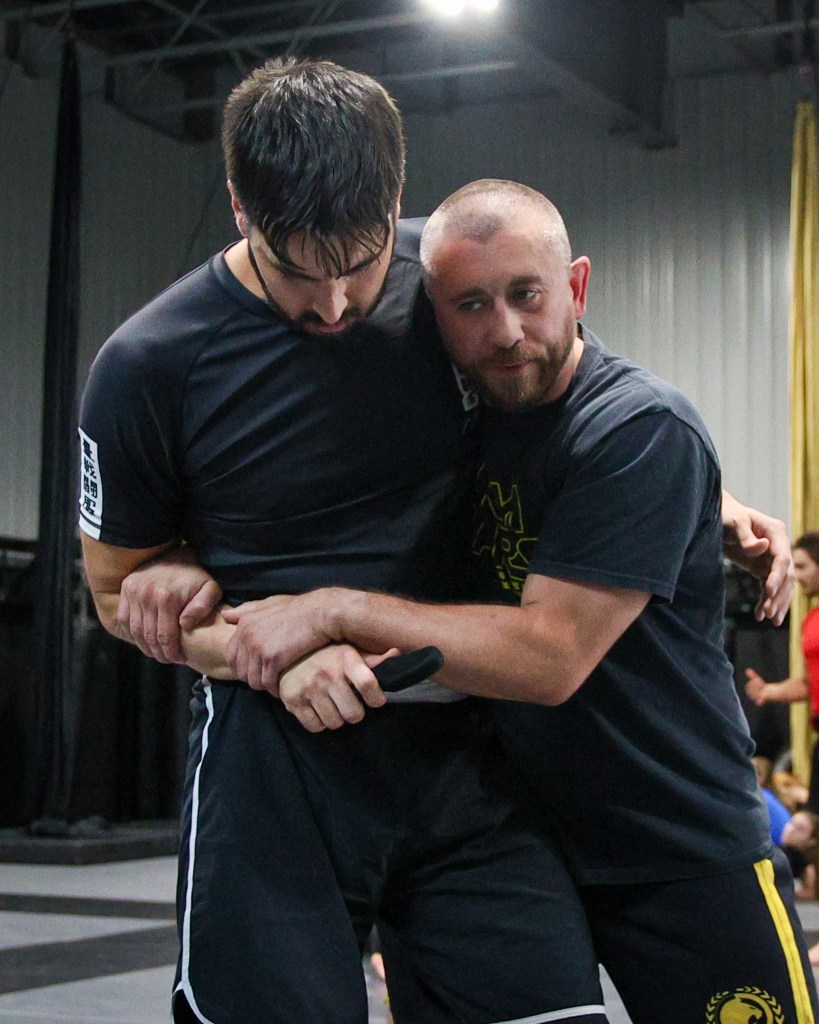
Technical instruction segued into a discussion of in-fight weapons access (IFWA): the act of, and requirements for, drawing a tool in an entanglement.
There are two rules for successful IFWA: control the limb of your opponent closest to the gun and avoid ‘floating’ the gun. Good timing cannot exist without control, even in a dominant position like mount or back control. Floating refers to an attempt to fire the pistol in a clinch without the visual reference of a sight picture or the physical reference of the thumb-pectoral index, in a partially extended arm pointed independently from your body.
According to Craig, this is sometimes seen in evolutions when people get their back taken and try to reach around themselves, over their shoulder, or even between their legs to point the sim gun at their opponent. It can also occur when an opponent stuck in a split seatbelt tries to spin away in the direction of the underhook. To float the gun is to give up all the defensibility and hit predictability of thumb-pectoral index while, at best, possibly flagging yourself and innocents or, at worse, shooting a bystander.
Centered Guard
As someone who often finds themselves both in bad positions on the mats and futilely attacking upper belt seated guard players, the groundfighting portion of the day was very interesting to me.
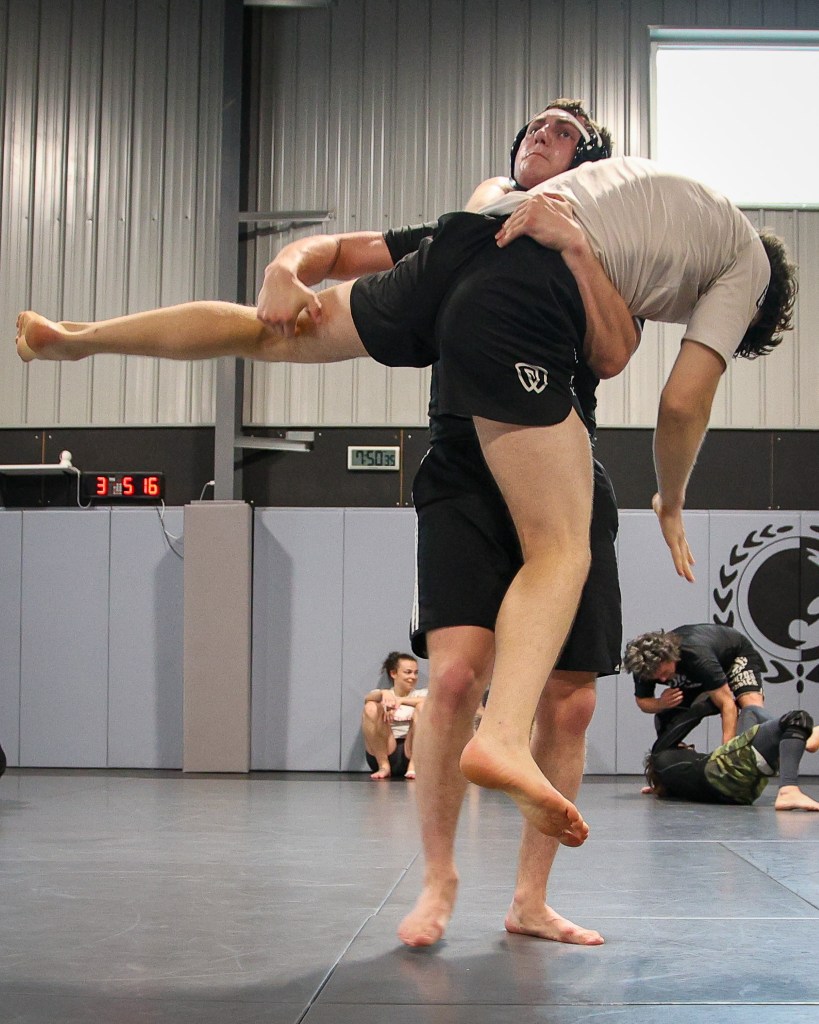
In the Shivworks conceptual schema, the ground is not a place you choose to go in order to butt-scoot into leg entanglements—it’s a place you find yourself after getting knocked on your ass, where your objective is to survive long to get up, preferably right the fuck now. All of the techniques shown during this block of instruction were conceived of and presented with this in mind.
With that being said, Craig did opine on day 1 that ‘all fights go to the ground’ is only true if a person has shitty posture and can’t sprawl on a shot or defend a takedown. It’s not the inevitable outcome it’s sometimes made out to be, though.
Brian demonstrated what they call centered guard: an open, supine guard with retracted legs, planted feet, and wide-flared knees that retains the compressed fence from the standing MUC repertoire. Flaring the knees permits safe(r) shooting from position 3 or a thumb pectoral index. Rounding one’s shoulders forward minimizes upper back contact with the ground, which makes swiveling to remain squared to an opponent easier on high-friction surfaces like pavement. Likewise, Brian offered a more robust technique for turning when supine. By posting the foot opposite the direction you want to turn, bridging to lift your hips, and then digging with the bottom edge of the other sole, a person is able to turn themselves even off the mats where you’re not able to backspin like a breakdancer.
We touched briefly on the viability of kicks from the bottom. While Shawn is a vocal proponent of upkicks and includes them in his curriculum at Stout, Brian expressed that he was not a fan for several reasons. First of all, not everyone has the requisite athleticism and hip mobility to pull one off. Secondly, the head is a relatively small (not to mention moving) target, and missing an upkick could easily leave you with your guard passed. He also mentioned that there have only been two finishes from upkicks in UFC history.
We also looked at a variation of the technical get up/technical stand up that was essentially a Turkish get-up (a total-body exercise usually done with a kettlebell or dumbbell). While the opposite-hand-and-foot method is fast, it would be near impossible to do while bearing weight. It also leaves one’s head at the perfect height for a devastating knee or soccer kick, either of which would likely be fight-ending, if not life-ending.
First Evolution
The first evolution of the class entailed one participant starting grounded in centered guard with a concealed sim gun and the other standing over them. If the attacker on top either felt or saw the defender’s sim gun, they were allowed to attempt to disarm them. Submissions were off-limits but open-handed strikes were permitted. This was prefaced by a pointed discussion about how much force to use and what was and was not acceptable from the standpoints of safety and sportsmanship.
As you might expect, the participants with grappling experience dominated these evolutions by a wide margin, passing guard to rapidly advance to mount, making use of textbook gi collar and sleeve grips on sweatshirts and hoodies, and sweeping to reverse position. Often, sim guns that were tucked in grounded participants’ waistbands fell out or became dislodged in the scuffle. At least half the time, this went totally unnoticed by anyone other than the spectators.
It’s worth noting that students who carry a Glock 17, 19, or 26 and who chose to use their own holsters during evolutions did not have this problem. Kydex holsters for double-stack 9mm Glocks should be compatible with the Glock 17T simunition pistols used in the class, provided they are open at the muzzle to accommodate the extra slide length.
So, in addition to the logistic advantages of cheap magazines and plentiful replacement parts, sim gun analogy is another thing Glocks have going for them. This is a niche benefit, to be sure, and not one that is necessarily consequential enough on its own to factor into your decision when shopping for a defensive pistol. Still, an EDC gun that feels and handles like a common force-on-force tool is great for realism.
Day 3
Sunday was less physically taxing and less technique-heavy than the previous day. We began by finishing up the live fire portion of the class.
First, we examined what Craig terms fending positions: the use of the support hand and arm as a defensive shield while shooting from a thumb pectoral index. This involved deconstructing the default position into its constituent vertical and horizontal elbow shields to deflect or absorb strikes, thereby serving those overarching directives of staying upright and conscious. Craig stressed that, while the drills would entail drawing and simultaneously assuming a fending position, this is not something that would be done in an altercation. If the immediate need to defend from strikes exists, you are within arm’s reach, so attempting to draw would be making a bad timing decision. He clarified that fending positions are meant to be used when exiting a clinch or if an adversary crashes into you when you have a pistol in your hand.
We then expanded upon the idea that range dictates the appropriate degree of extension or compression. The way that Craig and Brian paced this block of instruction is an excellent example of the crawl-walk-run progression they implemented throughout the course. They are masters at scaling difficulty by incrementally increasing the complexity of successive drills.

One segment of the afternoon was devoted to weapon retention, which, Brian clarified, is not a matter of ‘how long can I keep this gun in the holster?’ but rather of ‘how quickly can I inflict damage on them?’, since a disarm attempt can reasonably be interpreted as a threat of lethal force. He demonstrated how to keep a pistol carried AIWB holstered with the elbow pin technique and end an attempted gun grab by transitioning to a standing armlock.
Disarming techniques were one of the last things on the agenda. After Craig introduced us to the basic principle that a grip is compromised when the wrist is bent at a right angle and the thumb is straight, we got hands-on practice stripping sim guns from our partners. He also offered some strategic advice on how to handle a stickup by establishing a pattern of compliance to create an opening to counterattack.

Second Evolution
The highlight of the afternoon was a three-person evolution incorporating a ‘live’ MUC phase and—depending on how the scenario unfolded—use of the stand-up wrestling and grappling techniques we’d learned the previous day. Open-hand strikes were fair, with the added option of the eye jab as shown on Friday. The procedure was as follows: ringed by a human wall of our peers, a defender armed with a concealed sim gun would manage the approach of an unknown contact until Brian released the third participant, who would often act on a scripted role he provided.
Although the good guys did (or didn’t, in my case—more on that in part 2) move in an arc around the approaching party as if checking for a trailing accomplice, for the purposes of the evolution, the third participant was said to be invisible until Brian put them into play.
The defender could not leave the ‘Thunderdome’ prematurely; the action would continue until Craig called break. As the approaching party, your intentions could be totally benign, malicious, or something in between. It was totally up to you. The unknown contact could start neutral and turn hostile based on the defender’s actions, or start violent and be talked down or subdued preemptively.
Third Evolution
A final evolution with both participants seated in a parked car closed out the day. This gave us a chance to experiment with the techniques we’d learned in a new environment. It also gave us a snapshot of Shivworks’ Vehicle Combatives and Shooting Tactics (VCAST) course, for which ECQC is a prerequisite.
For this iteration, both parties were given sim guns. One participant played the role of rideshare or taxi driver; the other played a criminal who would initiate a robbery. The criminal would start with their sim gun in hand but held out of view, while the driver started with theirs concealed.
The most interesting thing about the car evolutions was how the environment disrupted the traditional hierarchy of positional dominance. For example, as Brian explained during the limited carfighting instruction, when your back is taken on the mats, your options are virtually nonexistent; in a car, however, you can plant your feet on the inside of the opposite-side door and crush your opponent’s ribcage with your back by leg pressing into them.
This would be validated again for me in Shawn’s Vehicle Combatives class later that month, during which Judd squashed me against the roof of a car like a bug, despite the fact that I was in a traditionally dominant position.
Overall, we saw that the first participant to get their hips out of the seat and take up space in the cabin can typically control the other person. Brian aptly described grappling in a car as a cross between jiu jitsu and rock climbing.
Takeaways
It might seem hard to believe given the length of this post, but I actually had to leave out some of what was covered in the class. Additionally, my memory cannot do justice to the continuity and pacing of Craig and Brian’s instruction.
Here are my closing thoughts.
Experience matters.
If you take this class without a solid foundation in wrestling or groundfighting, you’ll probably struggle. Does that mean that you shouldn’t take ECQC unless you have a background in some kind of martial art? To paraphrase an expression Craig used a few times that weekend, “the nursing home answer is, ‘it Depends.’”
While learning new techniques is a benefit of this class just as it is of any formal instruction, I personally think ECQC is best taken for validation and refinement. Here’s why.
Shawn and Derreck frame self-defense as a dramatic change in rule set. With that in mind, one could argue that starting from scratch is more efficient than having to unlearn aspects of BJJ and collegiate wrestling that run contrary to best practices for self-defense. And it’s true that you’d be hard-pressed to find a better way to start from scratch than Shivworks coursework.
However, I believe a rudimentary understanding of positional dominance, pressure, and angles is so beneficial for receiving and comprehending the content presented in ECQC that the difficulty of those adjustments pales in comparison.
In other words, experience is like scaffolding that starts a student higher up the learning curve, which far outweighs the hurdles of adapting sport to self-defense.
Where a person begins on that learning curve could potentially matter quite a bit. If, like me, you tend to be easily discouraged and are prone to frustration when techniques don’t ‘click’ right away, going into the class with a Fight IQ of zero might be really demoralizing.
Some people can drill a technique for the first time and use it an hour later in live training…but, if you’re not one of them (I’m not either), I think it could be difficult to find yourself unable to apply what you’ve been taught at a greater-than-zero success rate.
I’m grateful for having gotten a massive head start thanks to Derreck and Shawn. But I worry a less-experienced person with my temperament might have left the class feeling disheartened. I’d hate for someone to come away from ECQC feeling like they just got the most expensive ass kicking of their life. Craig and Brian are good matchmakers with a shrewd sense for selecting evolution participants who will test but not break each other (either spiritually or anatomically). Still, someone has to get partnered up with the hypothetical 250-pound black belt.

Age is just a number.
It doesn’t automatically exclude anyone from taking this class. With that being said, I followed up with Shinday, who was the oldest attendee at 56 years old. He sustained bruised ribs and a torn rotator cuff when he went to the ground during the second evolution; while he muscled through the course like a badass, those aren’t trivial injuries. Depending on your physical condition, you may have to train up to a higher level of readiness—train for your training, so to speak.
In spite of this, Shinday said the class was money well spent. He also admitted, “I need to stop thinking I’m still 20 years old.” That’s a degree of self-knowledge we should strive to emulate.
Doug (Kevin James): “But there are guys that run marathons well into their eighties.”
Nico (Bas Rutten): “Not when they’re being punched in the face!”
Ex-MMA-fighter Bas Rutten and Kevin James in Here Comes The Boom (2012)
Attitude is everything.
Evolutions aren’t simulations and aren’t trying to be; however, they still get us the closest to the real thing we can possibly get in training. While chatting about the class with one of my BJJ coaches who did not attend, he remarked that he seen videos of MUC encounters and didn’t feel like he would be able to take the process seriously enough to reap (I’m just now realizing that’s a pun) the full benefit. While I think that mindset is the biggest determinant of how much you take away from any training, I understand where he was coming from.
Participation to the fullest does require some suspension of disbelief. In our case, not only did some of us have to act as though we didn’t know our training partners or their capabilities, but everyone also had to keep a straight face even when some of the situations were objectively hilarious.
Use enough imagination to have fun but still recognize the value.
Conclusion
ECQC is a crash-course in stand-up wrestling, grounded grappling, and retention shooting that’s meant to cram as many of the most important tactics, techniques, and procedures into the fewest hours possible in order to give average self-defenders an edge over largely untrained criminals. And it totally delivers on that.
While the ‘another tool in the toolbox’ cliché has received criticism in the firearms training sphere, there is some merit to the techniques-as-tools analogy. And, in that sense, I think ECQC equips students with an excellent kit of necessities that will take care of the vast majority of jobs they’re most likely to encounter. The tools in this kit will work for both a novice and a seasoned handyman. They’ll handle everything from quick fixes to messy demolitions. Those tools you may only need once in a blue moon for an odd job have been omitted in favor of what Craig and Brian have deemed most practical.
“Collecting Hammers and the Pillars of Skill Building” by Aaron Moyer, Integrated Skills Group blog
MUC will handle 80% of typical defensive situations early enough to preclude the use of force. The one open guard, one way to get up off the ground, two simple ways to get to the back, and two ways to control the limbs taught in ECQC will cover the rest—either with or without in-fight weapons access.
Craig, Brian, and the Shivworks cadre know better than anyone that a three-day course isn’t long enough to develop a reasonable degree of lasting competence. It’s on you as a student to take the tools they introduced you to, learn how to use them, and build something.
 Fire Carrier Defense