Welcome back, friends.
For the sake of clarity: this blog post has nothing to do with the Contents Under Pressure course that Judd of Know H.O.W. Dynamics puts on every year—I just stole borrowed that title because it was catchy and convenient. Go train with Judd.
While you’re at it, check out part 1 of this AAR for a more generalized overview of ECQC and my thoughts on how much experience a person should have to get the most out of the class.
The author of the Primary & Secondary article below, Pat Tarrant, recommends writing an AAR as a method for retaining course material; as such, part 2 will mostly be a journal for my own reflection and notes for future self-improvement. I’ll also do some casual analysis of a few handpicked evolutions I witnessed as a spectator: ones that I think illustrate valuable real-world lessons or that allow me to weave in things that Craig and Brian taught that weekend.
For a more appetizer-sized recap, watch Brian’s travel vlog below (in which I made the highlight reel).
As I noted in part 1, we had only two female peers: a somewhat timid, first-time gun class enrollee named Suzie, and Misti. In reverse fashion from what is probably typical, Misti was new to firearms training but a very experienced grappler. On day 1, she shared that attending was a step in her journey to overcome past gun-related trauma, and I speak for everyone when I thank her for trusting us enough to divulge something so vulnerable and for making such a great training partner.
Suzie also deserves plenty of praise—to say signing up for ECQC as your first live-fire pistol class is a bold move is an understatement. Once the band-aid of being shot with a simunition gun for the first time had been ripped off, I feel like she really hit her stride by the end of Day 3.
The mental hurdle of fearing the pain from a sim round is valid. It’s helpful to think of it as negative reinforcement that will add a tiny bit of stress to your training and motivate you to get the techniques right. I personally sported a bruise on my butt cheek for the better part of two weeks.
First Evolution
I’ve included videos of the full evolutions for your review and critique. While I am already aware of many of the mistakes I made, your feedback is welcome nonetheless.
Bottom
Rather than focus on what I did right, I’d like to talk about what I can improve. I can sum it up in two words: get up. I would say get up sooner, but I clearly fell prey to the allure of ‘playing jiu jitsu’ on the ground and didn’t get up at all. No offense to Bogdan, but I don’t think the evolution would have gone as well for me had I been up against Derreck or Misti. If I could do it again, I would try to wrestle up or do a technical get-up.
Top
Here, I overextended myself trying to control Bogdan’s gun hand, came too far off my base, and slid off his back, which would have been catastrophic in a real-world situation. The worst part is that I know I could have prevented this by being more aggressive and less ‘nice.’ I use scare quotes because there is nothing rude about training at or near full intensity in a competitive context; it’s clear from the video, though, that I was mentally drilling when I should have been live training. Even my empty-handed strikes were sissy. Furthermore, when I stood up, you can see a clear moment of hesitation even though Craig did not call break. Bogdan should have filled me in with [simulated] lead like the C bubble on standardized test, but he hesitated, too. I know better than to give up as soon as I lose positional dominance, so this premature disengagement shouldn’t have happened, frankly.
Recall that in part 1, I observed that Derreck, Misti, Chris, and others passed guard and mounted their opponents rapidly when starting from their feet. As you can see, I did not do so. This was a deliberate choice on my part, but one that was—and continues to be—rooted in the lack of confidence in my ability to maintain mount. It is interesting that I didn’t attempt to gain side control, which I feel more comfortable with. I take after my coach Alex Hudic in favoring loose passing from the feet to knee-on-belly or reverse knee-on-belly, which is probably Derreck’s influence. These techniques were poorly executed in the evolution, to be sure, but at least now I recognize my tendencies and can articulate why they didn’t work.
Not to get ahead of my conclusion, but, yeah. It’s basically that.
Second Evolution
As I wrote in part 1, this was a three-person affair that provided the class our first chance to apply the MUC skills learned on Friday and, if needed, integrate the wrestling and groundfighting taught earlier that day. Each of the three participants got a turn as the good guy, the unknown contact, and the third party, who might be a distracting spectator, a good Samaritan trying to break things up, an ad-hoc ally, a second bad guy, or anything in between.
I was partnered with Misti and Bogdan.
I’ve written a recap of each of my rotations in this second evolution below, plus narratives of two other three-person scenarios. Even after Shawn Lupka’s 8-hour vehicle combatives class, I still don’t feel like I’ve got a solid-enough grasp of the principles of the environment to provide any insightful commentary about my performance or anyone else’s. You’ll have to settle for my retelling of the funniest and most iconic evolution of that series.
One last word of advice: if someone hands you the phone to record something—a kid’s piano recital, some spontaneous drunken parkour, an ECQC evolution, anything—please film in landscape mode.
Battered Girlfriend
In this rotation, Bogdan was assigned the role of defender and Misti that of the unknown contact. Before the ‘go’ signal, Brian pulled Misti and I aside and give us his script: she was to play the role of the abused girlfriend pleading for help, and I, her heavy-handed old man, would pursue and assault her. My second instruction was not to lay a hand on Bogdan unless he touched me first; theoretically, he could stand by doing nothing and remain totally safe while I pummeled Misti into faux unconsciousness. Brian’s hunch was that Bogdan would intervene regardless.
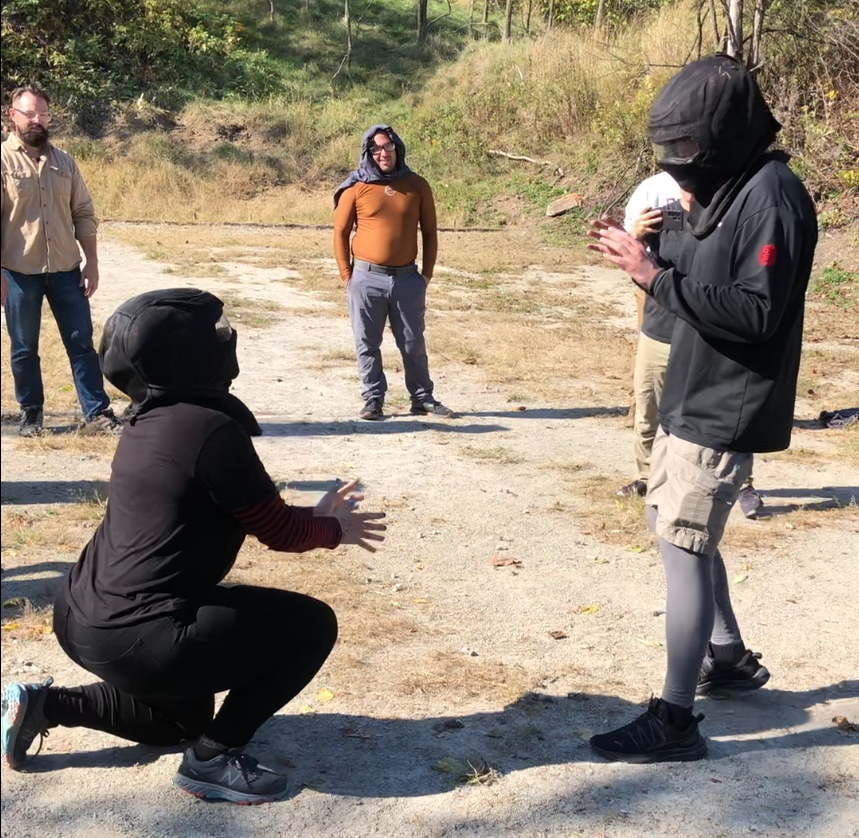
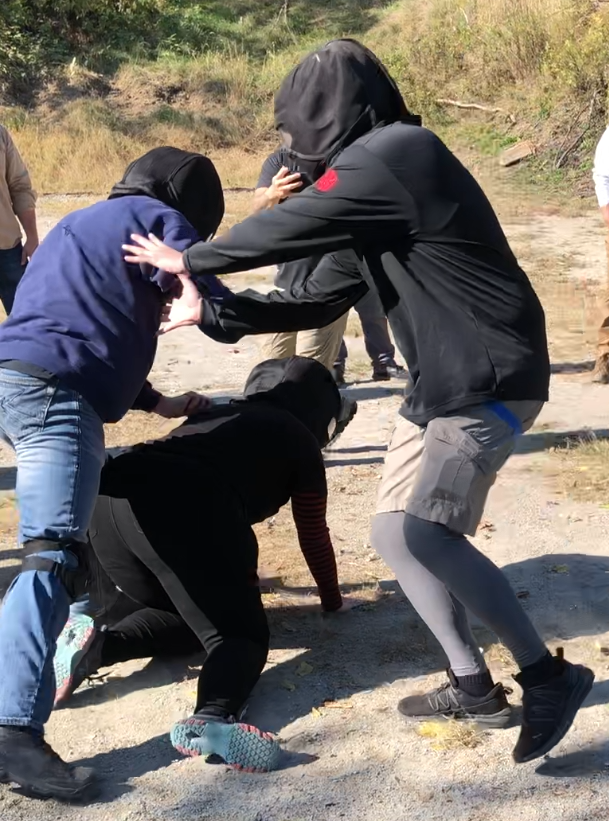
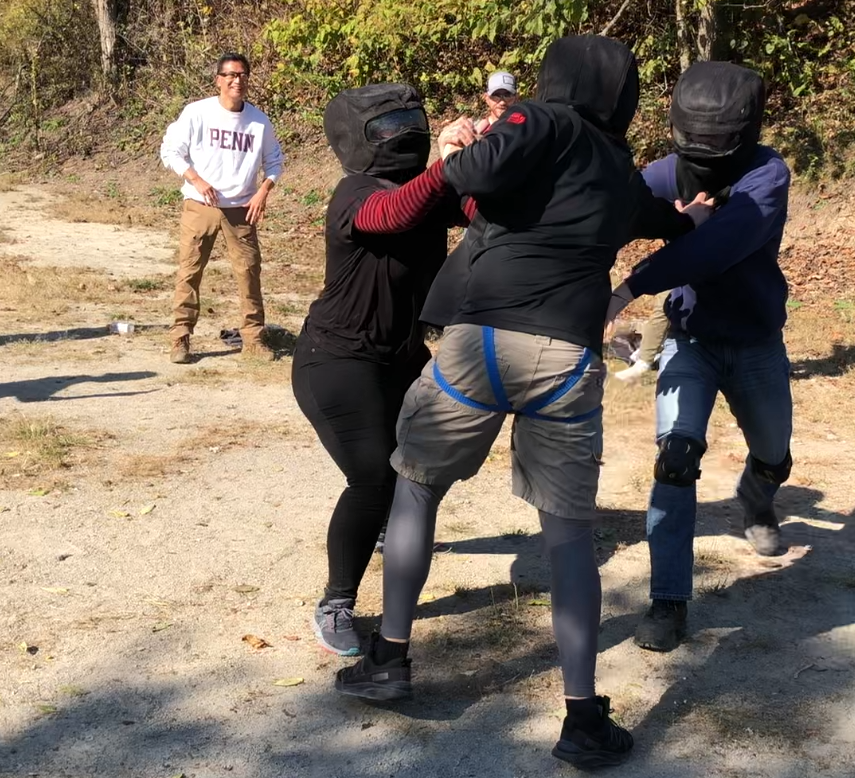
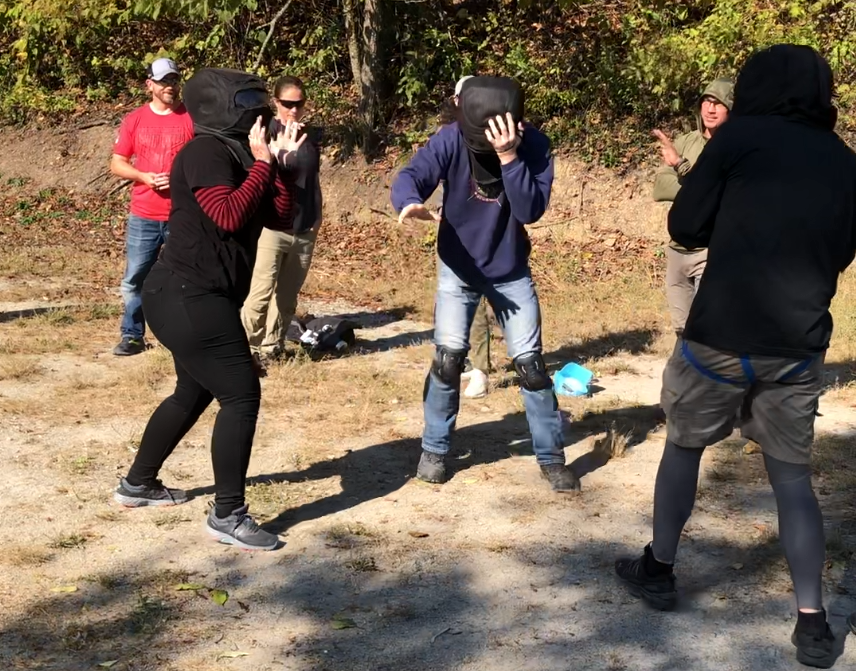
Misti caught me off guard with her intensity and acting prowess as she pled Bogdan for help. He seemed just as startled as I was. I’d only just recovered from my initial shock when Brian tapped my shoulder to send me into the fray. Misti was mid-grovel, kneeling in a supplicating posture, and my open-hand strike knocked her to the ground. Bogdan reacted just as Brian had anticipated he would by trying to push me off of her. She flipped like a switch, suddenly irate that he had laid his hands on ‘her man,’ and now we were both after him. He hit me with an eye jab which I deemed effective, so I broke off the attack and began staggering, clutching my face, and feeling the air around me while shouting, “I’m blind!”
In hindsight, I feel kind of guilty about hamming it up so much and taking training value out of my partners’ experience with my asinine antics. Things ended with Bogdan drawing the sim gun, which caused Misti to back off and come to the aid of her temporarily blinded abuser (me) in true battered wife fashion.
“Tend To Your Own Business” by Claude Werner, tacticalprofessor
This rotation gives us a great opportunity to reflect on our Mission and pre-decisions. Specifically, self-defenders must draw their line in the sand regarding intervention as a third party. In advance of a dedicated blog post on the topic, here are some thoughts on the topic:
- If starting an interpersonal conflict is like opening up a door without any knowledge of what will come out of it, then inserting oneself into an ongoing conflict is like rushing through an open door into a dark room. If you choose to carry a lethal defensive tool, your involvement introduces deadly force into an equation it might not otherwise be present in. Things have a way of snowballing.
- Legality is also a consideration. Per PA Statutes Title 18 Crimes and Offenses, Chapter 5, §506, subsection (a), paragraph 1, using force against one person on behalf of a third is justifiable when you would be justified in using force to protect yourself from the same injury you believe they are being threatened with. Basically, if you could justify using force to protect yourself from whatever threat is at hand, you can use it in defense of a third party. That may or may not be the case where you live.
- Things are rarely as simple as they seem. You run the risk of mistaking the victim for the aggressor or vice versa, meddling in what may amount to mutual combat, or being turned on by the person you’re attempting to ‘rescue,’ as happened in this evolution.
Keep in mind that what appears to be a minor dispute to you may not be so in reality. Even if there truly is no peril, you can’t be sure that neither of the two strangers will escalate the situation from verbal to physical—or from physical to deadly—without provocation.
If you yourself are not in danger, should you intervene for a stranger? A friend? A coworker? A girlfriend? What’s so insulting to your conscience and sense of morality that you couldn’t live with yourself if you didn’t do something about it? Are you willing to risk it?
Agitated Foreigner
I was the unknown contact this time around. Because I’d procrastinated and neglected to come up with anything better beforehand, I made the spur-of-the-moment decision to address Misti in Spanish and ask her for a cell phone. She responded in español even more broken than mine and it became clear that she didn’t understand me, so I added some charades to try and get my point across; speaking only English, she had no real ability to deescalate. I became more frustrated and insistent. She tried to leverage the few isolated words she knew, mentioning baños to my continued exasperation. At one point, through our helmets and mouthguards, she misheard the word llamada as ‘iguana.’
Then, she made the mistake of using the profane phrase chinga tu madre. That really set me off. In the heat of the moment, I decided that that had struck a nerve with my character and ended up yelling something to the effect of, “¡¿Por qué me estás diciendo?! ¡Ella está muerta!” before clinching with her. Misti and Bogdan did a terrific job of subduing me after I grabbed for Misty’s gun, which had fallen to the ground in the scuffle. When all was said and done, I was left flat on my back in the dust after approaching a stranger to make a call, still stricken with grief over the reopened wound of my (apparently) dead mother. I cried to the heavens in despair: “Por qué, Dios?”
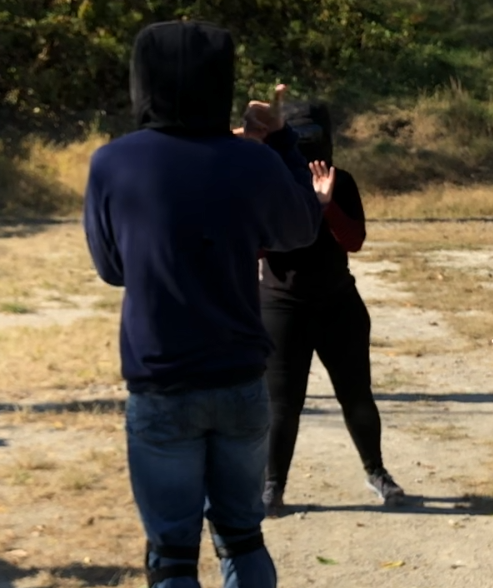
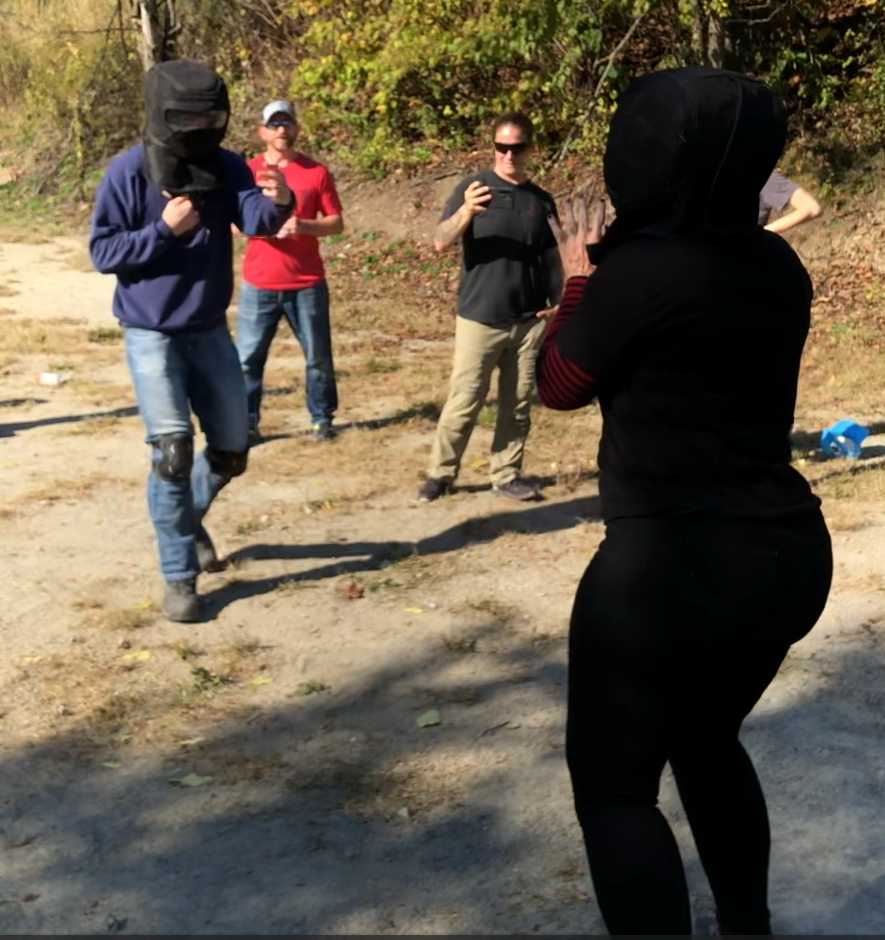
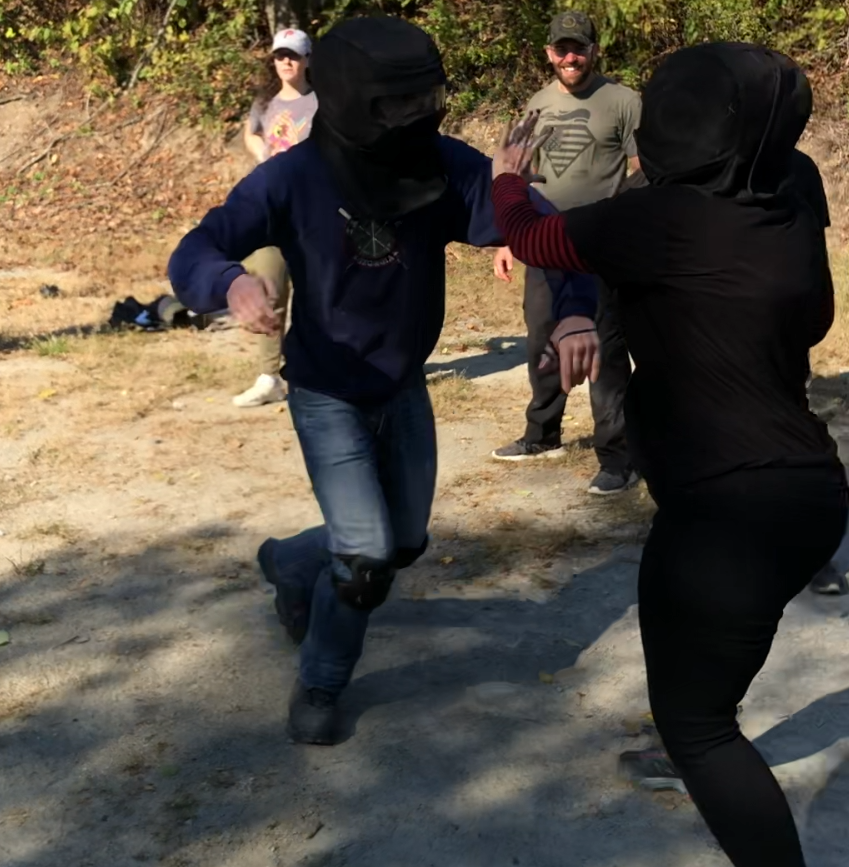
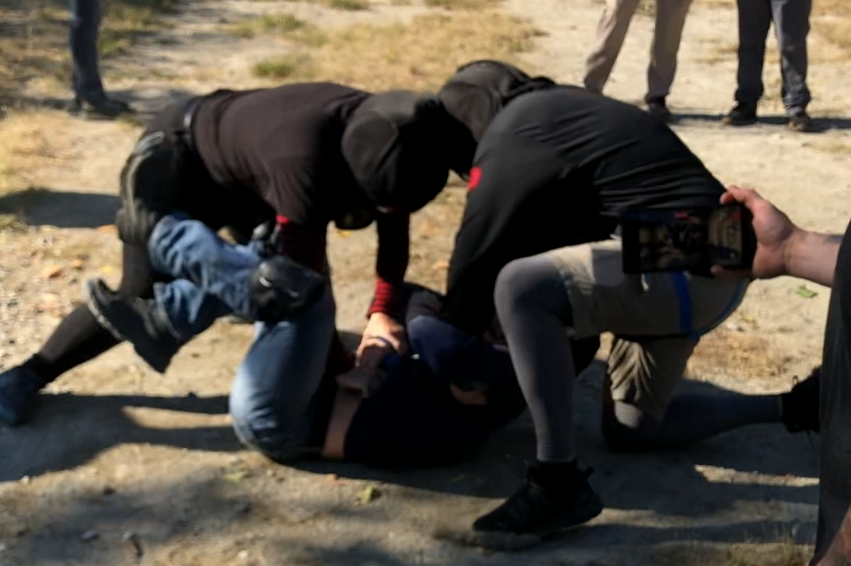
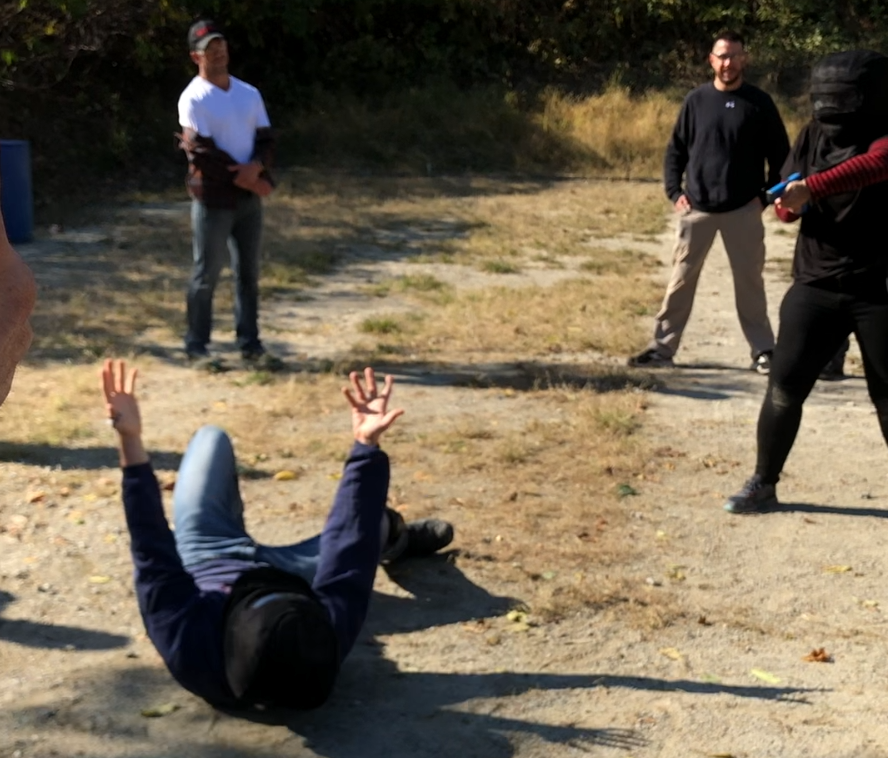
Were their actions reasonable and effective? Without a doubt. Did it need to happen, though? Normally that question would be impossible to answer. As the approaching party in this case, though, I can definitively say no. I was agitated, yes, but not hostile, and my request for a cell phone was not a ruse to close distance and attack.
I think we can learn two valuable lessons from this rotation. First, conversational proficiency in a second language could be as useful a tool as a knife or gun—more useful, even. Second, be careful who you motherfuck. Just the day before, Craig had paraphrased Greg Ellifritz in pointing out that there is a huge difference between, “Back the fuck up!” and, “Back up, motherfucker!”
Destitute Father
This was my turn in the crucible as the good guy with a gun. It definitely turned out to be the oddest interaction anyone had that day, which is saying something since one scenario ended with the defender holding a pimp at gunpoint while his own prostitute (played by Suzie) picked his pocket and ran away.
Bogdan inched closer, creeping towards me one slow, small step at a time with his hands folded in front of his chest in a disarming position. This gradual encroachment set off alarm bells in my head but I didn’t feel it warranted closing the distance to grapple. As he grew more desperate and picked up the pace of his advance, I posted out with a hand as a buffer—but only one, and it was not compressed enough that I could have defended strikes, had I needed to. Several times he grabbed onto me pitifully like a beggar, and I did a decent job of innocuously pummeling for inside position.
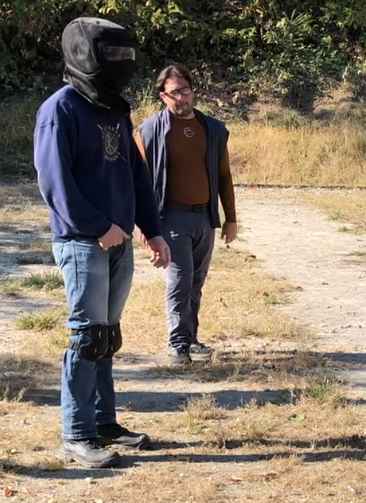
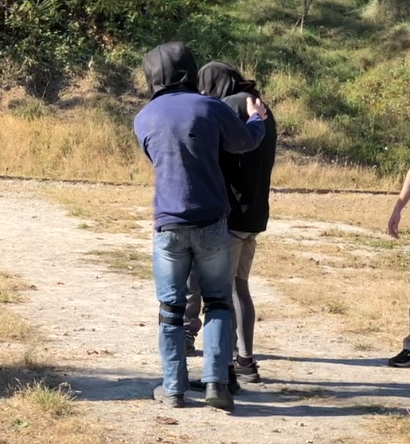
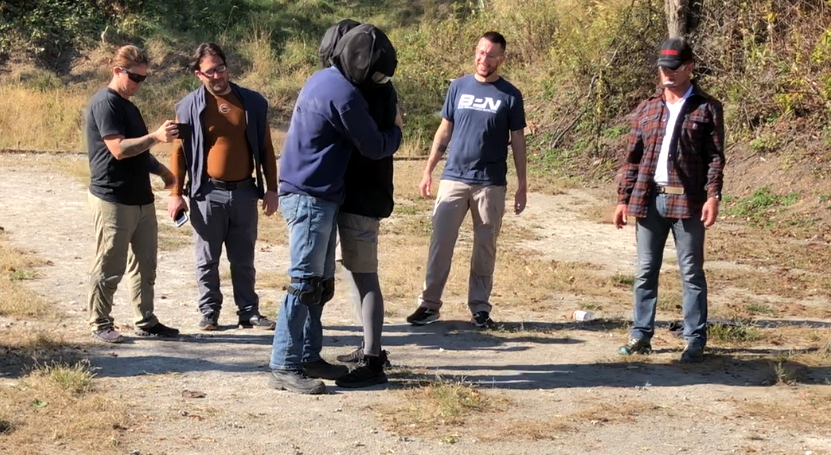
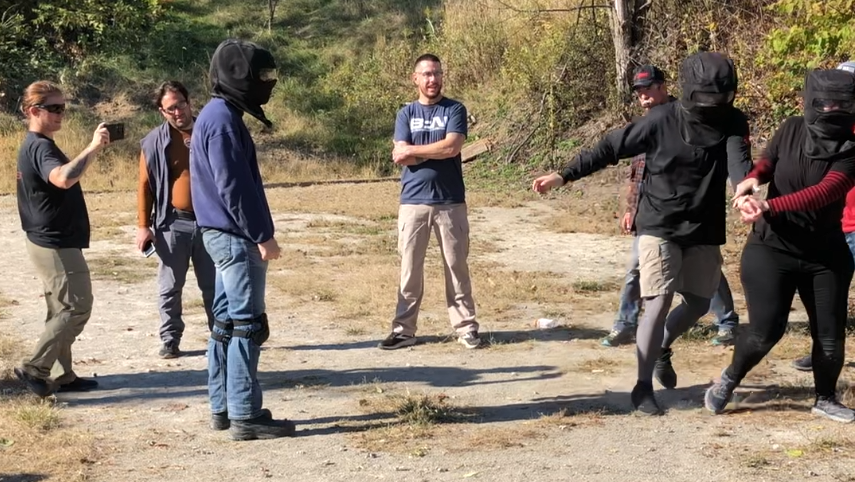
At one point I put a hand on his shoulder and tried to give him a compassionate pat on the cheek—like a “you’re okay, buddy” type of thing—which I think he mistook for a weak open-hand strike or eye jab attempt, and began to weep crocodile tears. I felt like a hug was needed, so I embraced him. With that, the situation was effectively deescalated, and soon after Brian released Misti; she played the role of a wife or girlfriend that had gotten food for them and their children, and she ushered Bogdan away to eat, leading Craig to call break.
I made a few glaring mistakes:
- Despite my best efforts, I couldn’t overcome my natural reaction to move straight backwards when approached. I took a very long time to arc and left my back exposed for what looks like an eternity on video.
- You can see my hands get ‘nervous,’ and I pick repeatedly at the hemline of my crewneck, although I had absolutely zero awareness of this in the moment. This happens both with my dominant hand and with my support hand; for a moment, it looks like I’m bringing it back as if in preparation to clear my cover garment.
- The simple fact is that my grappling and wrestling are not good enough to warrant me letting Bogdan get as close to me as he did. Yes, I was watching him like a hawk, but action still beats reaction, so he could have sucker-punched me into a coma at any time.
Some other thoughts:
- I sorely wish I had thought to bring my inert POM OC spray to use, as I’ve since seen other students do in YouTube shorts from other classes. I may have used it, if I’d had the option.
- After pointing out my lack of arcing movement and numerous gun-carrying tells, Brian recommended getting and staying outside of the person’s elbows if you find yourself within an unknown contact’s wingspan.
- You can post and pummel gently, in a way that’s not overtly threatening or aggressive; a hand on a shoulder or loose grip on the tricep allows you to place your hands for preemptive control without making a person feel like you’re manhandling them. Notice that, in one of the screenshots where I have a comforting hand on Bogdan’s back, I am outside of his elbow and could take his back easily if given reason to.
While there was some hemming and hawing from my bloodthirsty peers over the lack of violent spectacle, my words and actions kept me from having to draw or use the sim gun. And, no, participants’ actions technically aren’t constrained by the real-life legal thresholds for the use of lethal force: you
don’t automatically ‘lose’ the evolution if you draw your pistol before you should have, or if you finish a downed participant with an anchor shot to the dome when they’re no longer a threat.
But Brian’s post-evolution debrief wasn’t just to test our recall and demonstrate that our memory is often imperfect. It also tested our ability to articulate the reasons for our actions, which was like an unspoken litmus test of reasonability in the eyes of our peers. At the end of the day, I didn’t ‘assault’ or ‘shoot’ anyone, which is a better outcome than the two alternatives: doing so justifiably, or worse, doing so needlessly. I would see both by the end of the day.
Car Wreck
This scenario starred Josh and a peer of mine whose name I’ve since forgotten (tip: make sure you trade contact information with your training partners to keep in touch after a course is finished. Not only would that have made writing this AAR easier for me, the social and professional value of networking is tremendous. Consider that another mistake of mine you can learn from). Let’s call him Ned.
Ned approached in a heightened state of emotion, urging Josh to call 911—his family was dying, he said—his tone made it clear that time was of the essence. Josh did an excellent job of managing space and keeping an active fence, but repeatedly talked over Ned in the process. He was hearing, but not listening.
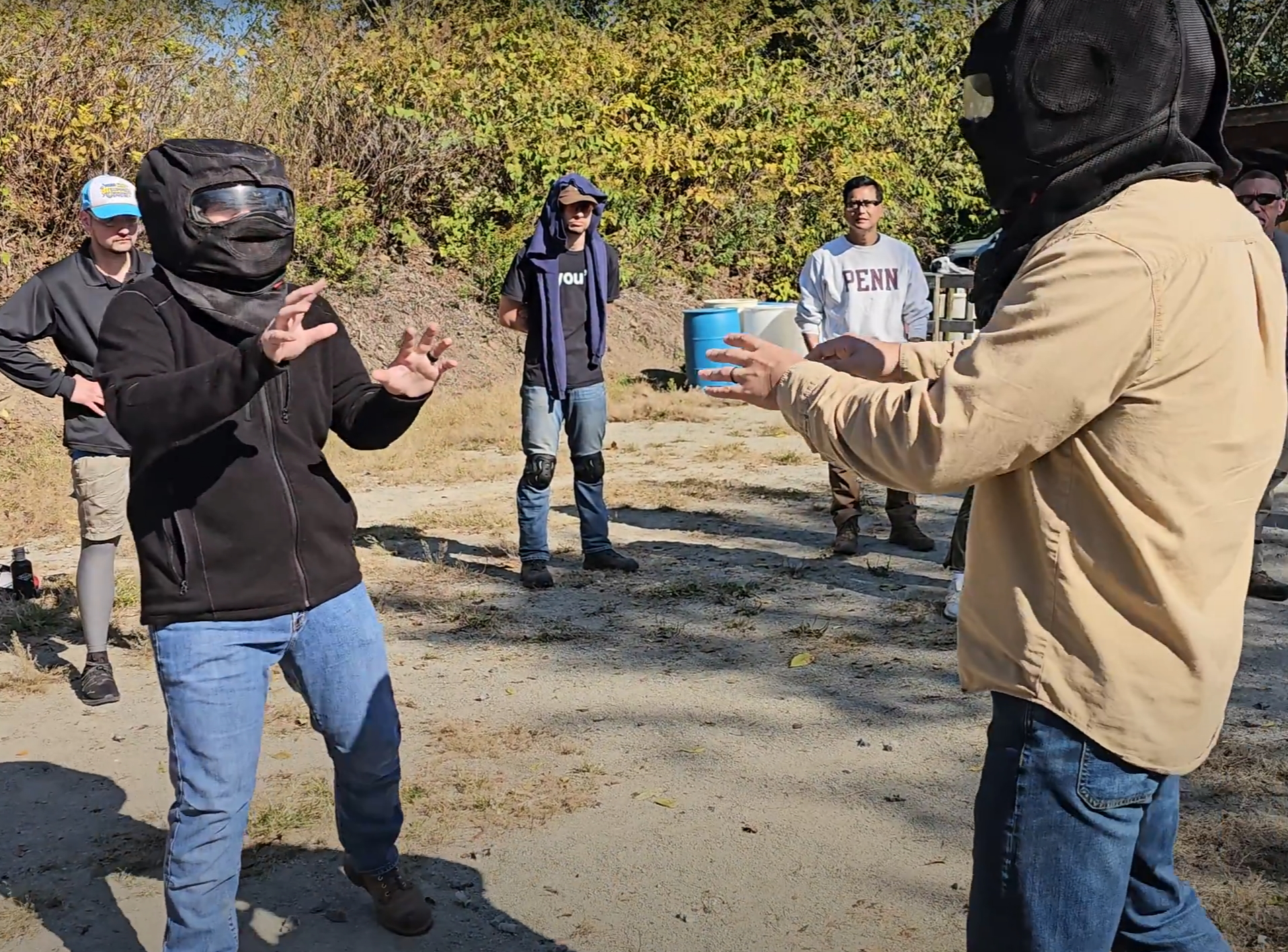
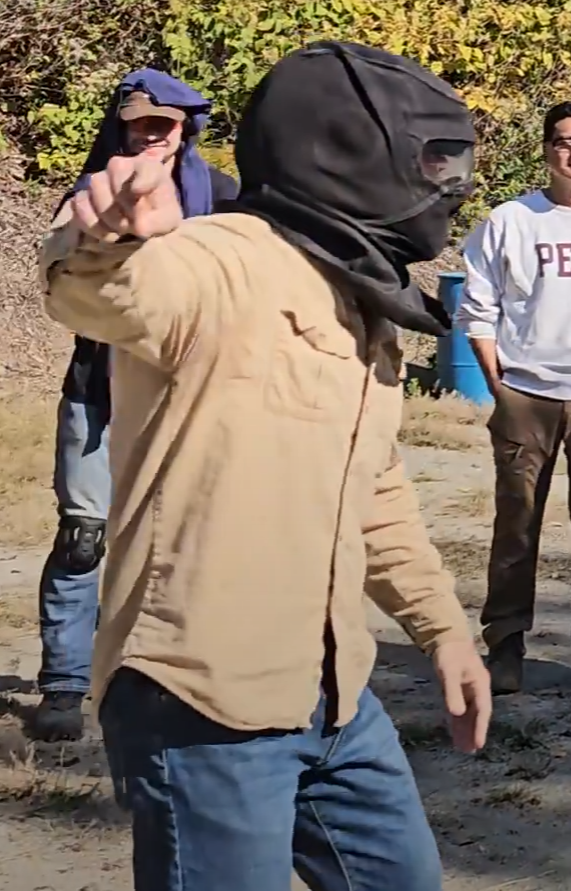
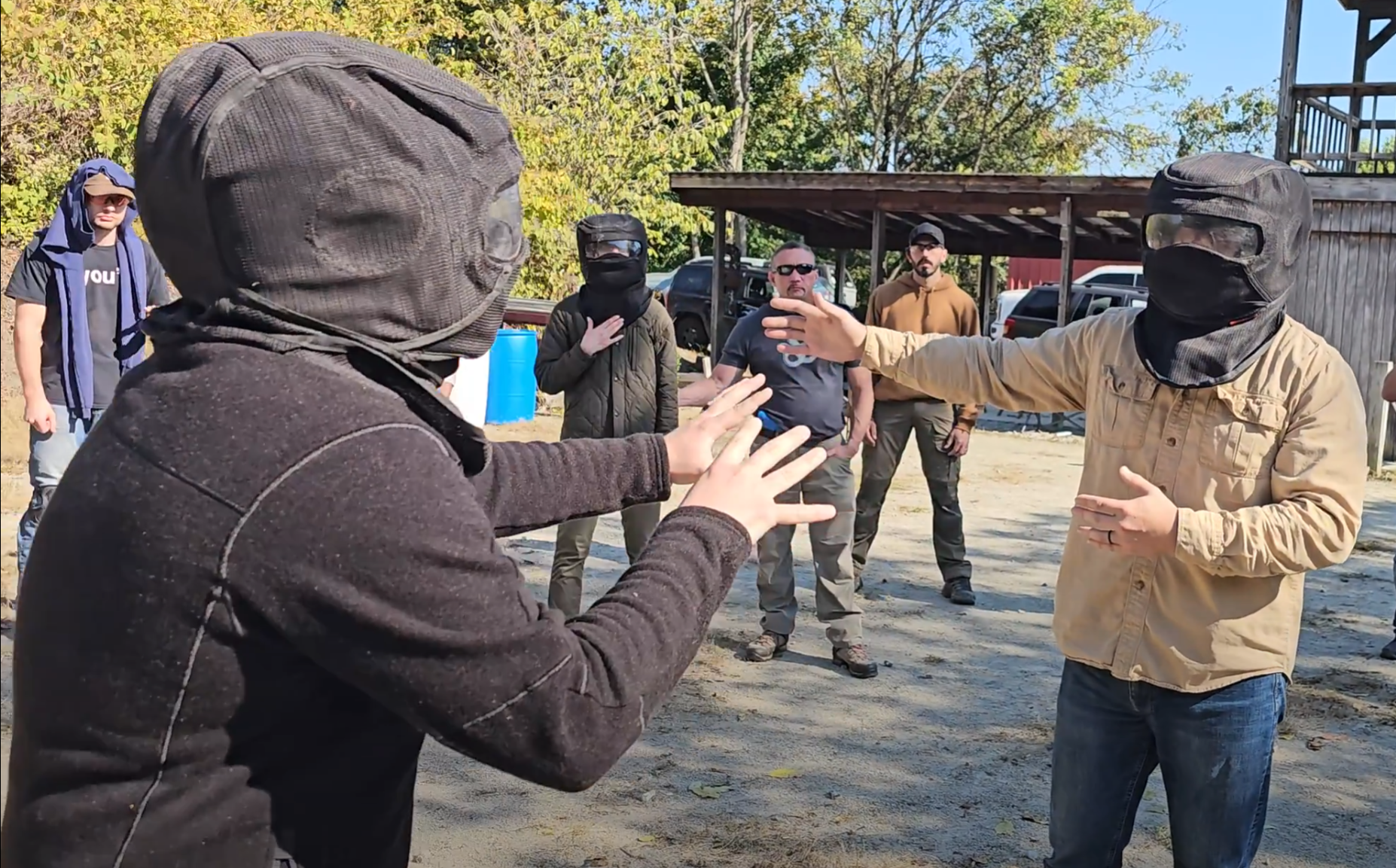
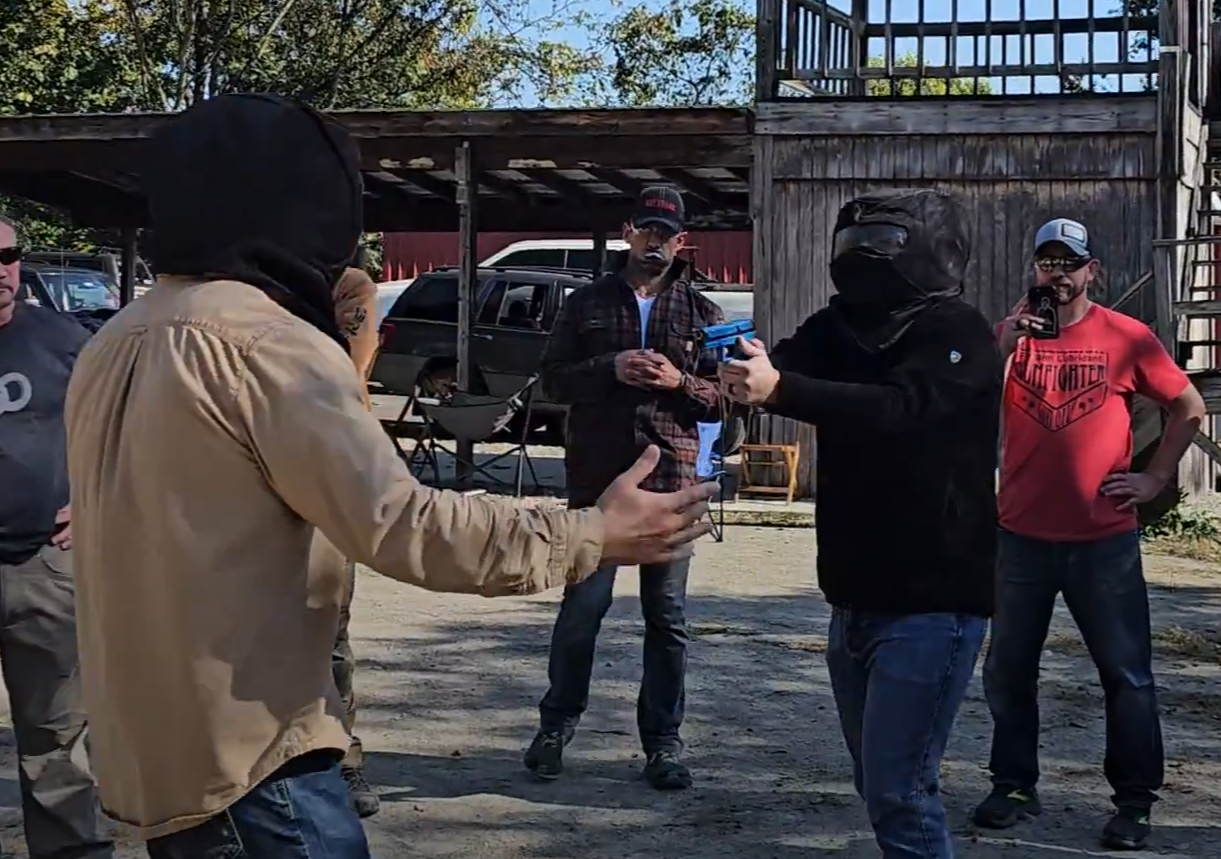
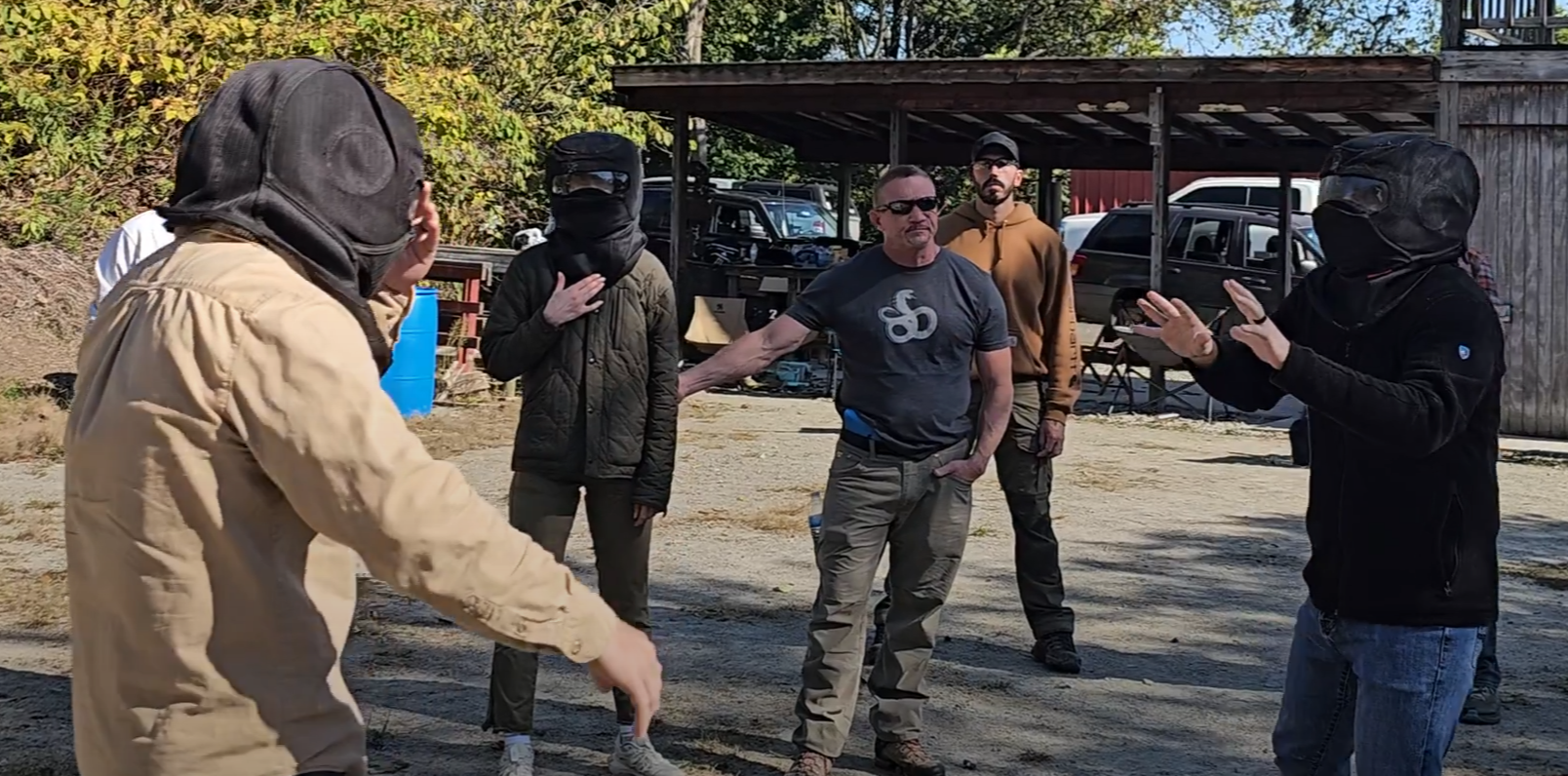
“Don’t just stand there, call!” Ned was becoming irate, almost indignant in disbelief. The dialogue in the video becomes incomprehensible as both men shout at once. Ned repeated his request ad nauseam at an elevated volume. “Just call! Take out your cell phone and call! Come on, man! My family is dying out there—CALL!”
The situation was so absurd you couldn’t help but laugh, which I did. Josh executed an eye jab, leaving Ned clutching his face. “My fucking wife and kid are dying, and you’re hitting me?!”
It was painfully obvious Josh was getting desperate. Feeling he had exhausted all other options, he drew the sim gun and brandished it as his demands to get back crescendoed to a shrill peak, something like, “Hey getbackGETBACK!”
Ned halted. “You’re gonna kill me when my wife and child are dying?! You’re worthless, man!” He tossed a contemptuous wave at Josh, berating him. “Jesus. They’re probably dead by now, thanks to you! Fuck you.”
With that parting insult, Ned gave up and retreated, leading Craig to call break.
If it sounds like I’m being unduly hard on Josh, I promise I’m not. He actually deserves major props because, unlike me, he picked up every tool taught to us during the MUC block of instruction and used it exactly as intended—right out of the box, so to speak. Just by taking the class, he proved his dedication beyond 99% of other gun owners. I thank him for enriching our cohort’s training experience and hope to see him on the road in the future.
As Craig and Brian pointed out during the debrief, grappling is a great way to develop both general emotional fitness and confidence in situations like this. To use a quote from Zee Durham that Mickey Schuch is fond of borrowing, “exposure equals composure.”
Outraged Husband
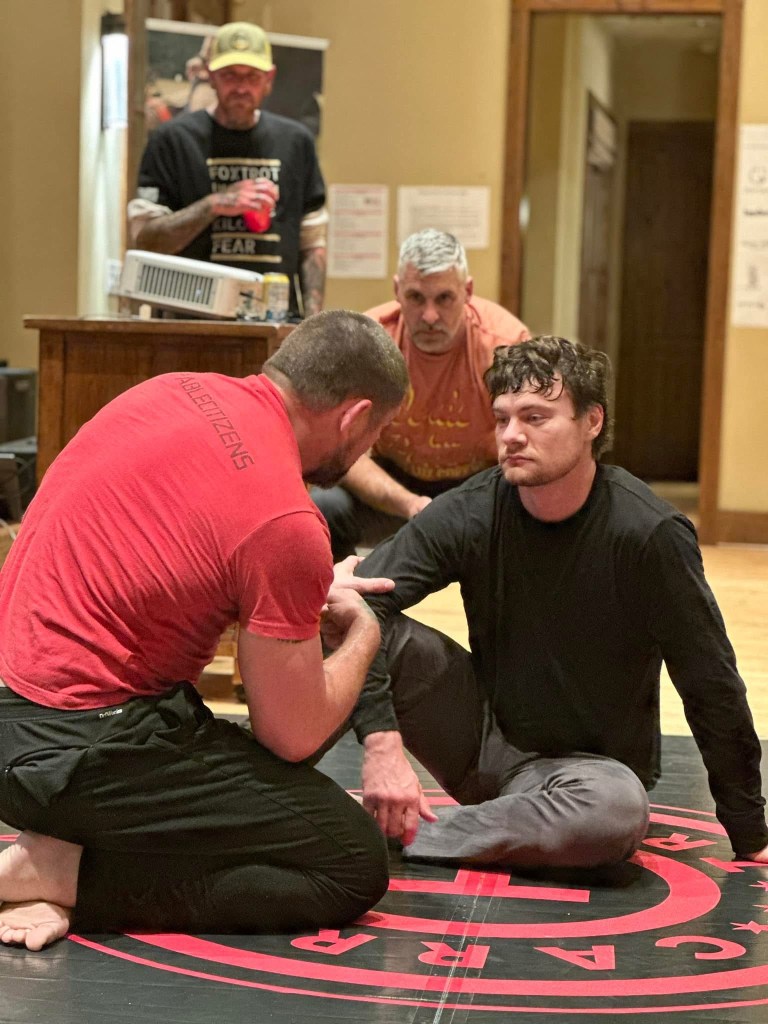
This evolution featured two guys, both named Michael, and the MD I mentioned in part 1. The Michael we knew as Tall Mike played the aggressor while Michael #2, who we’ll call ML, played the defender. Doc was assigned the role of third party. Tall Mike launched out of the gate with an accusation, offended that the other had checked out his wife. ML denied. Tall Mike flipped the script: “wait, you didn’t check her out? So you don’t think she’s good-looking?”
The two continued jawing. ML displayed excellent verbal agility, arcing while keeping an active fence and good posture.
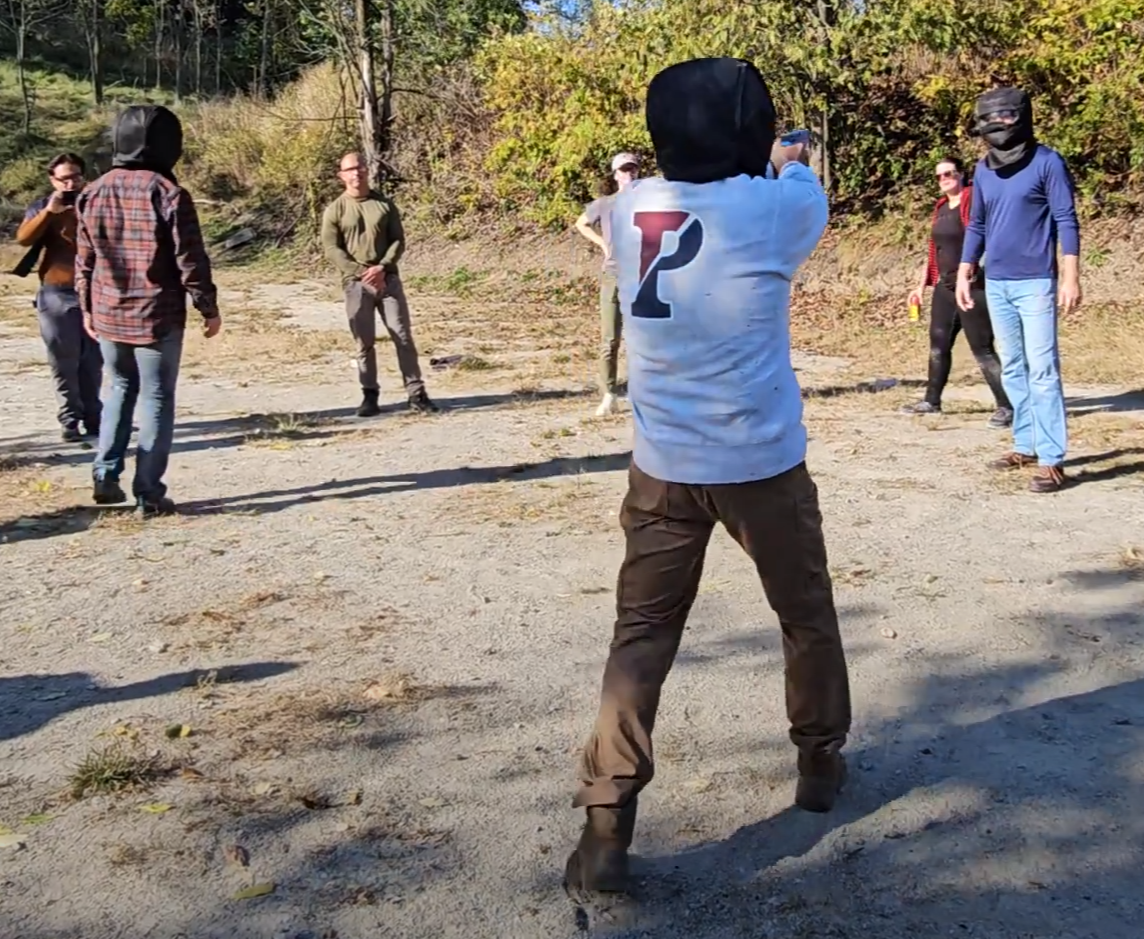
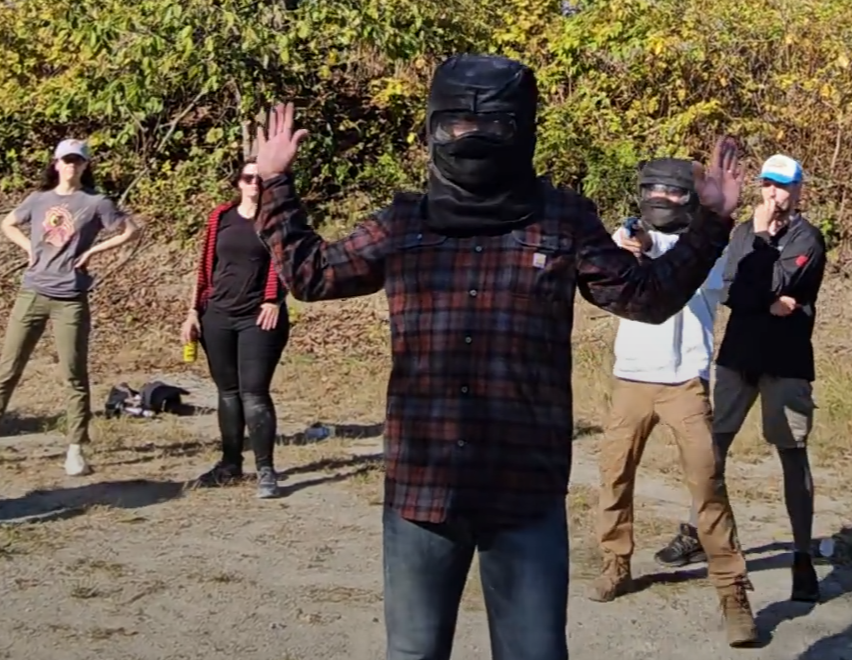
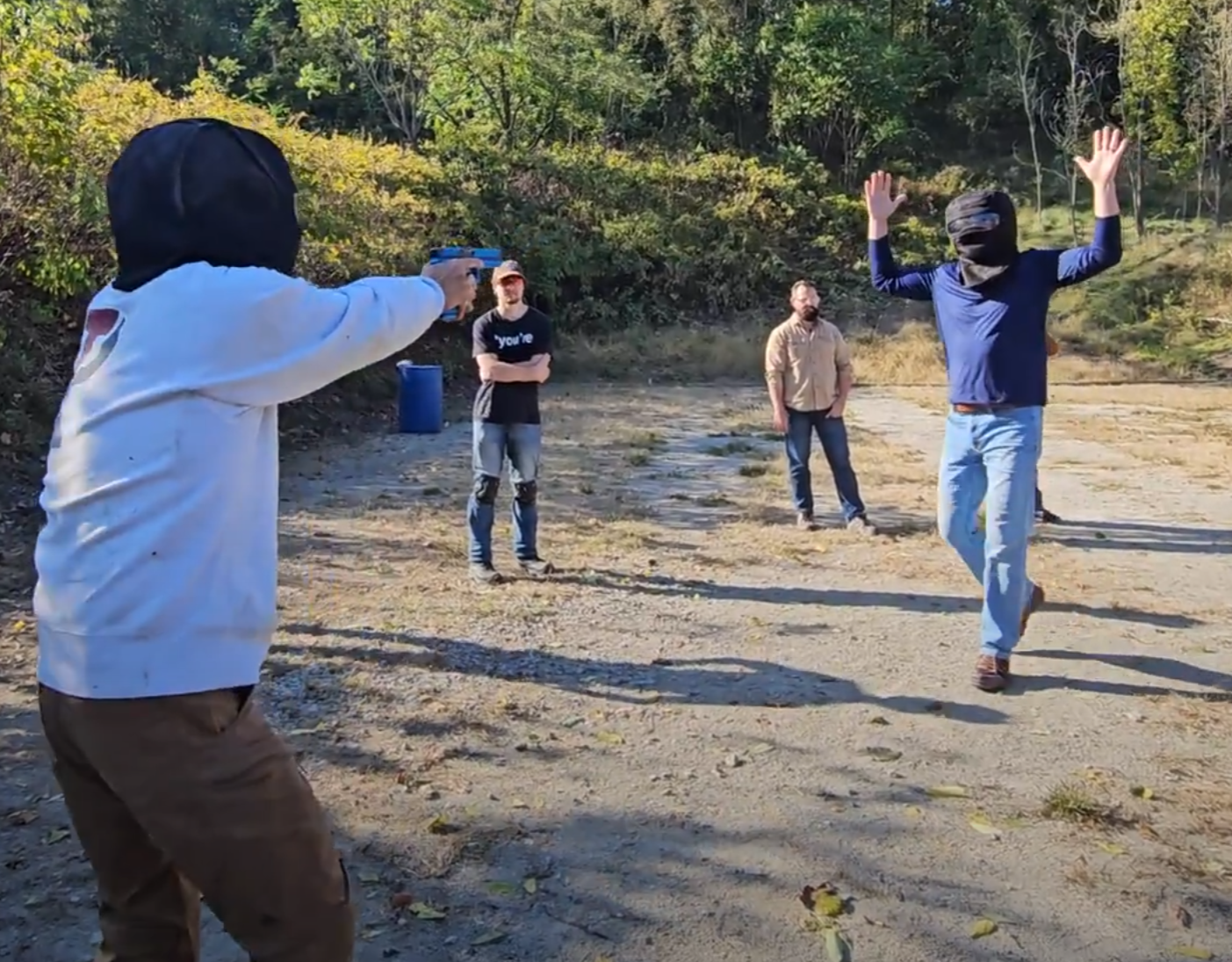
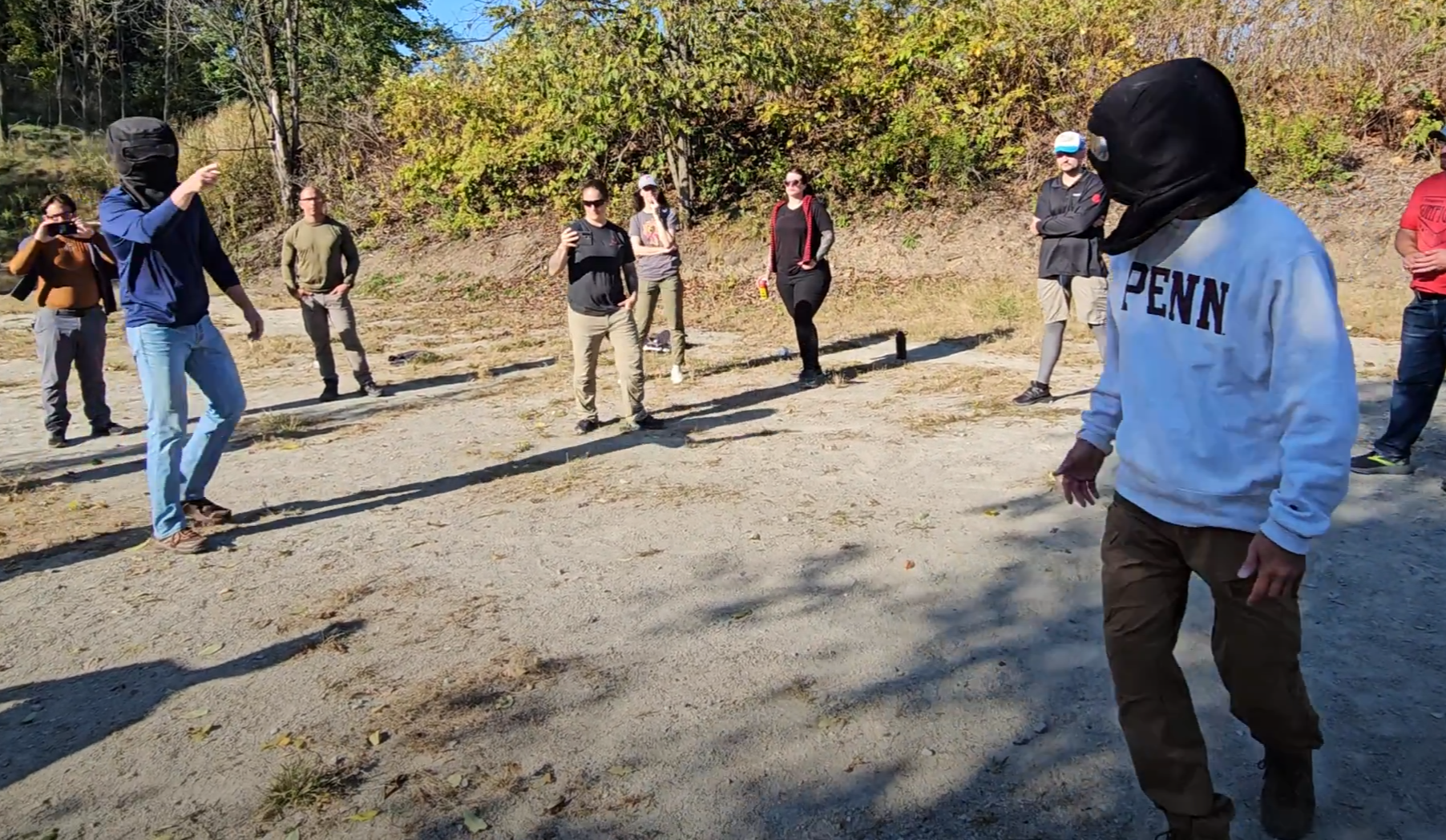
Doc entered the confrontation and ganged up on ML. At one point, Doc attempted to approach by walking backwards with his hands up in a ‘surrender’ position. I know for a fact that I’ve heard of criminals approaching the police in this way because they believe they won’t be shot in the back and hope that an officer will hesitate for fear of a PR shitstorm. For the life of me, though, I can’t remember any specific incidents. If you can name any cases where this occurred, please leave them in the comments.
One important observation is that, several times, ML actually advanced on Tall Mike and Doc while holding them at gunpoint. During the debrief, Craig referred to this as “compliance creep”: a term for when an otherwise righteous defender closes distance with a retreating perp they are brandishing a gun at. When the other party complies with their demands to back up, Craig explained, some people can feel a sense of power in that moment and begin to walk them down unconsciously, as if to say, ‘yeah, that’s right! Keep doing what I want!’
Afterwards, Craig shared a slick strategy for handling a case of mistaken identity like the one that precipitated the encounter. He gave a canned response that went something like this:
“Hey man, I’m really sorry about that,” he said sheepishly. “She’s just really hot and the truth is, I was kind of jealous because I wish I could find a woman like that. I didn’t mean to disrespect her or offend you, so I’ll just get out of here.” Tall Mike admitted that this would have caught him totally off-guard.
An apology—even for something you didn’t do—can go a long way. Think also of the “My Bad $20″ as popularized by Jack Clemens:
It’s worth considering that “here’s a few bucks; have a drink on me” as you walk away could potentially be all it takes to solve your problem.
Third Evolution
As stated in part 1, these were the carfighting evolutions.
The highlight, I think, of the entire class was Misti’s rotation in the passenger seat as a criminal. She was partnered with the MD I mentioned in part 1.
Misti opened with some over-the-top flirtation, using pet names and making a suggestive inquiry about what he was doing later that night. She responded to Doc’s innocent plans to watch the baseball game with a ‘bat and balls’ innuendo so transparent even Shakespeare would have rolled his eyes. Could she see his balls and his bat, she asked?
Mild-mannered Doc, who lacked Misti’s acting abilities and perhaps her commitment to the bit, rebuffed her advances and meekly suggested that his wife wouldn’t like that.
“You don’t want this pussy?!” she demanded. “Then gimme your money if you’re not gonna take my pussy!
Misti brandished the sim gun, getting more into character than perhaps anyone that day. “Gimme that fuckin’ money! YEEEAH!”
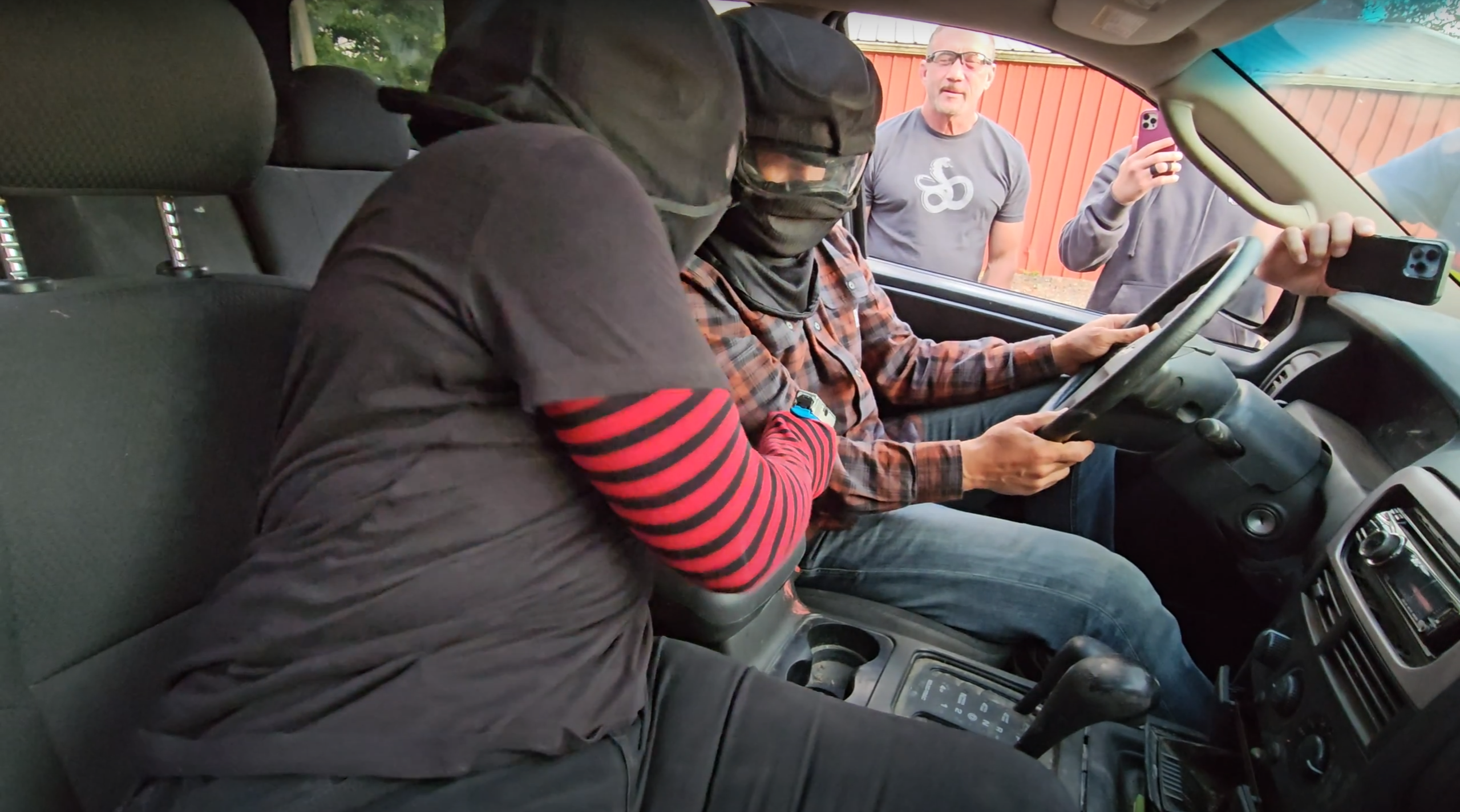
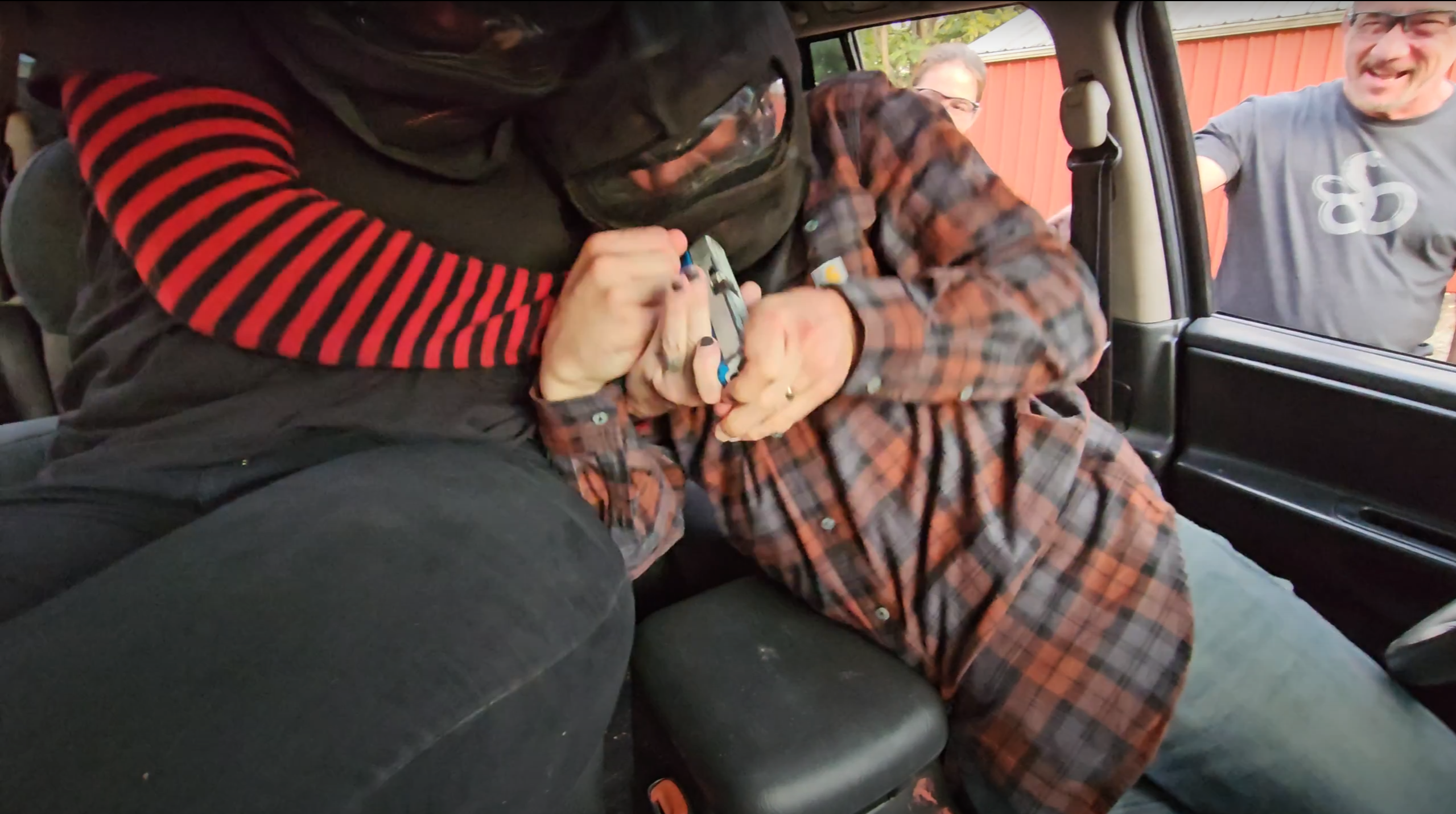
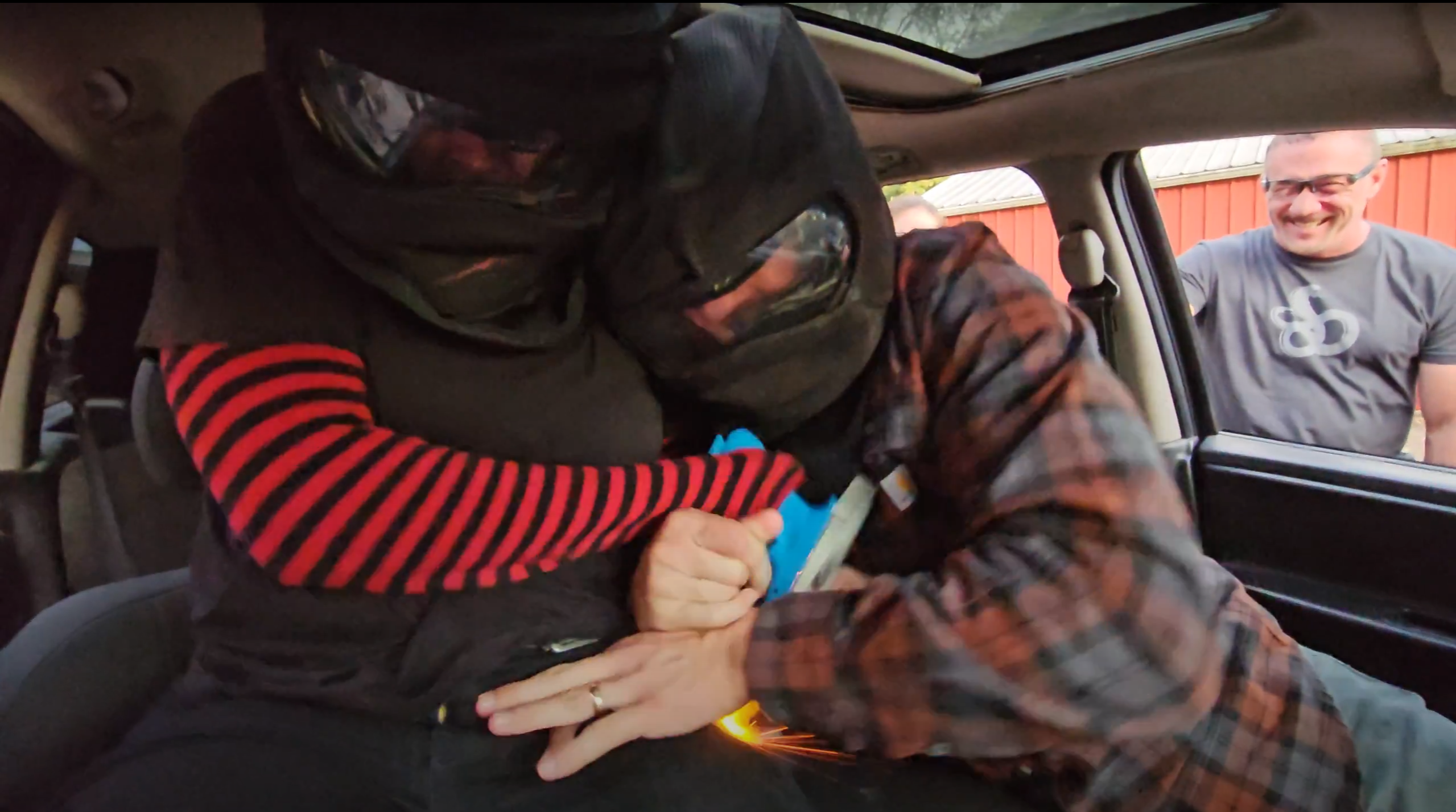
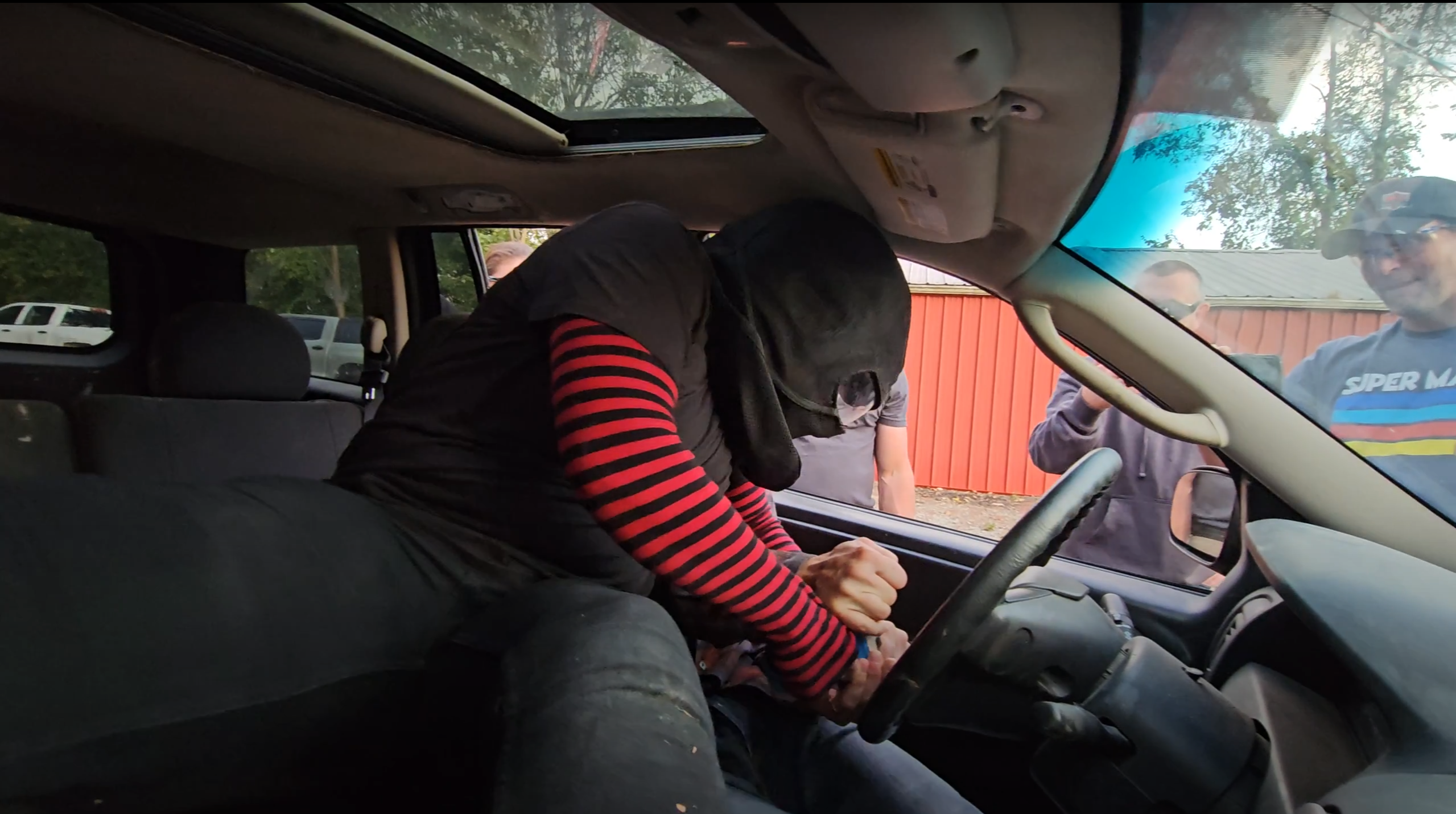
She got her hips out of the seat first, but Doc was almost able to pry the gun away; on the video, you can see a flash of fire as it negligently discharges in the struggle, hitting Misti in the thigh. With her legs extended and braced on the dash and passenger-side door, Doc was crushed into the gap between the driver’s-side seat and door. Just before Craig called break, she bellowed, “YOU SHOULD HAVE TAKEN THE PUSSY!”
Psychological warfare is real, and it works.
Personal Takeaways
I need to:
- Work on my stand-up game. No, I’m not a shark, and the ground is not my ocean. But I’m also not whatever the land-based predator equivalent is, either, because my wrestling is pretty lackluster.
- Begin cross-training in striking (eventually). The setup for one of the nonconsensual, competitive exercises on the first half of day one involved the ‘good guy’ starting from a stabilized clinch—that is, with dominant head position, an underhook or overhook, and a bicep or wrist tie. Whether it was due to my lack of skill, my partner’s grappling experience, or both, I was unable to capitalize on my initial advantage and get to his back with a duck under, arm drag, or arm bundle. He repeatedly broke free, and I found myself squared back up and hand fighting. My partner and I were no longer attached; I couldn’t draw my sim gun without control of either my partner’s arms, and I knew backpedaling wasn’t a good idea in terms of safety or strategy. It was frustrating: there we were, at arm’s length, but he wasn’t pressuring back into me, and I knew that in a real altercation I wouldn’t be deliberately clinching back up.
I described this to Craig during a break, who responded, “you would be swinging, at that point.” In that case, strikes would either diminish your opponent and allow you to make adequate space to draw, or give them no choice but to drive back into you rather than take a beating and, in doing so, open up an opportunity to get limb control or take the back. - Make deliberate additions to my BJJ training to break bad habits and build proficiency with core techniques. For example, for at least one round of open mat, I will make my only option when taken down to stand back up. Yes, my guard retention served me well, but I don’t want to inadvertently validate bad tactical decisions.
- Build my neck strength. I wasn’t nearly as sore from the mountain goat drill as I expected to be on Sunday, but years of desk-sitting still haven’t done me any favors. I’ll have to take a page from Shawn’s book and add some weighted neck flexion and extension exercises to my routine.
- Take Edged Weapons Overview (EWO) as soon as possible. I plan on doing this not only because it sounds incredibly fun, but also because I’ve now seen firsthand two of the main benefits associated with a defensive fixed blade carried forward of the hips: accessibility and defensibility. Not only can a knife be easier (depending on sheath orientation) to draw within wingspan than a handgun, but, with only a blade exposed once it’s in play, it’s certainly less inviting to a potential disarm. Even a bath salts zombie impervious to pain wouldn’t have much to hold onto.
Additionally, having reviewed the arm bundle and two-on-one split seatbelt with a partner during open mat, I’ve found it can be easy to wind up in a stabilized clinch with only your left hand free and no way to draw your gun. Having a tool available to draw with your support hand could come in handy. I’m curious to learn more.
That’s all I’ve got for you today. What’s the craziest ECQC evolution you’ve participated in or witnessed? Let me know in the comments.
Thanks for reading!

