
Welcome, friends.
When it comes to carrying a concealed firearm on one’s person, self-defenders have individual needs that are as unique as they are. Despite the multitude of methods and positions that have been devised over the decades to meet those needs—from the tried-and-true AIWB in a kydex holster on a belt to niche options like ankle carry—there may be scenarios in which none are feasible. Sometimes dress codes, activities, or policy may force a shift to non-traditional alternatives.
One of these is what’s called ‘off-body’ carry, which refers to the practice of carrying a concealed firearm in a purse, fanny pack, crossbody bag, backpack, briefcase, etc.
The line between on-body and off-body carry is blurrier than you might think. It’s also somewhat subjective. Personally, I consider all of the following methods of on-body carry:
- Holster and belt
- PHLster Enigma
- Belly band
- Kangaroo pouch like SmartCarry
- Pocket carry*
- Ankle carry
- Shoulder holster
*Only if in the pocket of a garment that will not be taken off. Kathy Jackson echoes this in The Cornered Cat, pointing out that pocket carry is technically on-body but “has more in common with off-body carry than,” say, IWB, because it’s so commonplace to shed layers with activity or when transitioning from outdoors to indoors (page 180).
Even though a gun carried in a bag is (in theory) not much farther away from one’s body than a gun carried inside the waistband, there are good reasons for drawing a hard line between the two.
Before we get into those, let’s explore some of the merits of carrying off body.
Use Case and Benefits
While its advantages are largely universal, women are more commonly drawn to off-body carry because their clothing choices and anatomy make many traditional methods of on-body carry more difficult, and because so many already carry a purse. In the past decade and a half, though, unisex bags like slings and waist packs have come back into mainstream style after a long hiatus in fashion purgatory; at the same time, the market for specially designed bags for concealed carry has seemingly exploded. As a result, carrying off body now enjoys considerable popularity among male self-defenders, as well.
Even outside of circumstances in which it might be necessary, it has certain benefits over traditional methods:
- Fashion. Historically, the prevailing attitude among adherents of the armed lifestyle has been to encourage dressing for concealment at the expense of style, comfort (see the next bullet point below), or even function. But, in recent years, the pendulum has begun to swing the other way, somewhat. The truth is that some people genuinely care about the clothes they wear and enjoy dressing well…Not me, but people. I dress like I do my wardrobe shopping at Costco—which I do—and, according to my striking coach Jonas, like an insurance agent, which I am. For many modern self-defenders, the ability to dress independently of gun-carrying considerations is a valued, legitimate benefit of off-body carry.
- Comfort. Going armed is always going to be less comfortable than going unarmed; we haven’t yet found a way to strap a rigid chunk of metal and plastic to the human body that’s pleasing to the senses. The truth is that the minor, unpleasant physical sensations associated with carrying a gun on body do make people less likely to carry them, or even not carry them at all. That shouldn’t be the case—as Clint Smith of Thunder Ranch has said, it’s meant to be comforting, not comfortable—but it is.
- Convenience. It’s not that putting on real pants, a belt, and a holster or a configured PHLster Engima takes much longer than buckling on a fanny pack or crossbody bag. It doesn’t. But there is something to be said for those situations where you’re bumming around the house in sweatpants and a T-shirt and need to run a quick errand to pick up a forgotten meal ingredient or cold medicine for a spouse or kid. Having a bag set up to grab and strap on as you head out the door could be an attractive option.
- More gun.Theoretically, a person could conceal a pistol off-body that they might not otherwise be able to with traditional on-body carry methods. I’ve always joked that, if I was a woman, I’d walk around with a Mini or Micro Draco in a trendy tote bag. Kidding aside, off-body carry is probably the only way a 110-pound lady could pack, say, a Glock 34 with a Trijicon SRO and SureFire X300.
- Support equipment. Similar to the above, the ability to carry useful ancillary tools that the average person can’t realistically manage to squeeze inside their waistband or pockets is a niche advantage of a large enough off-body carry bag, but worth mentioning. A more comprehensive trauma kit, an extra magazine, or a larger OC canister like POM’s mid-sized MK3 could be an excellent use of space that might not be normally available on one’s person.
- Surreptitious grip and draw. While comfort and convenience are infinitely more significant and practical considerations, off-body carry does share one niche situational advantage with pocket carry: it can allow a self-defender to get a full dominant-hand grip on their pistol while it’s still concealed, potentially initiate the draw in plain sight, or even shoot through the bag containing it as a last resort. Again, this could give a person the tactical edge in a small number of contingent scenarios, but isn’t the most consequential in and of itself. Also note that shooting any handgun enclosed in a bag—except perhaps a revolver with an internal, shrouded, or bobbed hammer—is likely to induce a malfunction. Read Greg Ellifritz’s post and watch Annette Evans’ video on the topic for more info.

Is Off-Body Concealed?
Because clothing is not the biggest variable in the concealment equation when carrying off body, it’s tempting to think of it as an easier carry method: one is no longer forced to ‘dress around the gun,’ as the tired cliché would advise. Not only is off-body carry far less restrictive of a person’s wardrobe, it also lets them skip the work of learning about concealment mechanics, the trial and error of tweaking, refining, and experimenting with holster adjustments, and the anxiety over printing (at least, printing in the traditional sense).
“‘Dress Around the Gun’ Needs to Die.” by Alex Sansone, The Suited Shootist
But, depending on your social, cultural, and geographical contexts, a pistol totally enclosed in a bag might not be as concealed as you think.
While all permutations of IWB carry have their potential tells, bags of any brand or style are more conspicuous if for no other reason than that they’re immediately visible. Furthermore, a fanny pack or crossbody bag with certain characteristics, worn by a person who fits a certain profile, might be far more likely to draw attention in the first place.
While overtly ‘tactical’-looking bags are probably liable to attract more scrutiny from those ‘in the know,’ even bags with more discreet colors and designs like those from Eberlestock or Hill People Gear will still ping on the radar of clueful self-defenders…And probably criminals, as well.
The general perception seems to me to be that physically fit, fighting-age men who wear fanny packs or crossbody bags are highly suspected, if not assumed, to be carrying a gun in them.
To either challenge or confirm this notion, I created a poll in the private Facebook group Deliberate Training V.2: a closed forum in which notables like Mark Smith, Memphis Beech, Rhett Neumayer, and John Hearne are members. I asked, “what is your typical reaction when you see a man wearing a fanny pack or crossbody bag? What other factors influence your perception of whether or not a person with this sort of bag might be armed? Do you think there are other social considerations that go along with this ‘fashion choice’?”
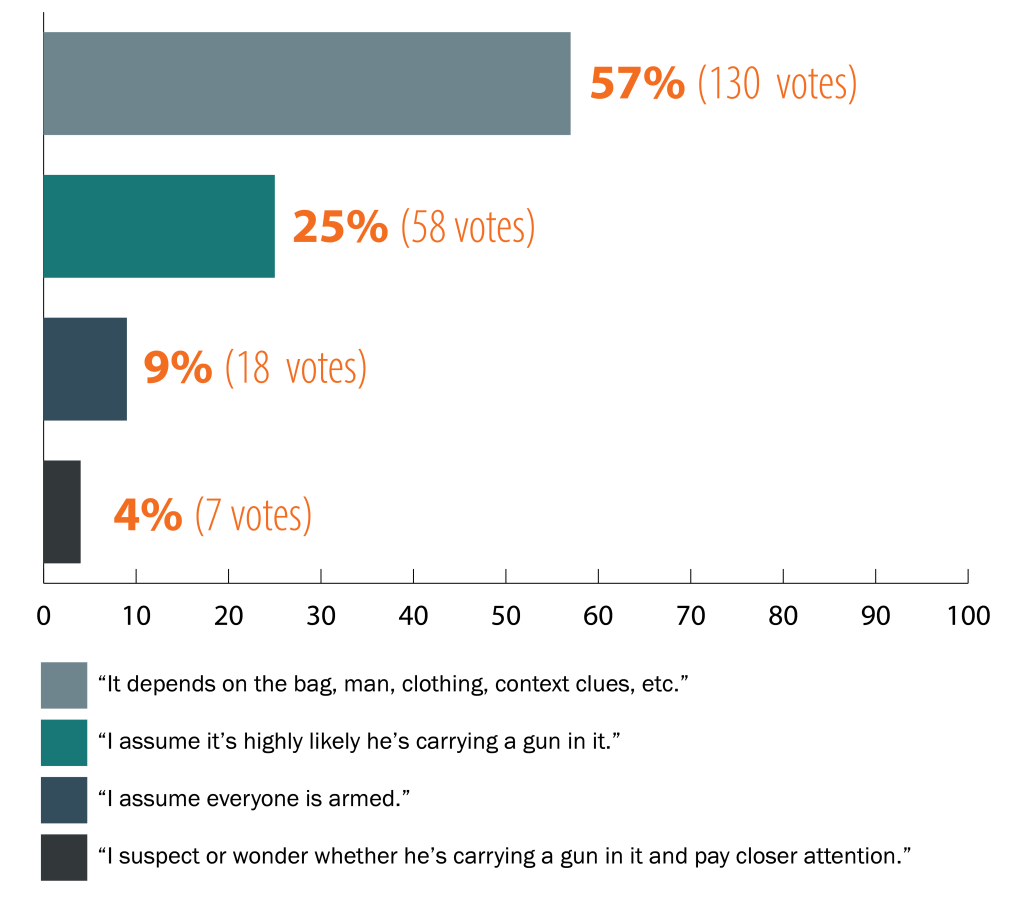
The results were informative, and I got some thoughtful comments.
It is important to recognize the bias of my informal poll, given the pool of potential respondents. Just because members of a moderated group full of training junkies, competitive shooters, and firearms instructors are quick to surmise a sling or waist bag contains a gun doesn’t mean the general public draws the same conclusion. Admittedly, neither group is the one we’re concealing from.
But, even though this wasn’t a survey of hardened violent criminal actors, I still think it tells us something about what is noticeable, generally speaking.
I’m not the most observant, but I am two for two in correctly guessing a bag-carrying stranger was armed: one gentleman at the jiu jitsu gym picking up his child, and the other at a commercial gym where I work out. I believe the former was using an Eberlestock Bando Bag, and the latter a Viktos Upscale 3 sling bag.
I couldn’t tell you whether I’m smarter or dumber than your average mugger or armed robber, but I think it’s better to plan for a streetwise, sharp-eyed con than be blindsided when you’re made.
Before we move on, let’s list some of the variables that might factor into onlookers’ conclusions about whether or not a bag is being used for off-body carry:
- General context. Here, ‘context’ is my catch-all word to encompass where you are—both geographically and incidentally—what you’re doing, what season it is, and a number of other variables not listed below. Anecdotally, I have heard that fanny packs are much more common in the Pacific Northwest than they are here on the East Coast. Know your region. Whatever activity you’re currently engaging in is a big piece of the contextual picture; strolling on the beach, hiking a trail, biking, working out, gardening in your yard, jogging around the block, and tossing a frisbee in the park or on a disc golf course are all activities during which a person might reasonably wear a waist or crossbody bag. Outside of those, there aren’t many others I can think of.
- Bag characteristics. This includes…
- Recognizable ‘tactical’ design elements such as traditional or laser-cut MOLLE, Velcro morale patch fields, shock cord daisy chains, etc. While even the chronically online would be hard-pressed to recognize every one of the numerous companies that sell bags for concealed carry, there’s a good chance that some of those from more well-known brands with more overtly placed logos might be recognized. 5.11 Tactical and Maxpedition are two that come to mind.
- Conspicuous quick-access aids like large pull tabs, oversized zipper pulls, webbing loop handles, or similar features that might speak to a dedicated gun compartment. Our needs for getting to a bag’s contents are different, and that difference is reflected in outwardly visible design choices.
- Color. Camo patterns like MultiCam or woodland are recognizably ‘military’ even to normies, and even tan, OD or ranger green, coyote brown, and plain ol’ black are so common among nylon manufacturers that they can also have a similar implication. Bags with brighter, more vibrant colors might actually be thought of as less suspect for their less-covert aesthetics. Something like Blue Alpha Gear’s 80s-vibed fanny pack is one example of what I might call the ‘reverse psychology gray man’ design philosophy.
- Material. I would say leather and waxed canvas are less commonly seen in purpose-built concealed carry bags (excepting purses) and might be less suspicious, but that’s subjective. On its own, I don’t think material carries much deductive weight; it is something to think about, though.
- Where and how the bag is worn. Much like the quick-access aids mentioned above, how a bag is positioned on a person’s body can hint at their perceived need to get to its contents fast. Fanny packs worn at the 6 o’clock position above the buttocks and sling bags carried on the back or under the arm could be considered more innocuous, but this is very much dependent on bag style and activity.
- Clothing choices. Normal considerations for not dressing like an undercover cop apply: any gun-, ammo-, or optic-related branding, Gadsden flags, Punisher skulls, or similar vetbro motifs are best avoided. And, of course, most formal attire precludes the use of any kind of bag at all aside from perhaps a very fancy messenger bag. Be aware that the presence of any visible pocket clips for knives, flashlights, or pepper spray could tip someone off. Consider also that a jangling wad of keys carabiner-ed to a belt loop, a wallet on a chain, or the chunky, rectangular outline of a phone in your pocket might lead anyone to wonder what you are carrying in a fanny pack or waist bag.
Footwear is also a consideration. One commenter on my poll made a joke about tall socks and Birkenstocks potentially deselecting you as a suspected gun carrier, and I think there’s something to be said for that. Same goes for flip flops. While neither are ideal for performing athletic feats, I think it’s unlikely footwear will be the variable that gets you killed in the streets. Another mentioned tie dye, which is not only social camouflage but actually quite a good pattern for cover garments when carrying on body. - Demographics and physical profile. Fashion magazines may call them unisex, but the number of women carrying any type of bag as a regular accessory far surpasses the number of men doing so, even allowing for regional and cultural differences. Being a man between the ages of perhaps 18 and 40 with muscle tone and tattoos will arguably increase the amount of scrutiny you might receive, minus some for a man bun or dreadlocks.
Safety, Access, and Retention
Note: On this blog, the word “retention” typically refers to one of two things.
Depending on the context, I may use retention as a noun referring to the features of a holster that allow it to hold a pistol securely (but not too tightly to draw). These features might include friction and/or interference afforded by the design of the holster or a combination of holster parts that physically block the pistol from being withdrawn, like a traditional thumb break or the rotating hood on some Safariland duty holsters. The retention of IWB holsters is also a function of being sandwiched between pressure from one’s body pushing outward and one’s belt cinching inward.
At other times, I may define retention as the act of maintaining decisive physical control over a firearm during a struggle with an opponent—the act of keeping ‘my gun’ from becoming ‘our gun,’ or, worst of all, ‘their gun.’ While it’s a noun in this sense as well, it can also serve as an adjective to describe circumstances, techniques, or skills, as in the phrase retention shooting. This is not to be confused with guard retention in jiu jitsu.
Despite its benefits, off-body carry comes with a number of interrelated disadvantages that affect a self-defender’s ability to safely carry, draw, and retain their pistol.
Inattentive concealed carriers and even cops forget their guns in bathroom stalls with disappointing frequency.
Off-body carry is even more conducive to such dangerous lapses of memory. Bags of all styles, shapes, and sizes routinely and habitually get hung on the backs of chairs at restaurants, dumped at our feet when we sit down at desks, tossed into drawers or center consoles, shoved into cubbies, and what have you.
Granted, there are circumstances in which a person might be more likely to leave a bag strapped to themselves when they might otherwise be tempted to remove their gun completely—the above scenario of sitting down in a public restroom, for example—but far more often, the inverse is true.
Setting aside the short-order concern of no longer having immediate access to a pistol (a likely requirement in a defensive situation), the legal, social, ethical, and public safety implications of misplacing a bagged gun could be catastrophic. Thankfully, I wasn’t able to find any news stories detailing incidents where someone was shot with a firearm left in a bag abandoned by a perfect stranger; but, based on real incidents in which the reported circumstances differed only slightly, it doesn’t seem farfetched.
Here are three tragic stories that illustrate the possibility:
- In December 2014, a young mother named Veronica Rutledge was shopping in Walmart when her two-year-old son, who was riding in the cart, removed her concealed pistol from her purse and fatally shot her.
- In September 2017, a sweet four-year-old girl named Yanelly Zoller was looking for candy in her grandma’s purse when she accidentally pulled the trigger of a pistol inside, fatally shooting herself in the chest.
- In February 2021, a North Carolina woman named Gabriel Alexis Henderson was in her apartment with her five children when one of them discovered a gun in her purse; it discharged, killing her and injuring her youngest child.
With the possible exception of the second incident (I couldn’t find details as to whether Zoller’s grandmother was in the same room or elsewhere in the house at the time), the purse owners were in close proximity when unauthorized access occurred.
The unfortunate victim in the first incident seems to have been physically the closest: police stated that both her purse and her child were in the shopping cart, which she was presumably pushing. Without seeing the security footage, it isn’t possible to know whether she stepped away or merely turned her head, or for how long. But it doesn’t matter. It was long enough.
It might seem obvious that total physical separation from a gun-bearing bag—as in the case of leaving it at the office, at a friend or relative’s house, or in a public place—is the ‘worst case scenario’ in terms of our ability to restrict access to it. With that in mind, it may be tempting to feel like we’re still in control of a bag that’s not worn but still close at hand.
Unfortunately, as we can see, ‘within sight’ or even ‘within arm’s reach’ is just not good enough.
As such, I would argue that bags being used for off-body carry must be under your direct physical control at all times. You cannot and should not leave an off-body carry bag anywhere you wouldn’t leave a loaded, unholstered pistol.
No leaving the purse on the passenger seat while you get out to run the pump at a gas station. No dropping your bag off at your cubicle and going across the office to the water cooler. And certainly no leaving your bag in a cubby in the jiu jitsu gym’s locker room while you’re on the mats.
Bag Requirements
While this post isn’t expressly about what to look for in a purse or waist bag for concealed carry, there are certain design and setup requirements pertinent to our overarching discussion of safety, access, and retention.
First and foremost, a bag for off-body carry must accommodate a dedicated holster that protects the trigger from being actuated. Ideally, this would also orient the pistol consistently for a reliable, repeatable draw, but Kydex trigger-guard-only minimalist holsters anchored by a static line are acceptable.
Furthermore, it must have a dedicated gun compartment or pocket or, in the case of bags with more basic designs that consist of basically a single pouch on a strap, must contain only a handgun and nothing else.
These two requirements work hand-in-hand to minimize the risk of negligent discharges. A proper holster is always a non-negotiable for this reason, but the separation between gun and other bag contents makes doubly sure no foreign object like keys or ChapStick can get jostled into an unprotected trigger guard and set off the gun.
Finally, it prevents clutter from hindering access to your holstered pistol and vice versa. We certainly don’t want pens, gum, or loose change to slow down or foul our draw in an emergency, but digging past a holstered pistol to get to frequently accessed everyday items isn’t practical or convenient, either.
Purse Snatching and Dragging
While purse snatching seems to be a statistically far less common form of larceny-theft than larceny-theft from motor vehicles (another reason not to treat your car like a holster), it does still happen.
“Stop Using Your Car as a Holster: 6 Reasons” by Matthew Maruster, ConcealedCarry.com
Take this local incident from Squirrel Hill, in what is generally considered one of Pittsburgh’s ‘safer’ neighborhoods. Note that the victim was knocked to the ground as her bag was “ripped away.”
Let that serve as an introduction to two distinct dangers that we see manifested in news stories and on video, neither of which are unique to purses: getting tangled up and not letting go.
As I said in my review of the book Calling The Shots, indirectly arming a criminal with a lost or stolen firearm is not something we should take lightly. Additionally, a mindset built on refusal to be victimized is probably the most important asset a self-defender can have. With that being said, there are times when the only way to avoid a worse negative outcome is to give up your bag and the gun inside it. I would argue one of those times is when a criminal with a solid purchase on that bag attempts to drive off in a getaway vehicle.
Fighting back against a purse snatcher on foot is a grappling problem. When the purse snatcher ducks into a waiting automobile (or initiates his grab from the driver’s seat), that is no longer the case.
To write this post, I examined over a dozen documented incidents to see what I could extrapolate; while researching, I saw probably three times as many headlines that could have ended up as bullet points below but for the time it would have added to the writing process. Suffice it to say that although the sample size is small, I don’t believe these trends are confined only to the cases described here. Here are brief descriptions of most of them:
- Saint Paul, MN (2019): at around 5:20 PM, an unnamed woman had just finished shopping at the Hmong Village indoor market and was loading items into her trunk when thieves pulled up in a stolen car. One jumped out and grabbed her purse from behind. When his getaway driver took off, her arm was caught in the strap, and she was dragged 75 yards. Miraculously, “she managed to escape without serious injuries.” 1, 2
- San Jose, CA (2019): at 11:56 AM, an unnamed woman was dragged down a flight of stairs outside a commercial complex. The perp grabbed a strap of the victim’s purse, which she was carrying in her left hand; in her right, she was holding the hand of her young daughter, who was pulled along bodily. Thankfully, the two suffered only “minor bruising.” 1, 2, 3
- Nashville, TN (2018): at 11:25 AM, a 70-year-old woman was approached in a church parking lot by a man driving a pickup truck. He asked a distracting question, then reached out the window from the driver’s seat, grabbed one of her purse straps, and started to drive. This poor, sweet old lady toppled to the ground and “suffered broken bones in her right hand and facial injuries.” 1, 2
- Southwest Ranches, FL (2019): around 11:09 AM, 64-year-old Patricia Coxe was at the pump of a Shell gas station when two men pulled alongside her car, broke the window of her passenger-side door, and swiped her purse from inside. She managed to grab onto it as they were accelerating, but her arm was caught in the door of the getaway vehicle. She was dragged until she let go, escaping with “only minor injuries.” 1, 2, 3
- Sandusky, OH (2016): an unnamed 45-year-old woman who was just leaving the checkout of a CVS pharmacy was dragged and brutally beaten as a 21-year-old attacker attempted to wrench away her purse. She was thrown to the ground, punched repeatedly, bitten, and had hair torn from her scalp. 1, 2, 3
- Venice, CA (2010): courtesy of Greg Ellifritz. At approximately 7:45 AM, an unnamed woman of unknown age was walking alone on a Los Angeles sidewalk when a white van pulled onto a side street behind her. A man disembarked, pursued her, and attempted to take the purse from underneath her arm. She was tossed to the ground, dragged bodily, and punched several times. According to the LAPD, “the victim suffered minor cuts and bruises to her eyes, shoulders and hips.” 1
- Pearl City, HI (2019): around 2:00 PM, 74-year-old Charlotte Ahlf was putting a Christmas wreath into the trunk of her car in a Sam’s Club parking garage. While she was occupied, a man grabbed her purse from her shopping cart; Ahlf managed to get a hand on it before he retreated to a running SUV driven by a female accomplice, who hit the gas. Charlotte was dragged until she let go. She chipped a tooth, needed stitches, and “was treated [for] bleeding on [in? Of?] the brain.” 1
- Cincinnati, OH (2017): an unnamed 55-year-old woman was dragged down four flights of concrete stairs by a 21-year-old perp when he grabbed her purse in a parking garage. He ducked into the stairwell to escape, pulling the victim with him when she “refused to let go.” It’s unknown if she sustained any injuries. 1, 2
- Houston, TX (2017): at 11:53 AM, an unnamed 77-year-old woman was moving groceries from her shopping cart into her trunk in the parking lot of the H Mart supermarket. A white car turned past her into the aisle, then performed a three-point turn and circled back toward the victim. The car crept up close enough for a thief in the passenger seat to reach through the open window and grab the woman’s purse from where it sat in her shopping cart. She grabbed one of the handles, but the getaway vehicle pulled away. According to the Houston PD, she “fell hard onto the ground and had to be transported to the hospital with a head injury.” 1, 2, 3
- Oakland, CA (2021):at 12:00 PM, an unnamed woman was dragged 100 feet by a car outside of a beauty supply store in the commission of a purse snatching. According to the victim’s husband, she “had her purse crossed around her neck and shoulder” when it was grabbed. “She was bruised and shaken,” but thankfully suffered no major injuries. 1, 2, 3
- West Melbourne, FL (2012): around 6:00 PM, 53-year-old Karen Brakes was loading her car in a Walmart parking lot when a white minivan pulled up near her shopping cart. A thief in the passenger seat snatched her purse; Karen grabbed onto it as the getaway driver hit the gas. She was dragged over 150 feet, suffering road rash and bruising. 1, 2, 3
These stories not only validate the perils of entanglement and refusal to disengage, but also the criminal assault paradigm, generally. The core themes of initiative deficit and close proximity feature in every one of the incidents above. They should also bring to mind the term ‘transitional spaces,’ as used by John Correia of Active Self Protection.
In my opinion, getting tied up in straps and handles is an inherent risk of off-body carry. By contrast, latching onto a bag after control of it is no longer physically possible out of knee-jerk instinct—or worse, out of stubbornness—is a mindset issue and the result of having not made pre-decisions.
Pay special attention to why Florida victim Patricia Coxe said she did what she did:
“I did not do this for my purse. I did not do this for my $600. I did this for principle. You don’t steal. In the world I live, in the world I was brought up in, you don’t touch what’s not yours.”
Was defending her belongings the morally right thing to do? Absolutely. Was she legally able to use ordinary force to protect her property? Likely, yes. Was it wise or practical to risk serious bodily injury or death to try and recover possessions that, at the end of the day, can all be replaced? I would argue not.
It only took a slight keyword tweak and five more minutes to find similar stories where the women in question weren’t so lucky. Here are three: one out of Dallas, Texas, one out of Glendale, Arizona, and one out of Garden Grove, California. All three women died after being run over.
I understand why Coxe, Ahlf, Brakes, and the other victims who fought back by clinging on did so, even if they could’ve been maimed, crippled, or killed. I’m writing with the benefit of hindsight. And, not having been in the same situation myself, I can’t say with any certainty I would do any differently. I hope I would, but I’m not about to dress in drag and dangle a purse over my shoulder in a bad part of town just to find out.
I also feel the need to make it clear that this has nothing to do with the victims in these stories being female. You can’t cheat physics, and no man weighs as much or can run as fast as a car (again, strength and empty-handed skills aren’t relevant to outcomes in those circumstances because it has ceased to be a grappling problem).
Fighting To, For, and Over
Obviously, a physical struggle over a bagged gun never happens if it gets forgotten in a restaurant booth or fitting room. But, because all bags are worn openly and are often targeted for the valuables criminals expect them to contain, off-body inherits many of the same potential risks as open carry.
Not only are there concerns about the defensibility of the bagged guns, but bags also add some vulnerability to purposeful attachment by the opponent. These issues are inextricable from one another.

Anyone who has trained in the gi knows that every article of clothing you wear is just a way for your opponent to attach themselves to your body.
That principle applies double for bags. Shirts and blouses will often stretch or tear; most jewelry is delicate and doesn’t provide sturdy grips. The same can’t be said for purse straps and nylon webbing. Although a purse or messenger bag only carried over one shoulder, under the armpit, doesn’t provide the same level of control to an opponent as a bag worn cross-body, I suspect even untrained bums will grab hold of a convenient handle if an obvious opportunity presents itself.
In addition to being used to push you away, pull you closer, break your posture, throw you off balance, etc., ‘lapel grips’ on bags could also be used to choke you.
Take this with a grain of salt. Just because my coach is a sadist who prides himself on inventing new ways to strangle his students unconscious with whatever articles of clothing they happen to wear to ‘street clothes’ day at the gym doesn’t necessarily mean that the average thug is going to hit with you a modified loop choke using the strap of your crossbody bag.
Is the chance that a creative brown belt might put you to sleep a definitive reason not to carry off body? In my opinion, no; there are plenty of more legitimate reasons. Still, jiu jitsu is more popular than ever, and being good at it does not automatically make you a good person. Not everyone’s motivation to train is righteous. You never know who you could run into…
Keep in mind that all of this contributes directly to the difficulty of disengaging from a purse-snatcher, as discussed at length above.
‘Never Point’ Rule and Drawstroke
In my opinion, drawing from an off-body carry bag involves a greater risk of flagging one’s support-side hand and arm than a traditional inside-the-waistband draw both on the flat range and, potentially, in a defensive situation. Depending on the style of bag, there is also greater potential danger of muzzling classmates on the firing line—or worse, innocent bystanders in public.
To explain why, I asked myself: how does flagging oneself happen in the course of normal training and practice, barring grossly negligent lack of muzzle discipline or ‘horseplay’? What are the contributing factors? What conditions must be present for this particular negative outcome to occur? How does all of this differ between off-body carry and IWB carry? Finally—and critically—what implications might that have for the comparative risk of these methods under the dynamic, high-stress conditions of actual self-defense?
At the root of this is that the IWB draw generally sees the support hand moving upwards away from the muzzle (clearing a cover garment), whereas the draw from a fanny pack or crossbody bag sees the support hand moving laterally, diagonally downward, or outward away from the body (yanking a pull tab, opening a zipper, or parting magnets). In either case, the pistol has to be raised above the waistline before the hands can marry to create a full two-handed grip. The difference is that the former usually leaves the support hand in a safer place relative to the muzzle when this occurs.
The sequence of these movements also differs. A cover garment must be cleared before the dominant hand can establish a grip, so the support hand is typically already higher than the muzzle when the pistol comes out of the holster. By contrast, depending on the type of closure(s) on an off-body bag and the motion associated with defeating it, the support hand might be lingering at waist height relatively late into the drawstroke.
How an off-body carry bag is set up can also make a big difference. For example, some fanny packs are large enough for the pistol to be oriented vertically relative to the hips, almost like an outside-the-waistband version of appendix carry. Other bags are designed such that they require a pistol to be canted at a 45-degree angle, which points the muzzle down and to the left for right-handed shooters.
The orientation of the muzzle while a pistol is bagged is not the issue. As Kathy points out in her book, a holstered gun is not ‘pointed.’ Regardless of whether a self-defender carries forward of or behind the hip, it’s highly likely that the muzzle of their holstered handgun will cover or cross their legs, hips, or genitals at some point during the day as they walk around, sit down, and bend over. Only once in hand, however, does the gun become ‘pointed,’ as it does when drawing, reholstering, shooting, handling administratively, etc.
Because of certain similarities to shoulder holsters, I would say that crossbody bags require the most caution.
I’ll expand on this with some pictures, gifs, and video in part two.
Speed and In-Fight Weapons Access
One of the most commonly touted disadvantages of off-body carry is how slow the draw is compared to forms of on-body carry. For reference, sub-second draws are not all that uncommon from appendix carriers. Personally, I’m not one to cast aspersions on pushing the performance envelope just for the sake of the pursuit itself. Sure, at some point, chasing the dragon arguably does devolve into preoccupation with inconsequential increments of time of the sort Jeff Cooper warned against, but I still believe speed is a worthwhile metric for objective measurement.
“Preoccupation with Inconsequential Increments (Myth)” by John Buol, FUNshoot News on Substack
However, as Alex points out in his video on shoulder holsters, some of the circumstances in which a self-defender might need to draw their firearm make raw speed far less contextually relevant. In a clinch or entanglement, the rules of in-fight weapons access (IFWA) apply: control over the opponent’s arm nearest to the tool or lack thereof dictates success or failure, not merely how fast you can get it out. Drawing to initiate a counter ambush is similar. Going for your own pistol while the bad guy or bad guys have you at gunpoint, as I’ll touch upon below, is as dangerous as drawing without control of the nearest hand.
Both are matters of timing, not speed. Granted, drawing from an off-body bag while within arm’s reach is fraught for other reasons, but not because of a slower draw.
Also note that, while comparing draw to first shot times in the clinch between carry methods might be moot, in basically all other circumstances it would be hard to argue that faster isn’t better.
Look forward to some live fire speed comparisons in part two.
Counter-Ambush
The fact that bags are commonly demanded outright by criminals when they initiate shakedowns of their victims puts off-body carriers in a tough spot when it comes to fighting back. Take a look at these two ASP videos from Philadelphia, PA and Buenos Aires, Argentina:
Drawing a handgun of your own while being held at gunpoint—or drawing from the drop, as John calls it—rarely seems to be a winning proposition. Better for a self-defender to ‘wait their turn’ and bring their tool into play when a robber’s attention is elsewhere, if possible. In order to do that, though, it’s often necessary to first comply to some degree…
…Which, of course, you can’t do. Not if it would mean giving up your bag. Unless you have a backup gun on your person (in which case, why are you carrying off body to begin with?), relinquishing that bag would not only mean losing some very expensive personal property and arming a criminal, but also forfeiting your best means of resistance.

Hypothetically, could you try and placate an armed robber by forking over the non-gun contents of your bag first—like your phone, wallet, and keys—and talk your hand onto the gun? Maybe.
In a multiple-victim robbery where there are other quarries to divide the attention of the perp(s), one might have better odds; less so when you’re all by your lonesome and your every move is being scrutinized. I believe that’s true regardless of carry method, though.
In ECQC, Craig likes to demo the use of deception and a pattern of feigned compliance to talk his way to the draw, coolly producing a tiny KelTec P32 from his back pocket while a student is holding him at gunpoint with a simunition pistol and ‘shooting’ them as casually as you would hand a few bills to a cashier. If you read my AAR, you can see a picture of my training partner Chris getting to do the honors and stick him up. As he said to our class, “Life’s a dope deal…Buying drugs is about selling yourself, not buying drugs. If you can sell it, you can do it.”
Depending on your acting ability, you might be able to “make [a bad guy] genuinely believe that you’re scared shitless and you’re not setting up a move,” but it’s a gamble.
This is as good an opportunity as any to reexamine one of the purported advantages of off-body carry, as mentioned at the beginning of the post: the ability to shoot through a purse or bag from the inside. To reiterate, the likelihood of ever needing to do this is slim enough that it probably shouldn’t be the deciding factor in your decision to carry off body. More important is the question of whether it can realistically be used with any degree of safety or success.
And, after poring over my accumulated sources on off-body carry, I’ve found that the consensus response seems to be ‘no.’ I’ll summarize, but I recommend first reading this post from Greg Ellifritz, this old article Melody Lauer wrote for Lucky Gunner, and watching this video Annette Evans did for ConcealedCarry.com to get all the details.
- For starters, in order to get a full dominant-hand grip on their handgun and access the trigger, a shooter will have already had to withdraw it from bag almost completely. Unless the compartment it’s riding in is sized very generously or the gun itself is exceptionally small, there isn’t a lot of room to finagle it into firing position while its still hidden—especially if it’s in a velcro-backed holster or minimalist trigger guard holster.
- Even if it discharges as commanded initially, any handgun enclosed in a bag (except perhaps a revolver with an internal, shrouded, or bobbed hammer) is likely to suffer a malfunction which is then that much harder to diagnose and clear for not being visible. Snubbies with hammers can end up with purse material pinched in the action, and semi-autos may not cycle reliably without room for the slide to reciprocate fully. Ejected brass also has nowhere to go but either back into the ejection port or on top of your shooting hand, burning the shit out of you. Last but not least, revolvers can apparently set a bag on fire when shot from inside. This would look badass in a movie but probably isn’t desirable from the perspective of the self-defender.
- Even when the handgun is isolated in its own pocket or compartment, there’s a nonzero chance that non-gun contents might end up in front of the muzzle when the first shot breaks. This could be because of a given bag’s layout, because the orientation of the bag has changed, or because motion has caused its contents to shift. In any case, loose change, electronics like a phone or tablet, metal bag hardware, or the cable in a slash-proof purse strap could deflect projectiles or stop them outright, possibly sending some frag back into the shooter’s hand in the process. Keyholing or tumbling bullets aren’t likely to have the desired terminal effect, and the unpredictability of where those shots will land presents a huge liability.
- In relation to the above bullet point, shooting from inside a bag prevents any visual reference to sights or optics before the gun goes off. While the ‘punch out’ method that both Greg and Annette show can allow the muzzle to protrude from a bag after the first few rounds have torn a hole through it, this is still fire that is unsighted and barely ‘aimed.’ You can always try to bring the gun to a thumb pectoral index and anchor it to your ribcage through the bag, but this is an arm’s-length solution only. Overall, this lack of accountability is a tremendous drawback. As Karl Rehn and John Daub write in Strategies and Standards, there is really no such thing as a miss—every bullet hits something. “The question is, is the something you hit acceptable or unacceptable?” (121)
Additionally, much like ripping submissions on our training partners, shooting through a bag is not something that you can practice more than once or twice without irreparably breaking our friends or our bags. I won’t say it never has a place, but I’d have to be desperate to ever try it.
As usual, I consulted dozens of articles and videos to write this post. I may not have quoted or paraphrased from all of the sources linked below—much less agreed with all of the information presented therein—and I take very little as gospel. But, in some way shape or form, they were involved in the formation of the opinions written above.
Snatchings and Draggings
Caught on Tape: Van Drags Woman Across Parking Lot by Purse; Robbery Gone Wrong – YouTube
Surveillance video shows woman dragged by car during Oakland purse theft – YouTube
Police Arrest 2 Men In Squirrel Hill Purse Snatching – CBS Pittsburgh
Caught on Tape: Violent Attempt Purse Snatch in Venice Area – YouTube
Elderly Woman Targeted For Her Purse | Active Self Protection – YouTube
Costco purse snatching victim in critical condition after being dragged – YouTube
Shocking video shows thief speed away, drag woman along car for 75 yards – ABC News
Purse Snatching Turns into Beating – YouTube
Important Reminder For Ladies About Purse Security | Active Self Protection – YouTube
‘Go to work like I did’: 74-year-old woman dragged by SUV during brazen purse robbery
Woman and Daughter Dragged Down Stairs During Violent Purse Snatching – YouTube
Video: Woman dragged down stairs in brutal casino purse-snatching
Caught on Tape: Violent Attempt Purse Snatch in Venice Area NR10469ah – LAPD Online
Surveillance Video Shows Truck Running Over Woman – NBC 5 Dallas-Fort Worth
Unauthorized Access and Forgotten Guns
Mom killed when son grabs gun from her purse in Walmart | CNN
Mom of 5 ‘inadvertently’ shot dead after kids find gun in her purse: Police – ABC News
Florida girl, 4, dies after shooting self while grabbing candy in grandma’s purse
Forgotten Bag With Gun Is Perfect Grab For Thief – YouTube
Purse Carry Too Slow for Woman to Defend Herself | Active Self Protection – YouTube
Cops: Elementary kids find loaded gun teacher left in Pennsylvania school bathroom – CBS News
Local high school student finds school resource officer’s gun inside restroom – WPXI
4-year-old grabs loaded gun out of school employee’s backpack, Texas officials say
Mom says she accidentally killed daughter with gun in purse
Jerah Hutchins: Purse Carry Is Not Effective – YouTube
Concealed Carry Purse Realities – YouTube
Why It’s Important To Carry On Your Person – YouTube
Fanny Packs for EDC are a Terrible Idea…or are they? – YouTube
The Fanny Pack Was Dead… – YouTube
Purse Carry, CCW, and Police Interactions | Active Response Training
Purse Carry | Active Response Training
Better Bag Carry | Active Response Training
Shooting Through Bags and Purses | Active Response Training
Your Tactical Training Scenario- Purse Snatching | Active Response Training
Your Tactical Training Scenario- Violent Purse Snatching | Active Response Training
Running with a Fanny Pack | An Official Journal Of The NRA
3 Things To Know About Wheelchair CCW | NRA Family
The Simplified Art of In-Hand Carry For Self Defense – Firearms News
Carrying Concealed: Are Old Fanny Packs The New Trend? – Firearms News
Fanny Pack Mother Lode – Growing up Guns
Pros & Cons Of Fanny Pack Concealed Carry – Gun Digest
Why Carrying a Handgun in a Purse or Bag is a Bad Idea | Locked Back
Off-Body Carry with a Concealed Carry Bag or Fanny Pack | RECOIL
Karen Whitlock – Covering your trigger and protecting your trigger are two very different things.
Dressing for Concealed Carry – Handguns
The Concealed Carry Chest Pack: a Good (if Niche) Way to Go Armed
Concealed Carry Handbags and Matching Handguns for Every Occasion
Purse Carry – Rolling the dice
Gun Goes Off After Woman Drops Purse In Whole Foods – CBS Colorado
Concealed Carry Purses | Cornered Cat
Should I Carry in my Purse? | Cornered Cat
SUMA Concealment Holster – Tenicor
Best Off-Body Concealed Carry Bags & Fanny Packs [Hands-On Tested] – Pew Pew Tactical
Technique: Draw from a fanny pack – Growing up Guns
The Concealed Carry Fanny Pack: A Revival – Inside Safariland
NRA Blog | Principles of Concealed Carry: Holster Accessories
When Were Fanny Packs Popular? A Brief History
Concealed Carry in a Fanny Pack — Good CCW Idea or Not? – The Armory Life
Carrying In A Bag Almost Cost This Man EVERYTHING | Active Self Protection – YouTube
Off Body Carry: What Do You Have To Overcome » Concealed Carry Inc
The Fanny Pack Draw – Inside Safariland
Best Concealed Carry Fanny Packs & Belt Bags for Women – Elegant & Armed
Conclusion
If you’ve made it this far, thanks for reading! Organizing this blog post was tricky because so many dimensions of off-body carry overlap, making it hard to break down the discussion into self-contained sections. For example, how do you separate the risk of being accidentally tangled up in handles or straps from the risk of an opponent intentionally using those points of attachment to manhandle you? How do you separate the matter of in-fight weapons access from defense against being disarmed? Well, you really don’t. But I have for the sake of discussion.
As a result of writing, researching, and thinking about off-body carry somewhat obsessively over the past few months, I’ve been experiencing profound frequency illusion. In other words, I now see CCW bags everywhere. Since I penned the two examples I described above, I spotted two more in the wild. While I didn’t feel the need to interrogate these men while they shopped for groceries and enjoyed a museum with their families, respectively, the fact that the bags were made by Eberlestock makes it more or less certain that they both contained handguns.
While all of my BJJ peers will have no doubt heard about and seen them by now, I actually bought not one but two concealed carry bags—one fanny-pack-style and one crossbody—for the sole purpose of experimenting with them in order to write about off-body carry from a more informed standpoint. Exploring concepts academically is fulfilling in and of itself, but I want to take this blog beyond theory to praxis whenever possible.
In the near[-ish] future, you can look forward to either a spiritual sequel to this post or a review double feature of those bags, since I’ve spent enough time tinkering with them to have some thoughts about how to optimize setup, drawstroke, and concealment. I also plan on recording some video while I explore the issues of retention and IFWA on the mats.
Until next time.

